Introduction
Latin America's medical device market is worth $48 billion in 2025 and climbing toward $79.66 billion by 2034, a 5.79% CAGR according to MarketDataForecast. That growth attracts attention fast.
But here's the common misconception: many MedTech leaders treat "opening LATAM" as a single regulatory registration project. It isn't.
The real pain point shows up once commercial teams push to enter the region. Each department moves on its own:
- Regulatory affairs starts a device registration in Brazil
- Legal drafts a distributor agreement in Colombia
- Tax and HR scramble to sort out payroll in Mexico
Nobody is managing this as one coordinated expansion, and the disconnect slows everything down.
This guide walks you through the full picture: market opportunity, entry structure choice, regulatory realities, tax and compliance obligations, hiring strategy, and a phased roadmap that keeps every workstream aligned.
Key Takeaways
- LATAM's device market will near $80 billion by 2034, led by Brazil, Mexico, and Colombia
- Registration structure and legal market entry are separate decisions with different risk profiles
- Mexico offers the fastest regulatory pathway among the five major markets
- EOR arrangements let companies hire local talent before committing to full incorporation
- A phased, milestone-driven roadmap beats opening every country simultaneously
Why Latin America Is a High-Priority MedTech Market in 2026
The regional device market is expanding fast, propelled by a rapidly aging population. LATAM and the Caribbean had 98.1 million people aged 60 or older in 2025, roughly 14.7% of the population. That figure is projected to hit 182.7 million by 2050, according to ECLAC.
Chronic disease compounds the pressure, with PAHO reporting 5.5 million noncommunicable disease deaths annually across the Americas, including 2.2 million among working-age adults (30-69).
Three additional forces are shaping 2026 demand:
- Hospital infrastructure investment - the World Bank backs 28 health projects worth $3.9 billion across the region, including an $80 million hospital expansion in Mato Grosso do Sul, Brazil
- Digital health adoption - PAHO's 2025 digital transformation work highlights expanded telehealth and AI integration across public health systems
- Diagnostics demand - rising chronic disease caseloads are driving imaging, IVD, and monitoring equipment purchases
Which Markets Matter Most?
| Country | Market Position | Key Detail |
|---|---|---|
| Brazil | 37.3% of regional device revenue (2024) | Largest single market in the region |
| Mexico | Region's largest device exporter, 8th largest globally | Advanced diagnostics remain import-dependent, per Trade.gov's Mexico healthcare guide |
| Colombia | Rounds out the top three | Relies heavily on imports |
The player mix is shifting too, as global multinationals like BD continue manufacturing in Mexico City while regional manufacturers, such as Brazil's ABIMO-affiliated companies, gain share in mid-tier device categories.
Choosing the Right Market Entry Structure
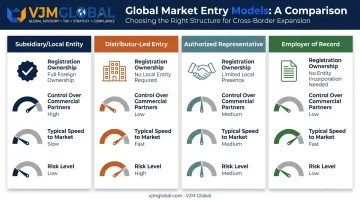
Regulatory approval and legal market entry are two separate decisions. Confusing them is where most companies stumble.
The structure you choose determines who legally owns the device registration and how easily you can switch commercial partners later. Get this wrong, and you're locked into a distributor relationship you can't exit without re-registering the product from scratch.
Subsidiary / Local Entity Formation
Setting up your own entity gives you maximum control:
- You hold the registration in your company's name, not a third party's
- You can appoint, replace, or terminate distributors freely
- You retain the regulatory dossier if a commercial relationship ends
The tradeoff: longer incorporation timelines and higher upfront investment. This route makes sense once a market has proven commercial traction.
Distributor-Led Entry
This is typically the fastest path, especially when a distributor already holds active regulatory licenses in-country. You skip months of registration work.
The catch is dependency. The registration lives in the distributor's name. If the relationship sours, unwinding it often means starting the regulatory process over with a new partner.
Authorized Representative (AR) Model
An AR holds the registration on your behalf as the manufacturer, rather than in a distributor's name. The AR model gives you more flexibility to switch commercial partners without losing your registration status, a meaningful middle ground between full incorporation and distributor dependency.
Employer of Record (EOR) as a Lower-Risk Entry Alternative
Before committing to incorporation, many MedTech companies need boots on the ground: a sales rep testing physician relationships, a clinical liaison supporting early adopters, or a regulatory contact managing local paperwork.
An Employer of Record lets you hire these people on locally compliant contracts, without first standing up a legal entity.
VJM Global's Employer of Record and multi-jurisdiction hiring capability, spanning 100+ countries, fits precisely this need: establishing an in-market presence in Latin America while you validate demand, ahead of any decision to incorporate.
Regulatory Registration Snapshot: What to Expect Across Key LATAM Markets
Each LATAM market runs its own device regulator, classification system, and review clock. Here's the starting-point comparison:
| Country | Regulator | Classification Approach | Typical Review Timeline |
|---|---|---|---|
| Brazil | ANVISA | Class I-II (notification); Class III-IV (marketing authorization) | 30 days for notification; 250-365 days for high-risk registration |
| Mexico | COFEPRIS | Classes I, II, III | 20-35 business days (official SLA) |
| Colombia | INVIMA | Risk-based: I/IIa (low-moderate) to III (very high) | 2 business days (I/IIa, automatic); 90 business days (IIb/III) |
| Argentina | ANMAT | Classes I-IV (2025 Mercosur-aligned) | No published class-specific range |
| Chile | ISP | Risk Classes I-IV; 10 specified device/IVD groups mandatory | Approximately 60 business days |
Prior approvals help, but don't eliminate the work. Reliance pathways vary by market:
- Brazil (ANVISA): Accepts optimized review referencing FDA, Health Canada, TGA, or Japanese MHLW authorizations for Class III/IV devices
- Mexico (COFEPRIS): Runs equivalence routes for FDA, Health Canada, and Japan approvals
- Colombia, Argentina, Chile: No verified equivalent accelerator currently available
Even with reliance pathways, local translation, legalization, and administrative documents are still required everywhere.
Administrative paperwork causes more delay than technical review. Powers of attorney, apostilles, and notarizations are common culprits, and Emergo by UL specifically flags documentation errors as a recurring cause of approval delays across the region.
Treat this table as a starting point, not a complete regulatory strategy. Pairing a specialized regulatory affairs partner with your entity, tax, and hiring plan (covered next) is what actually gets products to market on schedule.
Entity Formation, Tax and Ongoing Compliance Obligations
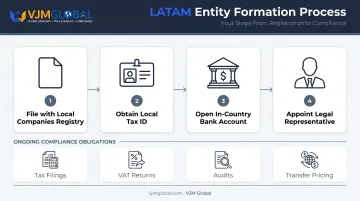
Once you decide to incorporate, the process follows a familiar shape across most LATAM jurisdictions:
- File with the local companies registry to establish the legal entity
- Obtain a local tax ID equivalent (Mexico's RFC, Brazil's CNPJ, and similar instruments elsewhere)
- Open an in-country bank account under the new entity
- Appoint a legal representative who can act on the company's behalf locally
Incorporation is just the starting line. Once the entity exists, ongoing statutory obligations kick in immediately:
- Corporate tax filings on a recurring schedule
- VAT/IVA returns, typically monthly or quarterly
- Annual financial statements or statutory audit requirements
- Transfer pricing documentation for transactions with the foreign parent company
Missing these deadlines carries real financial consequences. In Mexico, for example, an unfiled annual tax return one month past deadline, or two or more skipped provisional returns, lets the tax authority restrict the company's digital seal certificate under CFF Article 17-H Bis. This certificate is the instrument required to legally issue invoices.
Companies get 40 business days to resolve the issue before the certificate risks invalidation. This is a serious penalty that can effectively halt invoicing.
Mexico deserves particular attention as an entry point. It combines a strong manufacturing ecosystem (exporting $10.67 billion in devices against $5.24 billion in imports, per INEGI data) with a comparatively faster regulatory pathway through COFEPRIS's equivalence routes.
Mexico is also one of VJM Global's active service markets for entity formation, accounting, and tax compliance, which matters when you need local execution rather than a checklist.
VJM Global delivers entity formation, accounting, audit, and tax compliance locally across 100+ countries, using each market's own regulators and statutory instruments rather than a one-size-fits-all template. That local specificity is what structuring the finance and compliance side of a LATAM expansion actually requires, alongside your regulatory registration partner.
One practical recommendation: build a centralized compliance calendar tracking filing deadlines, registration renewals, and local representative contract terms across every LATAM entity. Fragmented tracking across countries is exactly what slows multi-country expansion down.
Payroll, Local Hiring and Employer of Record in LATAM
Labor law varies sharply across LATAM, and getting it wrong is expensive. Consider the mandatory benefit differences:
- Brazil: 13th salary paid in two installments, an 8% employer-funded FGTS contribution, and termination fines of 20-40% depending on dismissal reason.
- Mexico: A 15-day aguinaldo minimum, 12+ vacation days after year one, a 25% vacation premium, and up to 12 months' back pay for unproven-cause dismissals.
- Colombia: Statutory social benefit provisioning is mandatory for private-sector contracts, with settlement calculations depending on contract dates and termination basis.
Two paths to local hiring:
| Hiring Path | What It Involves |
|---|---|
| Fully owned entity | Register for local payroll and manage ongoing labor compliance directly, on top of everything else the entity already handles. |
| Employer of Record | Shift that compliance burden elsewhere, employing staff on locally compliant contracts without incorporating first. |
VJM Global's global payroll and EOR services exist for exactly this gap: compliant hiring before you've committed to a full entity.
In practice, the first LATAM hires MedTech companies make aren't back-office roles. They're sales representatives, clinical specialists, and regulatory liaisons, the people who need to be in-market while registration and commercial validation are still underway. EOR is the practical bridge during that window.
Building a Phased, Risk-Managed LATAM Market Entry Roadmap
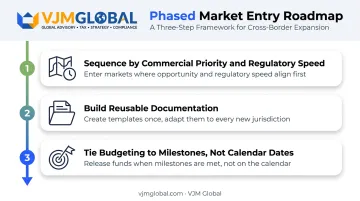
Trying to open Brazil, Mexico, Colombia, Argentina, and Chile at once is how expansion budgets get burned. A phased approach works better:
- Sequence by commercial priority and regulatory speed. Enter faster, lower-cost markets like Colombia (Class I/IIa devices clear in 2 business days) first, while running Brazil's longer 250-365-day registration in parallel rather than sequentially.
- Build reusable documentation. A core dossier structure and centralized tracking system reduce duplicated effort as entity, tax, and regulatory workstreams scale across five-plus countries.
- Tie budgeting to milestones, not calendar dates. Base entity formation, hiring, and further market investment on concrete commercial signals, such as securing distributor interest or clearing initial registration, rather than opening every market simultaneously on a fixed schedule.
This sequencing matters because each market's timeline compounds against you. Start Brazil's registration in month one and Colombia's in month six, and you'll be months ahead of a competitor who waits to launch everything together.
Frequently Asked Questions
What are the MedTech trends in Latin America for 2026?
Digital health adoption is accelerating, especially telehealth and AI-diagnostics. Regulatory bodies are also modernizing toward IMDRF alignment, with Brazil already a member and Mexico and Argentina as observers. Growth concentrates in imaging, IVD, monitoring, and surgical tools.
Is Latin America a good market for MedTech investment in 2026?
Yes. The region's aging population and rising chronic disease burden support long-term demand growth toward $79.66 billion by 2034. However, regulatory fragmentation across five national systems favors a phased entry over a simultaneous multi-country launch.
Who are the major MedTech players in Latin America in 2026?
The market mixes global multinationals like BD, which manufactures locally in Mexico, with a growing base of regional manufacturers, particularly in Brazil. Brazil's device market remains import-dependent, with the US, Germany, and China as top suppliers.
Do I need to set up a local entity to sell medical devices in LATAM?
No. Distributor-led entry, the Authorized Representative model, or Employer of Record arrangements can all precede full incorporation. Which one fits depends on how much control you need over the registration and how quickly you want to enter.
How long does it take to establish a business entity in Latin America?
Timelines vary by country. Argentina takes 2-3 weeks for local entity registration once documents are signed, versus 1-2 months for a foreign entity. Plan ahead, since these timelines run longer than an EOR-based entry.
What ongoing compliance obligations exist after registering a medical device in LATAM?
Beyond the device registration itself, companies face corporate tax filings, VAT/IVA returns, statutory audits, and local representative contract renewals. Product registrations also require periodic renewal. Firms like VJM Global centralize tracking across these deadlines to prevent costly lapses.