But the move isn't as simple as incorporating offshore and calling it done. UK tax residents remain subject to HMRC on worldwide income, and choosing the wrong structure in the UAE can cost more to fix than it would have cost to get right the first time.
This guide walks through every practical stage of setting up a small business in the UAE as a UK-based entrepreneur — from picking the right structure to understanding what ongoing compliance actually looks like.
Key Takeaways
- UK citizens can set up 100% foreign-owned businesses across most UAE sectors — no local Emirati partner required since the 2021 reforms
- Three structures exist: Free Zone (international/digital businesses), Mainland (UAE market access), and Offshore (holding/structuring only)
- Full setup (license, banking, visa, and attestation) typically takes 4 to 8 weeks — plan accordingly
- UAE corporate tax is 0% up to AED 375,000, then 9% — and if you remain UK tax resident, HMRC retains taxing rights on worldwide income
- Total setup costs typically range from £1,500 to £5,000+ depending on structure and visa requirements
Why UK Entrepreneurs Are Setting Up Small Businesses in the UAE
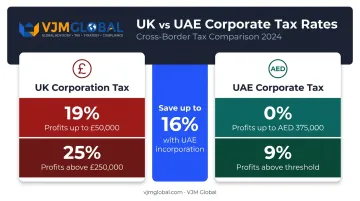
The tax comparison is stark. The UK's main Corporation Tax rate sits at 25% for profits above £250,000, with a small profits rate of 19% for those at or below £50,000. The UAE charges 0% on taxable profits up to AED 375,000 and just 9% above that threshold — a meaningful gap for any profitable SME.
Tax rates are the starting point, not the whole picture. UK-UAE total trade reached £25 billion in the four quarters to Q4 2025, and 562 new British companies joined Dubai Chamber in Q1 2026 alone, bringing active British member companies to over 10,000. For UK entrepreneurs, that existing network means professional contacts, sector expertise, and service providers are already in place before you arrive.
The practical appeal extends beyond numbers:
- Geographic position — Dubai connects Europe, Asia, and Africa, making it a natural hub for service businesses, consultancies, and trading companies with multi-regional clients
- English is widely used — over 120,000 UK nationals reside in the UAE, and business is routinely conducted in English
- Infrastructure and stability — reliable legal frameworks, modern banking infrastructure, and political stability cut through the administrative complexity that slows expansion elsewhere
- Remote-first flexibility — many free zones allow virtual office arrangements, meaning you don't have to relocate immediately to maintain a legally compliant entity
What UK Entrepreneurs Should Know Before Starting
This Is Not a Tax Shortcut
Incorporating in the UAE does not automatically reduce your UK tax bill. UK residents pay UK tax on worldwide income regardless of where the income is earned or where the company is registered. Genuinely benefiting from UAE tax rates requires establishing UAE tax residency and substantially cutting UK ties — which takes far more than opening a Dubai company.
The UK-UAE Double Taxation Convention (signed April 2016, effective from 1 January 2017 in the UAE) prevents the same income from being taxed twice. But it doesn't override UK residence rules. If you remain a UK tax resident, HMRC's claim on your income doesn't disappear because you've opened a Dubai company.
Set Realistic Timeline Expectations
The trade license itself can be issued surprisingly quickly — Dubai Silicon Oasis states it issues licenses within 2 days of receiving legal documents, while DMCC typically takes around 10 working days. But the full picture is different:
- Document attestation: 1–2 weeks
- Banking: anywhere from a few days (digital-first banks) to 4+ weeks (traditional UAE banks)
- Visa process (if relocating): 3–5 weeks
Realistically, plan for 4 to 8 weeks from start to fully operational.
Structure Must Match Business Intent
Once you have a realistic timeline, the next decision — and the one where most mistakes happen — is structure. Free zone companies cannot trade directly with UAE mainland customers. Offshore companies cannot operate locally at all. Mainland licenses require physical offices. Choosing a structure because it's cheaper or faster, without checking whether it matches how the business actually operates, creates problems that are expensive to fix.
Choosing Your Business Structure in the UAE
Your choice of business structure determines your market access, tax obligations, and operating costs from day one. Get it wrong and you're either locked out of UAE customers or paying for compliance that your business model doesn't need.
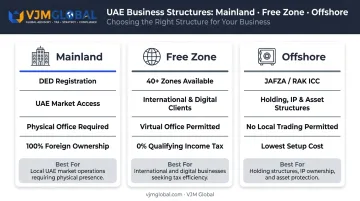
Mainland Company
A mainland company, registered with the Department of Economic Development (DED) or the relevant emirate authority, gives you unrestricted access to the UAE domestic market. You can trade with local customers, bid for government contracts, and operate from any commercial address in the emirate.
Since the 2021 Companies Law reform, 100% foreign ownership is permitted for most business activities — the historical requirement for an Emirati majority shareholder has been removed. Key points UK founders should know:
- A small category of "strategic impact" activities (Cabinet Resolution No. 55 of 2021) still carry special conditions — verify your specific activity before assuming no local partner is needed
- A physical, Ejari-registered office is mandatory
- No restrictions on trading with UAE-based customers or government entities
Free Zone Company
Free zones are designated economic areas offering 100% foreign ownership, simplified registration, and (for many qualifying activities) 0% corporate tax on qualifying income. Over 40 free zones operate across the UAE, many sector-specific:
- DMCC — trading and commodities
- IFZA — general professional and commercial services
- Dubai Silicon Oasis — tech and innovation
The key restriction: free zone companies can only trade within their zone or with international clients. Direct sales to UAE mainland customers require either a mainland licence or a local distributor arrangement.
Virtual and flexi-desk office arrangements are permitted, keeping overhead lower than mainland.
Offshore Company
Offshore structures (Jebel Ali/JAFZA and RAK ICC are the main options) work as holding vehicles — useful for international investment, IP ownership, or asset structuring. Setup costs are the lowest of the three options.
They cannot trade within the UAE or serve local customers. For UK entrepreneurs running an active business rather than holding assets, offshore structures serve a narrow use case — most will find mainland or free zone more appropriate.
Quick Decision Framework
| Business Situation | Recommended Structure |
|---|---|
| Serving UAE-based clients or customers | Mainland |
| International/remote clients, digital services | Free Zone |
| Holding assets, IP, or international investments | Offshore |
How to Set Up a Small Business in the UAE from the UK — Step by Step
Step 1: Define Your Business Activity and Choose Your Jurisdiction
Every UAE business must register with approved business activities from a regulated list. The activity you select determines your license type — Commercial, Professional, or Industrial — and which regulatory authority governs your business.
Research jurisdictions based on:
- Your actual client base (local vs. international)
- Sector fit (some free zones are industry-specific)
- Visa allocation needs
- Budget
Step 2: Reserve a Trade Name and Obtain Initial Approval
Trade names must reflect the business activity and cannot include religious references, political organisations, or existing registered names. Reservation is processed through the DED or free zone authority and typically completes within a few days.
Initial approval confirms that your activity and applicant profile are permitted to proceed — this step must happen before you sign any lease, draft documents, or pay license fees.
Step 3: Prepare and Submit Required Documents
Standard documentation for UK applicants:
- Valid passport copies (all shareholders)
- UK proof of address (utility bill or bank statement, within 3 months)
- Passport-sized photographs
- Business plan or professional CV (required by most authorities)
For applications involving a UK parent company, documents such as the Certificate of Incorporation and Articles of Association must be legalised by the relevant UK authority. They then require attestation by the UAE Embassy in London before submission. Arabic translation requirements vary by authority, so confirm this with your chosen jurisdiction.
Incomplete or unattested documents are the most common reason for delays. A consultant experienced with UK-originating applications can cut processing time — sometimes by weeks.
Step 4: Receive Your Trade License and Arrange a Business Address
Once the authority reviews and approves your documents and government fees are paid, your trade license is issued — the legal authorisation to operate in the UAE.
- Mainland: Requires a signed office lease registered through Ejari (Dubai Land Department)
- Free zone: Flexi-desk or virtual office packages satisfy the legal address requirement at significantly lower cost
Licenses are valid for one year and require annual renewal.
Step 5: Open a Corporate Bank Account and Apply for a Visa
Banking requires more preparation than most first-time UAE incorporators expect. Banks typically require:
- Trade license
- Shareholder passport and visa copies
- Proof of address
- Company documents
Some traditional banks require in-person attendance. Digital-first options like Wio Bank (licensed and regulated by the Central Bank of the UAE) offer digital onboarding, which suits UK-based founders who haven't yet relocated.
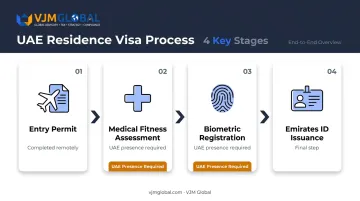
Residence visa (if you're relocating to the UAE): The process follows four stages:
- Entry permit issued remotely
- Medical fitness assessment (requires UAE presence)
- Biometric registration (requires UAE presence)
- Emirates ID issuance
Once the owner's visa is confirmed, dependent and employee visas can follow.
Tax, Banking, and Ongoing Compliance for UK Entrepreneurs
UAE Corporate Tax
The UAE introduced corporate tax in 2023:
- 0% on taxable profits up to AED 375,000
- 9% above that threshold
Free zone companies can retain 0% on qualifying income — but this is conditional. Requirements include maintaining adequate economic substance in the UAE, meeting transfer pricing rules, and filing audited financial statements. The 0% rate is not automatic.
Most small businesses in their early stages will fall below the AED 375,000 threshold without triggering any corporate tax liability.
UK Tax Position
The UK-UAE Double Taxation Convention (effective 2017) covers UK income tax, corporation tax, and capital gains tax — preventing double taxation on the same income. But it doesn't remove UK taxing rights for UK residents.
UK entrepreneurs who want to genuinely benefit from UAE tax rates need to:
- Establish UAE tax residency
- Reduce or sever UK resident ties
- Ensure the company's management and control is exercised in the UAE
Getting this wrong has real consequences. Cross-border tax advice covering both HMRC obligations and UAE Federal Tax Authority requirements should be in place before you restructure — not after.
UAE VAT
Beyond income tax, UAE VAT applies at 5% on taxable turnover exceeding AED 375,000. International B2B services may qualify for zero-rating — but eligibility depends on specific conditions set by the Federal Tax Authority. Each transaction type needs to be assessed separately; blanket assumptions about zero-rating will create exposure.
Ongoing Compliance Obligations
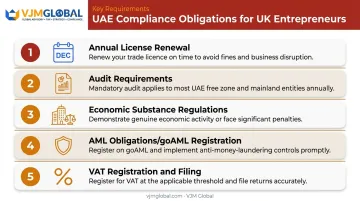
UAE compliance requirements that often catch UK entrepreneurs off-guard:
- Annual license renewal — required each year to keep the company active
- Audit requirements — DMCC, for example, requires audited financial statements within six months of financial year-end; requirements vary by free zone
- Economic Substance Regulations (ESR) — applies to entities conducting relevant activities including holding company, IP, headquarters, and finance activities
- AML obligations — certain business types (including corporate service providers) must register with goAML and report suspicious transactions
- VAT registration and periodic filing — once the threshold is crossed
These are separate from and additional to any remaining UK Companies House or HMRC obligations.
Frequently Asked Questions
Can a UK citizen set up a business in Dubai?
Yes. UK citizens can legally set up a business in Dubai and across the UAE. Following the 2021 Companies Law reforms, 100% foreign ownership is permitted in most sectors. No Emirati partner is required for the majority of business activities.
Do I need to travel to the UAE to set up a business as a UK resident?
Much of the process — document submission, initial approval, licensing — can be handled remotely. However, opening a bank account with a traditional UAE bank and completing the residence visa process (medical fitness and biometrics) typically requires at least one visit to the UAE.
What is the difference between a free zone and mainland company for UK entrepreneurs?
The right structure depends on who you plan to sell to:
- Free zone: Lower cost, virtual offices permitted, suits remote or digital businesses — but restricted to free zone or international trade only
- Mainland: Higher setup costs and a physical office required, but allows direct trade with UAE customers and eligibility for government contracts
How does setting up a UAE company affect my UK tax obligations?
UK tax residents remain subject to HMRC on worldwide income. The UK-UAE Double Taxation Treaty prevents double taxation, but benefiting from UAE tax rates requires establishing UAE tax residency and reducing UK ties. Specialist cross-border tax advice is essential before proceeding.
How long does it take to set up a small business in the UAE from the UK?
The trade license can be issued in as little as 2 to 10 working days once documents are verified, depending on the jurisdiction. The full setup including banking, visa, and document attestation typically takes 4 to 8 weeks.
How much does it cost to set up a small business in the UAE from the UK?
Free zone license costs vary by jurisdiction. DMCC, for example, publishes fees of AED 1,035 (application) and AED 9,020 (registration), with annual license fees around AED 20,000. Including virtual office, visa where applicable, and document attestation, total costs for UK entrepreneurs typically range from £1,500 to £5,000+ depending on the chosen structure.