Introduction
Setting up a business in Nigeria from the UAE means incorporating and legally operating a Nigerian entity while you, your company, or your capital remain based in Dubai, Abu Dhabi, or elsewhere in the Emirates.
UAE-resident entrepreneurs, trading firms, and members of the Nigerian diaspora in the Emirates are exploring this route in growing numbers.
Non-oil trade between the UAE and Nigeria hit US$5 billion in 2025, having doubled over five years, according to the UAE Ministry of Foreign Affairs.
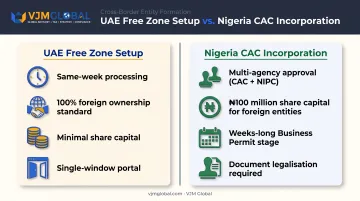
Many founders still expect Nigeria's registration process to move at UAE free zone speed. It doesn't. The Corporate Affairs Commission (CAC), foreign investment rules, and currency controls follow a different logic—and that gap is where timelines and budgets slip.
This guide covers the steps, documents, costs, and pitfalls specific to UAE-based founders.
Key Takeaways
- Register through the CAC—Nigeria has no free-zone vs. mainland split
- Budget NIPC registration and typically ₦100 million share capital for foreign-owned entities
- Document UAE capital inflows with a Certificate of Capital Importation (CCI)
- Incorporate remotely; banking and visas usually need someone on the ground
- Hire without incorporating via an Employer of Record (EOR)
What Is Business Setup in Nigeria from the UAE?
Business setup in Nigeria from the UAE is the legal process by which a UAE-based individual or company forms a recognised business entity in Nigeria, most commonly a private company limited by shares. The goal at the end of the process is straightforward: a CAC-registered company with tax registration, a functioning Nigerian bank account, and full legal standing to invoice, trade, and hire staff locally.
Nigerian law is stricter than many UAE founders expect. Under Section 78 of the Companies and Allied Matters Act (CAMA) 2020, a foreign company intending to trade in Nigeria must incorporate a separate local entity, according to the official CAMA gazette. A liaison office that quietly invoices clients or signs contracts doesn't count as an exemption. It's treated as unauthorised trading.
Why UAE Entrepreneurs Are Choosing Nigeria for Expansion
UAE-based founders are drawn to Nigeria for a few practical reasons:
- Market size — Africa's most populous country, with over 200 million consumers
- Trade momentum — the US$5bn non-oil trade corridor between the markets keeps growing
- Diaspora links — a large Nigerian community in the UAE already moves capital, goods, and ideas between the two markets
- Sector demand — fintech, logistics, and agribusiness have all attracted recent foreign investment
What trips founders up is assuming Nigerian bureaucracy mirrors a UAE free zone application. It doesn't. This is statutory compliance under CAMA and the NIPC Act, not an optional best-practice checklist. Skip a step, and your company simply cannot legally trade, invoice, or open a bank account.
Step-by-Step Process to Set Up a Business in Nigeria from the UAE
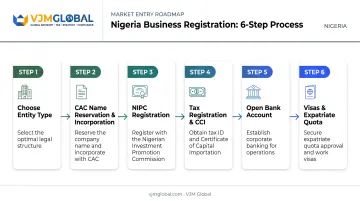
The journey moves from choosing your entry structure, through CAC and NIPC registration, to tax onboarding, banking, and (if you're relocating staff) visas and expatriate quota. Most filing steps can be handled remotely by a Nigeria-based agent. Banking and physical presence steps usually cannot.
Step 1: Choose Your Entity Type and Entry Structure
UAE promoters generally have three realistic options:
- Private company limited by shares — the standard vehicle for 100% foreign ownership and the only practical way to trade, contract, and invoice legally in Nigeria
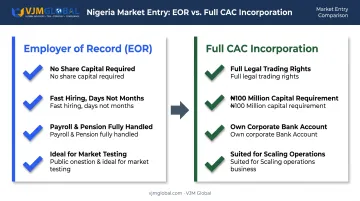
- Employer of Record (EOR) — useful if you just need to hire a small Nigerian team before committing capital to a full entity
- Representative presence — narrow and project-specific exemptions exist under CAMA Section 80, but these don't apply to normal commercial activity
A conventional branch office isn't a general alternative here, unlike in some other jurisdictions. If you intend to actually operate and generate revenue in Nigeria, incorporation is the route.
Step 2: Reserve a Company Name and Incorporate with the CAC
Once you've settled on a private company limited by shares, the next move is registering it:
- Run a name availability search on the CAC portal and reserve your preferred name
- File the Memorandum and Articles of Association (MEMART)
- Submit particulars of directors and shareholders, along with the share-capital statement
- Disclose persons with significant control, a mandatory CAMA requirement
The CAC's Company Registration Portal supports remote filing and payment, so a UAE-based founder can complete this stage without travelling. That said, treat any "instant" processing claims with caution. Incomplete documentation or portal downtime can add days.
Step 3: Register with the Nigerian Investment Promotion Commission (NIPC)
Any company with foreign shareholding, including 100% UAE ownership, must register with NIPC before starting operations. This produces a Business Registration Certificate, and it's a separate approval from the Ministry of Interior's Business Permit.
Here's where budgeting mistakes happen most often. Recent practice has centred on a ₦100 million minimum share capital requirement for foreign-owned companies, though the exact legal basis has shifted.
A 2024 update from Aluko & Oyebode noted that while a formal CAC directive was withdrawn, the ₦100 million requirement for issued and allotted shares continued in administrative practice. Confirm the current figure with your agent before you file. Don't budget off an old blog post.
Step 4: Complete Tax Registration and Capital Importation Documentation
Once NIPC registration is underway, tax onboarding runs in parallel:
- Obtain a Tax Identification Number (TIN) and register with the tax authority for company income tax and VAT (currently 7.5%)
- File company income tax returns within six months of financial year-end, or 18 months after incorporation, whichever comes first
- Submit VAT returns by the 21st of the following month, even in nil-activity periods
For any funds moving from the UAE into Nigeria, route them through a Nigerian authorised dealer bank and obtain a Certificate of Capital Importation (CCI). Skip this step, and you'll struggle to legally repatriate profits later.
Step 5: Open a Nigerian Corporate Bank Account
Banks typically request:
- CAC certificate and NIPC registration
- Board resolution authorising the Nigerian entity
- Director identification
- Proof of the UAE parent company or shareholders
Foreign-resident directors often face additional KYC checks, including notarised documents and work-permit evidence.
This step is genuinely easier with a local director, representative, or agent physically present. Purely remote account opening for a foreign-owned entity is possible but slower, and banks apply risk-based checks that vary by institution.
Step 6: Secure Visas, Expatriate Quota, and Work Permits
If a UAE-based director or employee plans to relocate to Nigeria:
- Short business visits use the F4A Business Single Entry Visa, valid 90 days from issuance, permitting a single stay of up to 30 days. It does not authorise employment
- Actual employment requires an approved Expatriate Quota first, typically valid three years and renewable
- Long-term residence uses the Combined Expatriate Residence Permit and Aliens Card (CERPAC), which requires the employment contract, quota approval, and supporting credentials
Skipping the quota step and just showing up on a business visa is a common and costly error.
Documents, Costs, and Compliance Factors for UAE-Based Founders
UAE shareholders and directors need to prepare documentation early, since legalisation delays are one of the biggest timeline killers.
Core documents required:
- Passport copies and proof of UAE address for all directors and shareholders
- Board resolution authorising the Nigerian entity
- UAE parent company's Certificate of Incorporation (for subsidiaries)
- Each document attested through the UAE Ministry of Foreign Affairs and legalised for use in Nigeria via the Nigerian Consulate
Capital and Fees to Budget For
| Item | Approximate Figure | Notes |
|---|---|---|
| NIPC registration fee | ₦150,000 | Non-refundable; new schedule effective March 2026 |
| Minimum share capital (foreign-owned) | ₦100 million | Administrative practice; confirm before filing |
| Business Permit | No single fixed fee | Allow 3–8 weeks or more (2020 benchmark); process is separate from NIPC |
| CAC incorporation fees | Varies | Check the live CAC fee schedule at filing time |
Don't treat these as fixed. Fees and thresholds shift, and your agent should confirm current figures before you commit capital.
Repatriation and Tax Treaty Status
Setup cost is only half the picture—you also need a clean path to move profits back to the UAE.
Many UAE founders expect treaty relief here. There is currently no double taxation agreement in force between the UAE and Nigeria. The UAE does not appear on Nigeria's official treaty list, so repatriation follows standard withholding tax rules, not treaty rates.
What actually protects dividend remittance is the Certificate of Capital Importation (CCI) obtained when capital enters the country. The Central Bank of Nigeria uses it to confirm funds were properly declared, which lets an authorised dealer bank convert and remit dividends later. Lose that paperwork, and repatriation gets complicated fast.
Realistic Timeline
Expect the Business Permit alone to take 3 to 8 weeks or more, based on established benchmarks. Other steps move faster when paperwork is complete:
- Name reservation and CAC incorporation: often 1–2 days
- NIPC registration: as little as 48 hours once fully filed
- Usual bottlenecks: Business Permit, bank KYC for foreign-owned entities, and legalised documents arriving on time from the UAE
Common Mistakes and When Full Incorporation Isn't Necessary
Common Mistakes UAE Founders Make
- Underbudgeting for capital — treating ₦100 million as a formality rather than a real funding requirement, then running short mid-process
- Skipping document legalisation — sending unattested UAE documents, which Nigerian authorities simply reject, resetting the filing clock
- Assuming free zone speed — expecting a UAE-style same-week turnaround when Business Permit processing alone can run two months
- Ignoring the DTA gap — planning repatriation around a tax treaty that doesn't actually exist yet
When You Don't Need a Full Nigerian Entity
Not every UAE founder needs to incorporate immediately. Consider alternatives if you're:
- Testing the Nigerian market through a local distributor or agent before committing capital
- Hiring a small Nigerian team to validate demand before setting up formal operations
- Still evaluating whether Nigeria justifies the ₦100 million capital commitment
An Employer of Record (EOR) solves the hiring problem without full incorporation. Through VJM Global's EOR service, a UAE company can legally employ Nigerian staff and cover contracts, payroll, statutory pension, and NHF contributions without a CAC entity.
If Nigeria later warrants full incorporation, VJM Global handles CAC registration, NIPC filings, and tax onboarding. The same support extends to entity formation in Kenya, South Africa, Egypt, and other African markets when your plan spans more than one country.
Conclusion
Setting up a business in Nigeria from the UAE follows a CAC- and NIPC-driven process that looks nothing like free zone incorporation back home. Foreign capital thresholds, expatriate approvals, and currency documentation all add layers UAE founders don't encounter locally.
Getting the share capital rules, document legalisation, and CCI requirements right before you start filing saves weeks of delay later. Given how differently the UAE and Nigerian systems work, most founders benefit from a firm experienced in both. VJM Global can handle entity formation, tax registration, and compliance so you are not piecing the process together alone.
Frequently Asked Questions
Can a UAE company or citizen own 100% of a business in Nigeria?
Yes, most sectors permit full foreign ownership subject to NIPC registration and meeting minimum share capital requirements. A handful of regulated sectors, such as oil and gas or broadcasting, carry additional restrictions.
How long does it take to register a company in Nigeria from the UAE?
CAC incorporation and NIPC registration can complete in a few days, but the Business Permit stage typically takes 3 to 8 weeks or more. Add bank account opening, and the realistic end-to-end timeline often runs two to three months.
Do I need to travel to Nigeria to set up a company from the UAE?
Incorporation and tax registration can largely be handled remotely through a Nigeria-based agent. Bank account opening and expatriate quota processing, however, usually go faster with someone physically present.
Is there a double taxation agreement between the UAE and Nigeria?
No, there's currently no DTA in force between the two countries. Profit repatriation relies on standard Nigerian withholding tax rules rather than treaty relief, so plan your capital structure accordingly.
What business can I start with ₦500,000 in Nigeria?
That amount suits a small-scale local trading or service business registered as a CAC business name, not a foreign-owned limited company. Foreign investors face the much higher ₦100 million capital threshold.
What is the most profitable business to start in Nigeria?
UAE investors commonly target trading and import-export, fintech, logistics, and agribusiness, sectors that have drawn recent foreign investment. Actual profitability still depends on product-level market research and solid compliance from day one.