Introduction
UAE companies are no longer just attracting investment. They're increasingly the ones investing abroad. Outward FDI from the UAE reached 4.4% of GDP in 2024, according to UNCTAD, a clear sign that UAE-based businesses are actively pushing capital and operations into overseas markets.
Many business owners assume setting up abroad simply means replicating their UAE entity elsewhere. That's rarely true. Each host country applies its own company law, tax rules and consolidation requirements. Getting this wrong can expose the parent company to liabilities it never intended to carry.
This article breaks down what a foreign subsidiary actually is, the legal and tax considerations UAE parent companies need to plan for, how to pick the right jurisdiction, and the practical steps to get incorporated without costly missteps.
Key Takeaways
- A foreign subsidiary is a separate legal entity, not a branch or a copy of your UAE company.
- UAE participation exemption can shield foreign dividends and gains from corporate tax if ownership and holding-period tests are met.
- Transfer pricing documentation between the UAE parent and subsidiary is mandatory, not optional.
- Jurisdiction choice hinges on tax treaties, capital rules and ownership caps—not market size alone.
- An Employer of Record can test a market before you commit to full incorporation abroad.
What Is a Foreign Subsidiary and How Is It Different From a Branch or EOR Arrangement?
A foreign subsidiary is a separate legal entity incorporated in another country, majority or wholly owned by a UAE parent company. It operates under the host country's company law, not the UAE's, and it can enter contracts, hire staff and take on debt in its own name.
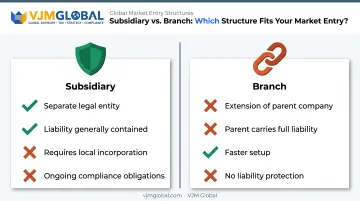
This separation matters. A subsidiary's liabilities generally stay with the subsidiary, ring-fenced from the parent's balance sheet, provided it's properly governed. A branch office, by contrast, is simply an extension of the parent company. It has no independent legal personality, and the UAE parent remains fully liable for everything the branch does.
Key differences:
- Subsidiary: Separate legal entity; liability generally contained; requires local incorporation and ongoing compliance.
- Branch: Extension of the parent; parent carries full liability; often faster to set up, but offers no liability protection.
Ownership rules sit on a separate axis. Most jurisdictions now allow 100% foreign ownership, though some still restrict it. Egypt permits full foreign ownership except in activities reserved for Egyptian nationals or requiring minimum local participation. Nigeria keeps a negative list of sensitive sectors where foreign equity is capped.
Subsidiary vs. Employer of Record: When Incorporation Isn't Necessary Yet
Not every market entry needs a subsidiary from day one. An Employer of Record (EOR) lets a UAE company hire and pay staff in a foreign market compliantly, without incorporating any local entity. The EOR becomes the legal employer on paper, handling contracts, payroll, statutory contributions and local labour-law compliance, while the UAE company directs the actual work.
This is useful for testing a market—hiring a handful of people in Kenya or Singapore before committing capital to a full subsidiary. EOR providers such as VJM Global cover 100+ countries, so UAE businesses can hire abroad with lower upfront risk before deciding whether incorporation is worth it.
Why UAE Businesses Are Establishing Subsidiaries Abroad
Three forces are pushing UAE companies to incorporate overseas rather than simply export or contract from Dubai or Abu Dhabi:
- Diversification beyond oil. As the UAE's non-oil economy expands, companies are following growth into new consumer bases rather than waiting for demand to arrive.
- Direct market access. A locally incorporated entity can open bank accounts, sign leases and build relationships that a foreign exporter simply can't.
- Tender and contract eligibility. Many government and enterprise tenders abroad require bidders to be locally incorporated, not just locally represented.
This shift isn't marginal. Outward investment now equals a meaningful share of the UAE's GDP, a figure that would have looked unusual for the region a decade ago. VJM Global has supported UAE-based businesses through this kind of cross-border expansion, with India among the more common destinations for outbound UAE capital.
Liability containment is the other driver. If a foreign subsidiary is properly governed (separate board, its own resolutions, arm's-length dealings with the parent), its debts and disputes stay with the subsidiary.
A lawsuit or insolvency in Lagos or Nairobi shouldn't touch the UAE parent's balance sheet when corporate formalities are respected. A branch office structure does not offer that protection.
Key Legal, Tax and Compliance Considerations for UAE Parent Companies
Three areas trip up UAE parent companies more than any others: participation exemption, transfer pricing, and repatriation. Get these wrong, and the cost shows up years later in tax assessments or lost limited-liability protection.
Corporate Tax Consolidation and the Participation Exemption
The UAE's participation exemption can shield dividends and capital gains from a qualifying foreign subsidiary from UAE corporate tax entirely. According to the FTA's guidance on exempt income, qualifying conditions include:
- At least 5% ownership, or an acquisition cost of at least AED 4 million
- Holding the stake for an uninterrupted 12 months (or intending to)
- The subsidiary being subject to tax at 9% or more in its home jurisdiction
- Entitlement to at least 5% of profits and liquidation proceeds
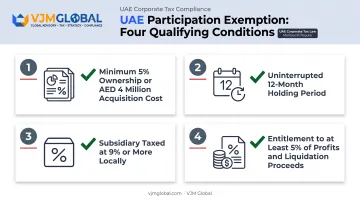
Miss any one of these, and the exemption doesn't apply: standard corporate tax rules take over instead.
Separately, IFRS 10 requires the UAE parent to consolidate the subsidiary's financials into group accounts wherever control exists, regardless of where the subsidiary is incorporated. Consolidation and tax exemption are two different tests; passing one doesn't mean you pass the other.
Transfer Pricing Between the UAE Parent and the Foreign Subsidiary
Management fees, intercompany loans, royalties, and other charges between the UAE parent and its subsidiary must be priced at arm's length. Both UAE and host-country rules expect supporting documentation, usually in three layers:
- Master File with group-level information
- Local File with transaction-specific detail per country
- Country-by-Country Report for larger groups
Skipping this isn't a minor paperwork gap. Tax authorities on either end can challenge undocumented intercompany pricing and reassess taxable income retroactively.
Double Taxation, Withholding Tax and Repatriation
The UAE has signed more than 130 double taxation agreements, according to the Ministry of Finance, which can reduce or eliminate withholding tax when the subsidiary sends profits back to the parent. But the treaty only helps if it's claimed correctly and residency tests are met.
What often catches UAE parents off guard:
- Host countries often impose exchange controls, withholding tax, or approvals before dividends can leave, unlike the UAE's unrestricted repatriation
- Some jurisdictions need central bank sign-off on outbound remittances, which can add weeks
- Thin subsidiary governance (no separate board resolutions or documented decisions) can undermine the parent's limited liability
Choosing the Right Jurisdiction and Entity Type for Your Overseas Subsidiary
Jurisdiction choice isn't just about market size. The right destination depends on a mix of practical factors:
- Tax treaty coverage - does the UAE have a DTA with this country, and does your structure qualify for treaty benefits?
- Minimum capital rules - Singapore requires as little as S$1 in paid-up capital, while Egypt requires an LLC's stated capital to be fully paid on incorporation.
- Speed and ease of incorporation - some regulators process applications in days; others take months.
- Sector-specific ownership caps - even where 100% foreign ownership is generally allowed, certain sectors remain restricted.
Common Destinations for UAE Outbound Expansion
- US and UK - chosen for market credibility and larger enterprise contracts. Delaware allows incorporation regardless of founder residence; UK Companies House needs just one shareholder.
- India and Singapore - popular for regional access into South Asia and Southeast Asia via India's Ministry of Corporate Affairs and Singapore's ACRA.
- Africa (Kenya, Nigeria, Egypt) - attractive for emerging growth, each with its own foreign-ownership rules. Nigeria's negative list restricts sensitive sectors; Egypt requires local participation in specific activities.
Entity Type Options
Liability and reporting obligations differ by structure:
| Structure | Liability | Reporting Burden |
|---|---|---|
| Wholly owned subsidiary | Ring-fenced from parent | Full local company reporting |
| Branch office | Parent fully liable | Lighter, but tied to parent filings |
| Holding company | Depends on structure layers | Varies by jurisdiction |
Every one of these markets applies its own statutory instruments - there's no universal template. A provider delivering entity formation locally in 100+ countries, such as VJM Global, helps UAE businesses navigate each market's specific regulator rather than forcing a one-size-fits-all approach.
One caution: some destination markets still require a local partner or special approval for certain activities, not unlike the ownership restrictions the UAE itself only recently relaxed for many onshore sectors.
Step-by-Step Process to Incorporate a Subsidiary Abroad
Incorporating overseas follows a broadly similar sequence everywhere, even though the specific forms and regulators change by country.
- Secure a board resolution and feasibility assessment. The UAE parent's board must formally authorise the overseas subsidiary and document the commercial rationale. That resolution becomes part of the incorporation file in most jurisdictions.
- Legalise the parent company's documents. Certificates of incorporation, MOAs and board resolutions need notarisation plus apostille or embassy attestation. The UAE is not a party to the Hague Apostille Convention, so UAE-origin documents usually need full legalisation rather than a simple apostille.
- Complete local registration. This covers name reservation, licensing or trade registration, and tax authority registration, filed with whichever regulator the host country designates: India's MCA, the UK's Companies House, or Nigeria's Corporate Affairs Commission, among others.
- Handle post-incorporation setup. Open a corporate bank account, arrange employee visas or work permits, and build a compliance calendar covering the new jurisdiction's filing deadlines. In India, for example, the new entity must deposit its subscription capital within 180 days of incorporation.
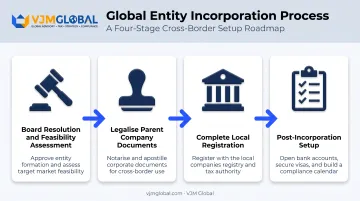
Document legalisation is where most UAE parents lose the most time. The attestation chain differs by destination, so a generic checklist rarely matches what each host country actually requires.
Common Compliance Mistakes UAE Businesses Should Avoid
Most problems with overseas subsidiaries come from treating the new entity as an afterthought.
- Treating the subsidiary as an administrative extension. Skipping separate board meetings, minutes and resolutions blurs parent–subsidiary separation and puts limited liability at risk.
- Overlooking transfer pricing documentation. Undocumented management fees, loans or royalties between the UAE parent and the subsidiary are an easy target in a tax audit.
- Missing consolidated reporting or UAE tax filing deadlines. IFRS 10 consolidation and UAE corporate tax run on separate clocks, and missing either creates gaps that compound over time.
- Underestimating repatriation restrictions. Host-country exchange controls, withholding tax or central bank approvals can trap capital founders expected to move as freely as within the UAE.
Compliance on a foreign subsidiary isn't a one-time incorporation task. It's an ongoing obligation that runs in parallel with whatever the UAE parent is already managing at home.
Frequently Asked Questions
What is a foreign subsidiary company?
A foreign subsidiary is a separate legal entity incorporated abroad and majority or wholly owned by a parent company. Unlike a branch, it has its own legal personality and generally keeps its liabilities separate from the parent.
Can a subsidiary of a foreign company be a small company?
Yes. Classification as a "small company" depends entirely on the host country's own company law thresholds for capital and turnover, not on who owns the entity. A foreign-owned subsidiary qualifies if it meets those local criteria.
How do you incorporate a subsidiary of a foreign company in India?
The core steps are obtaining a DIN and DSC for directors, reserving a name via SPICe+, filing incorporation documents with the MCA, and submitting notarised or apostilled parent company documents. This is a common route for UAE businesses expanding into India.
Does a UAE parent company need to consolidate its foreign subsidiary's financials for UAE Corporate Tax purposes?
IFRS 10 consolidation applies for group financial reporting wherever control exists. UAE Corporate Tax treatment is separate, and depends on the parent's tax residency status and whether the participation exemption conditions are met.
What's the difference between a subsidiary, a branch, and an Employer of Record arrangement abroad?
A subsidiary is a separate legal entity with contained liability. A branch is an extension of the parent and carries full parent liability. An EOR employs staff on your behalf without creating any local entity.
Are dividends received by a UAE parent company from its foreign subsidiary taxable?
Dividends can be exempt under the UAE's participation exemption if ownership, holding-period and subject-to-tax conditions are met. If those conditions aren't satisfied, standard UAE corporate tax rules apply to the income.