Introduction
Vietnam is no longer just a manufacturing story. For UAE entrepreneurs and corporate decision-makers looking beyond traditional Western and Gulf markets, it represents a serious Southeast Asia growth opportunity — 100 million consumers, GDP growth of 8.0% in 2025, and a bilateral trade agreement with the UAE now in force.
The numbers are striking. UAE-Vietnam non-oil trade exceeded USD 16.05 billion in 2025, up from USD 12.6 billion the prior year. Abu Dhabi's sovereign investor ADQ signed an MOU with Vietnam's State Capital Investment Corporation in February 2025 to explore investment opportunities — a signal that Gulf capital is paying serious attention.
That momentum doesn't translate automatically into results. The regulatory framework is unfamiliar, business culture is relationship-first, and an incorrect entry structure creates friction that compounds over time.
This guide walks through why Vietnam matters for UAE businesses, which sectors suit Gulf-based operators, how entry structures compare, what compliance actually requires, and the mistakes that derail otherwise well-planned expansions.
Key Takeaways
- Vietnam's GDP grew 8.0% in 2025, with a working-age population of 68% and a middle class projected to add 36 million members by 2030
- The UAE-Vietnam CEPA entered into force on 3 February 2026, with over 95% of qualifying goods receiving immediate tariff elimination
- UAE businesses have natural competitive advantages in real estate, halal F&B, logistics, retail, and fintech
- Five entry structures are available: distributor, representative office, WFOE, joint venture, or acquisition
- Relationship-building, local talent, and early compliance planning separate successful entrants from those who struggle
Why Vietnam Is a Strategic Opportunity for UAE Businesses
The Economic Case
Vietnam's fundamentals are hard to ignore. GDP growth hit 7.09% in 2024 and accelerated to 8.0% in 2025 according to the World Bank. The population reached 101.6 million in 2025, with 68% aged 15 to 64 — a large, young, and productive consumer base. McKinsey projects Vietnam could add 36 million consuming-class members by 2030, with more than half the population potentially entering the global middle class by 2035.
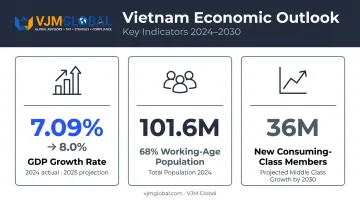
This translates into fast-growing demand for quality goods, international brands, and modern services — areas where Gulf-based operators are well-positioned to compete.
The CEPA Advantage
Vietnam participates in 17 Free Trade Agreements as of February 2026, including the CPTPP (in force January 2019) and EVFTA (in force August 2020). The critical development for UAE businesses is the UAE-Vietnam CEPA, which entered into force on 3 February 2026, with over 95% of qualifying goods receiving immediate tariff elimination. This creates a direct preferential trade channel that most competitors from non-CEPA countries do not have access to.
The China+1 Dimension
Vietnam recorded USD 38.23 billion in registered FDI in 2024, with processing and manufacturing accounting for USD 25.58 billion — 66.9% of the total. UAE companies that source from China or supply into Chinese-linked supply chains are increasingly treating Vietnam as a complementary production base.
Three factors make this a credible move:
- Geographic proximity to China keeps supply chain disruption risk low
- Lower labour costs compared to most regional manufacturing alternatives
- Established clusters in electronics, textiles, and industrial manufacturing already operating at scale
A Cultural Parallel That Matters
Both UAE and Vietnamese business cultures are relationship-driven and trust-first. Business owners who already operate this way will find Vietnam's commercial environment more familiar than many Western entrants do — relationships are built before deals are negotiated, not during. That shared instinct can open doors faster than any trade agreement.
Top Sectors Where UAE Businesses Have a Competitive Edge
Real Estate and Construction
Vietnam's rapid urbanisation is driving strong demand across residential, commercial, and industrial real estate. FDI into Vietnam's real estate sector reached USD 6.31 billion in 2024 — 16.5% of total registered FDI, up 18.8% year-on-year.
UAE businesses with property development, construction management, or smart city infrastructure expertise are well-positioned. Key constraint to note: foreigners may own eligible project housing but not land. Foreign ownership is capped at 30% of apartments per condominium and 250 detached houses per ward-equivalent area, with individual ownership terms generally of 50 years (renewable once).
Halal Food and F&B
Vietnam has built dedicated halal certification infrastructure — the state-linked HALCERT platform — under Decision 10/QD-TTg (February 2023), which created a national halal industry development project through 2030. The strategic intent is clear: Vietnam wants to produce halal-certified goods for Gulf export markets.
UAE businesses in halal food production, certification, or F&B franchising have a direct opportunity on two fronts: investing in local production capacity and acting as distribution channel partners for Vietnamese halal goods entering Gulf markets.
Logistics and Supply Chain
Vietnam's port infrastructure is significant. Hai Phong's ports handled 46 million tonnes in H1 2024 alone. As a major export-oriented economy within ASEAN, Vietnam needs logistics operators with international capability.
UAE companies — particularly those based in Dubai with deep freight forwarding and supply chain management experience — will find strong demand. Under Decree 163/2017/ND-CP, warehousing and freight-transport agency services can generally be wholly foreign-owned. However, road freight carries a 51% foreign ownership cap, maritime cargo transport 49%, and container handling 50% — so the right entry structure depends entirely on which logistics segment you operate in.
Retail, E-Commerce, and Consumer Goods
Vietnam's e-commerce market reached USD 25 billion in 2024, up 20% year-on-year, representing 9% of total retail sales. The dominant platforms — Shopee, TikTok Shop, and Lazada — offer immediate distribution reach with lower physical infrastructure requirements than traditional retail.
UAE companies in retail, fashion, beauty, and lifestyle carry strong brand recognition in urban Vietnamese markets. Foreign-invested retailers fall under Decree 09/2018/ND-CP, which covers business and retail licensing — and where applicable, an Economic Needs Test applies before opening additional outlets.
Financial Services and Fintech
77.41% of Vietnamese adults held payment accounts as of January 2024 — but account penetration tells only part of the story. The sophistication gap in digital credit, insurance, and lending remains wide, and that's where foreign fintech can compete.
Decree 94/2025/ND-CP, effective 1 July 2025, established a banking sector sandbox covering credit scoring, Open APIs, and P2P lending. UAE fintech businesses with qualifying products can apply to operate within this framework. Sandbox approval, however, is not a general fintech licence — full commercialisation requires a separate regulatory pathway.
Vietnam Market Entry Models: Choosing the Right Structure
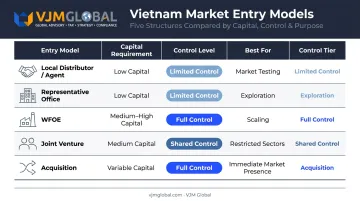
The entry structure decision is one of the most consequential a UAE business will make. Getting it wrong creates operational and legal friction that is difficult to undo later. Five main models exist, each suited to a different risk appetite, sector, and commercial objective:
| Entry Model | Capital Required | Control Level | Best For |
|---|---|---|---|
| Local Distributor / Agent | Low | Limited | Market testing |
| Representative Office | Low | Limited | Exploration & relationship-building |
| WFOE | Medium–High | Full | Operational control, scaling |
| Joint Venture | Medium | Shared | Restricted sectors, local relationships |
Using a Local Distributor or Agent
The lowest-capital entry point. A UAE company appoints a Vietnamese distributor who handles importation, warehousing, sales, and sometimes marketing. Suitable for testing demand before committing to a local presence.
- Advantage: Fast, low-cost, low-risk
- Limitation: Limited brand control and full dependency on distributor performance
- Critical requirement: Thorough due diligence on permits, financial standing, and market relationships before signing
Representative Office
Governed by Decree 07/2016/ND-CP, a Representative Office is a non-revenue-generating entity used for market research, relationship building, and liaison activities. It cannot issue invoices or sign commercial contracts in Vietnam. The licence is up to 5 years and renewable.
Suitable for UAE companies in the exploration phase — especially in sectors where government relationships matter, such as energy, infrastructure, or financial services. The licence decision is issued within 7 working days of a valid dossier. Low setup cost, but deliberately limited scope.
Wholly Foreign-Owned Enterprise (WFOE)
The most common structure for serious foreign investors seeking full operational control: the ability to issue invoices locally, hire staff directly, and build a scalable business. Requires an Investment Registration Certificate (IRC) followed by an Enterprise Registration Certificate (ERC).
Statutory timelines: 15 working days for the IRC (for projects not requiring investment-policy approval) and 3 working days for the ERC — though these are authority decision periods, not guaranteed end-to-end completion times.
This structure works well for UAE companies in manufacturing, services, retail, technology, or any sector where brand and quality control are priorities. Note: certain sectors restrict 100% foreign ownership, so sector screening before committing to this structure is required.
Joint Venture with a Local Partner
The right choice when:
- A sector requires local participation (logistics sub-sectors, certain education and distribution activities)
- Local market relationships are critical to commercial success
- Regulatory approvals are genuinely accelerated by local partner involvement
JVs require clear governance structures, with shared decision-making, profit distribution, and exit rights defined upfront. Choosing the wrong local partner is one of the most common and costly mistakes UAE businesses make in Vietnam.
Legal and Regulatory Requirements for UAE Companies
The Two-Stage Licensing Process
All foreign investors must complete two stages:
- IRC (Investment Registration Certificate) — issued by provincial authorities or the Ministry of Planning and Investment
- ERC (Enterprise Registration Certificate) — issued after the IRC is obtained
Standard IRC processing is 15 working days for valid dossiers not requiring investment-policy approval; ERC takes 3 working days. In practice, total setup timelines range from 2 to 4 months depending on sector classification, province, investment scale, and whether the business falls in a conditional sector.
Projects within designated industrial zones may process faster due to streamlined local authority approvals.
Key Ongoing Compliance Obligations
UAE companies must plan for these from day one:
- Corporate Income Tax (CIT): Standard rate of 20%. Priority-sector or favored-location projects may qualify for preferential rates (10% for 15 years), exemptions, and reductions — subject to specific project and location tests, not merely zone tenancy
- VAT: Standard rate of 10%, with a temporary 8% rate for qualifying supplies through 31 December 2026 (excluding telecommunications, finance, banking, insurance, real estate, and securities)
- Transfer pricing: Governed by Decree 132/2020/ND-CP, as amended by Decree 20/2025/ND-CP (effective 27 March 2025, applying from the 2024 tax year) — Vietnam's transfer pricing rules carry real enforcement risk and require structured, contemporaneous documentation
- Labour law: Social insurance contributions, mandatory benefits, and termination procedures are strictly governed
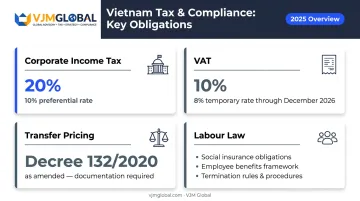
Building the right compliance framework before entry — rather than retrofitting it after problems surface — is one of the most cost-effective decisions UAE companies can make at this stage.
Intellectual Property Protection
Beyond tax and labor compliance, IP protection deserves early attention. Vietnam has strengthened its framework under WTO/TRIPS obligations, but enforcement remains registration-dependent — proactive filing with the National Office of Intellectual Property (NOIP) is essential. Trademark registration involves:
- 1 month formality examination
- Publication within 2 months after acceptance
- 9 months substantive examination from publication
UAE businesses bringing proprietary brands, formulas, or technology into Vietnam should file with NOIP before — or at the point of — market entry. Registration timelines mean early action is the only reliable protection.
Vietnam's Three Economic Regions: Where to Set Up
| Region | Key Cities | Best For UAE Businesses |
|---|---|---|
| North | Hanoi, Hai Phong, Bac Ninh | Electronics sourcing, industrial manufacturing, government relations |
| Central | Da Nang | IT/software, high-tech, early-mover positioning |
| South | Ho Chi Minh City, Dong Nai | Retail, F&B, services, fintech, consumer goods |
For most UAE businesses, Ho Chi Minh City is the right starting point. Services account for over 60% of HCMC's GRDP, and its 2024 nominal GRDP of approximately VND 1.78 quadrillion significantly outpaces Hanoi's VND 1.43 quadrillion. HCMC's commercial ecosystem is more open to international brands and faster to transact with than the more government-oriented north.
Hanoi is the better choice for businesses with a significant government relations component, state-linked enterprise partnerships, or industrial manufacturing strategy — the north's higher concentration of ministries and state enterprises makes relationship-building there distinctly different from HCMC.
Beyond city choice, where you physically locate within a region matters. Businesses manufacturing or exporting that set up inside approved industrial parks may qualify for:
- Preferential corporate income tax (CIT) treatment
- Import duty relief on qualifying inputs
- Streamlined licensing under Investment Law Articles 15 and 16
Exact incentives vary by project type, sector, and park designation — confirm specifics with local legal or tax counsel before committing to a site.
Common Mistakes UAE Businesses Make When Entering Vietnam
Underestimating Relationship Timelines
Vietnam operates on trust networks. UAE businesses used to faster transactional deal cycles often push for commercial agreements before the relationship foundation is in place. Major sales in Vietnam can take up to two years to close. Consistent face-to-face engagement, local presence, and structured follow-up are not optional — they are the mechanism by which deals eventually happen.
Treat the relationship-building phase as a structured business activity with its own milestones, budget, and timeline — not as an obstacle to the real work.
Choosing the Wrong Entry Structure
Starting with a distributor when brand control matters, setting up a WFOE without adequate market validation, or entering a JV without clear governance terms — all of these create structural problems that compound. The entry structure should be driven by a clearly defined 3 to 5 year Vietnam strategy, not by whichever option appears fastest or cheapest at the outset.
Ignoring Local Talent and HR Compliance
Getting the people layer wrong derails Vietnam operations faster than almost any other factor. Two failure modes appear consistently:
- Weak local leadership: Underinvesting in Vietnamese management or withholding real decision-making authority stalls growth at the market level
- HR compliance gaps: Mishandling social insurance contributions, mandatory benefits, or termination procedures triggers regulatory consequences and damages employer reputation
Companies that scale in Vietnam share one common trait — they empower strong local leadership early and budget for competitive local compensation from day one.

Frequently Asked Questions
Can UAE companies own 100% of a business in Vietnam?
Yes — 100% foreign ownership is permitted in most sectors through a Wholly Foreign-Owned Enterprise (WFOE) structure. However, sectors including logistics sub-services, telecommunications, and certain distribution activities have conditional restrictions that may require a local partner. Early sector-specific regulatory screening is essential before committing to a structure.
How long does it take to set up a company in Vietnam as a UAE investor?
The statutory process — IRC followed by ERC — takes 15 working days for IRC approval and 3 working days for ERC, but end-to-end setup typically runs 2 to 4 months depending on sector, province, and investment scale. Projects in designated industrial zones often benefit from faster approvals.
Is there a free trade agreement between the UAE and Vietnam?
Yes. The UAE-Vietnam CEPA entered into force on 3 February 2026, with over 95% of qualifying goods receiving immediate tariff elimination. UAE-origin goods and investments entering Vietnam now benefit from preferential treatment under this agreement, which also creates a framework for investment protection.
What is the minimum capital requirement for a foreign-owned company in Vietnam?
Vietnam does not impose a universal minimum capital requirement for all foreign-owned companies. However, regulated sectors have specific thresholds — a commercial bank requires VND 3 trillion, for example. The declared capital for any entity must be credible for the stated business purpose and is subject to regulatory scrutiny during licensing.
Which Vietnamese city is the best starting point for UAE businesses?
Ho Chi Minh City is the primary entry point for most UAE businesses in retail, services, F&B, and consumer goods — it has Vietnam's largest commercial market, most mature infrastructure, and greatest openness to international brands. Hanoi is more appropriate for businesses with a significant government relations or industrial manufacturing component.
Do UAE businesses need to hire a local Vietnamese legal representative?
Yes. Under Article 12 of the Enterprise Law (59/2020/QH14), all foreign-invested companies in Vietnam must have at least one legal representative residing in Vietnam at all times. This person — a foreign national or Vietnamese citizen — carries personal liability for key compliance obligations, making careful selection essential.