It's not just the big ASX-listed players making the move. Australian SMEs, export-driven agribusinesses, education providers, and investors chasing lower-cost manufacturing bases are all looking at Vietnam seriously.
This guide walks Australians through the practical, legal steps to register and operate a business in Vietnam, from choosing a structure to navigating tax obligations.
Key Takeaways
- Vietnam allows up to 100% foreign ownership in most sectors; LLC is the standard structure for Australian investors
- Complete registration with an Investment Registration Certificate (IRC) and Enterprise Registration Certificate (ERC)
- Budget for flat 20% corporate tax and 10% VAT (8% on eligible goods through 31 December 2026)
- Use local expertise to avoid delays from documentation, translation, and compliance gaps
Why Australians Are Turning to Vietnam for Business Expansion
Vietnam's appeal rests on conditions that favour Australian businesses right now. That said, favourable conditions don't guarantee success without proper planning.
Key drivers for Australian investors:
- Strategic partnership status – Comprehensive Strategic Partnership from 7 March 2024; DFAT reports A$30.0 billion in two-way trade in 2025
- Sector demand – Vietnamese buyers actively seek Australian expertise in agriculture, education, and clean energy
- Market access via trade blocs – CPTPP (~598 million people, 14.4% of world GDP) plus RCEP (2.2 billion more consumers), per Vietnam's Ministry of Industry and Trade
- Lower operating costs – Regional minimum wages in Vietnam range from roughly VND3.70M to VND5.31M monthly, well below Australian labour benchmarks
Vietnam's economy also backs this up with hard numbers. The World Bank reports 8% GDP growth in 2025, with a 6.8% projection for 2026. That's a strong macro tailwind for manufacturing and export-focused investors specifically.
Choosing the Right Business Structure as an Australian Investor
Your structure choice determines liability exposure, capital requirements, and how easily you can scale later. Get this wrong and you will restructure mid-operation at real cost in time and money.
| Structure | Best for | Key constraint |
|---|---|---|
| LLC | Most SMEs, trading and services | Max 50 members |
| JSC | Larger capital and share fundraising | At least 3 shareholders |
| Representative office | Market testing and liaison | Cannot generate revenue |
| Branch office | Extension of Australian parent | Limited by parent scope and treaties |
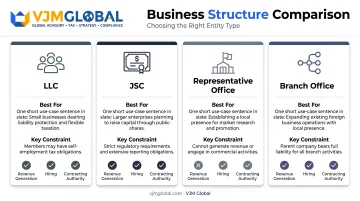
Limited Liability Company (LLC)
The most common choice for Australian SMEs. An LLC can have a single owner or up to 50 members, with liability capped at contributed capital. Setup is straightforward, ownership stays simple, and the form suits most trading or service businesses.
Joint Stock Company (JSC)
Better suited if you're planning larger investments or want to raise capital through share issuance down the track. A JSC requires at least three shareholders, with no upper limit, making it more flexible for growth-stage fundraising.
Representative Office
A low-cost entry point if you want to test the Vietnamese market before committing capital. Representative offices can conduct liaison work and market research but cannot generate revenue directly.
Branch Office
Tied to your existing Australian parent company's registered business scope. Only viable where Vietnam's treaty commitments and sector rules permit a branch for your specific activity.
Common mistake: choosing on setup cost alone. A representative office looks cheap upfront but cannot scale into an operating business without a full restructure later.
How to Start a Business in Vietnam from Australia – Step by Step
This breaks registration into the practical stages Australian investors actually need to navigate. The two biggest traps: underestimating document translation lead times, and assuming a low registered capital figure will satisfy every sector's requirements.
Step 1 – Define Your Business Scope and Investment Structure
Decide your industry code and business activities first, then check whether a local partner is legally required. Vietnam's current Negative List under Decree 96/2026 closes 23 sectors to foreign investment entirely and imposes conditions on 62 others.
Next, lock in your shareholder structure and capital contribution plan. This isn't a box-ticking exercise. Your registered capital needs to genuinely support the scale of operations you're proposing.
Step 2 – Secure a Registered Address and Prepare Documents
You'll need a compliant commercial address, physical or virtual, before filing anything.
Australian documents typically require a specific chain:
- Notarisation in Australia
- DFAT authentication
- Legalisation by the Vietnamese consular mission
- Vietnamese translation and notarisation of the translated versions
Skip a step here, and your entire application gets bounced back.
Step 3 – Apply for Investment Registration Certificate (IRC) and Enterprise Registration Certificate (ERC)
Under the current framework, you can actually establish the enterprise before securing the IRC, though the IRC must follow within 12 months. Statutory processing windows vary: ERC registration is generally three working days, while IRC timelines range from 5 to 15 working days depending on whether policy approval applies.
Incomplete submissions are the number one cause of delay. Missing translations, inconsistent shareholder details, or unclear business scope descriptions will bounce your application straight back to square one.
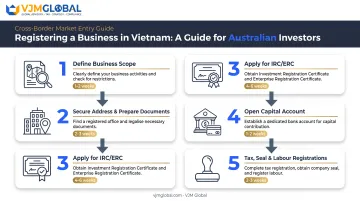
Step 4 – Open a Capital Account and Deposit Registered Capital
Once your entity is established, you'll open a Direct Investment Capital Account (DICA) at a licensed Vietnamese bank. Capital contributions, dividend transfers, and outward remittances all route through this account.
Committed capital is generally due within 90 days of ERC issuance, according to Vietnamese legal sources. Missing that window creates compliance headaches down the line.
This is precisely where cross-border banking coordination becomes valuable. Aligning your Australian entity's financial documentation with what a Vietnamese bank expects is rarely intuitive on the first attempt.
Step 5 – Complete Tax, Seal, and Labour Registrations
With your capital deposited, register for:
- A tax code and e-invoicing capability (mandatory since Decree 70/2025)
- Social insurance for any local employees
- Your company seal on the national business portal
- Work permits for any Australian staff relocating to Vietnam, governed under Decree 219/2025
Costs, Taxes & Compliance Australians Must Plan For
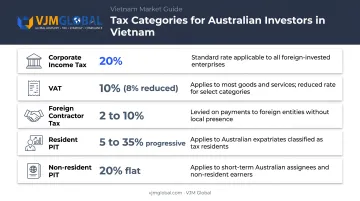
Understanding your tax exposure upfront prevents nasty surprises at year-end. Vietnam layers several tax types depending on your revenue streams.
| Tax Type | Standard Rate | Notes |
|---|---|---|
| Corporate Income Tax (CIT) | 20% | Reduced rates (15-17%) apply below certain revenue thresholds |
| VAT | 10% | Reduced to 8% for eligible goods through 31 Dec 2026 |
| Foreign Contractor Tax (FCT) | 2–10% (varies by activity) | Applies to cross-border service payments |
| Resident PIT | 5-35% | Progressive brackets on employment income |
| Non-resident PIT | 20% | Flat rate on employment income |
Registered capital and fees vary by sector. There's no single universal minimum for an ordinary LLC or JSC. Regulated industries can impose their own legal-capital thresholds, so confirm the figure against your specific business line.
Where companies fall behind: Ongoing compliance, not initial setup, trips up most foreign-owned entities. Quarterly CIT prepayments and annual filings require consistent local support. Missing a quarterly deadline triggers penalties that compound quickly.
Common Challenges Australian Investors Face (and How to Avoid Them)
Even well-prepared investors hit friction points. Knowing these in advance saves weeks of back-and-forth.
- Bureaucratic delays – Incomplete or poorly translated documents cause most slowdowns; use certified translations and a pre-submission checklist
- Sector-specific restrictions – Vietnam’s Negative List requires local partners in some industries; confirm your exact business line, not a broad label
- Language and cultural barriers – Filings and negotiations move faster with advisors who know local business norms
- Dossier accuracy – Decree 296 makes owners and shareholders liable for registration accuracy; nominee arrangements are prohibited
Work with an advisory firm experienced in Vietnam entity setup. That cuts rework risk and shortens turnaround on each of these points.
Frequently Asked Questions
How much does it cost to open a company in Vietnam?
Costs vary significantly by industry and location, with registered capital expectations differing by sector. There's no universal minimum, so budgeting requires checking requirements specific to your business line and location.
Can an Australian start a business in Vietnam?
Yes. Most sectors allow up to 100% foreign ownership, with the limited liability company (LLC) being the most accessible structure for Australian investors entering the market.
Which businesses are most profitable in Vietnam?
Manufacturing, e-commerce, education, and agriculture/food often offer the strongest commercial upside for foreign entrants, supported by Vietnam's growing consumer base and export infrastructure.
Can an Australian live in Vietnam permanently?
Temporary residence cards are available, tied to work permits or investment status. Permanent residency follows separate, stricter criteria and isn't a routine outcome of business ownership alone.
How long does company registration take in Vietnam?
Timelines depend heavily on documentation readiness. Statutory processing windows for the ERC and IRC are relatively short, but delays from incomplete paperwork are common and extend the overall timeframe.
Do I need a local partner to start a business in Vietnam?
Most sectors don't require one. However, certain restricted industries under Vietnam's Negative List do mandate local partnership, so check your specific business activity against current regulations.
Conclusion
Starting a business in Vietnam from Australia is achievable, but it rewards careful structuring, thorough documentation, and realistic tax planning. Get your entity structure right from the outset and stay ahead of compliance deadlines to avoid costly delays that catch unprepared investors off guard.
VJM Global works with cross-border investors on entity setup and compliance across multiple international markets, and supports Australian businesses with accounting, tax, and advisory needs. If you're weighing up Vietnam market entry, early groundwork on structure and compliance makes the rest of the journey smoother.