But here's what most guides don't tell you: registration timelines advertised online rarely match reality. Many US entrepreneurs plan around a 15-day statutory benchmark, then get blindsided when banking, document legalization, and licensing stretch the process to several months.
This guide walks through entity types, the actual step-by-step registration process, tax and compliance obligations, and — critically — the US-side reporting requirements that come with owning a Vietnamese subsidiary.
Key Takeaways
- Vietnam permits 100% foreign ownership in most sectors; conditional sectors require additional screening
- Realistic setup timelines run 3-6 months, not the often-quoted 15-day minimum
- LLCs suit most US investors; JSCs, representative offices, and branches serve narrower purposes
- Standard corporate income tax is 20%, with incentives for tech, renewable energy, and education
- Vietnamese subsidiaries trigger FBAR, Form 8938, and GILTI obligations in parallel with local compliance
Why US Businesses Are Setting Up in Vietnam
Vietnam's economy grew an estimated 8.02% year over year in 2025, according to the Vietnam General Statistics Office. The World Bank projects continued expansion, forecasting 6.8% growth in 2026 and 7.1% in 2027.
The labor force backing this growth is substantial: 53.5 million people aged 15 and over were active in 2025. That's a young, growing workforce many manufacturers cite as a core reason for relocating operations from China.
Trade Relationships Give Vietnam an Edge
Vietnam's trade position with the US is significant. Reuters reported the country's 2025 trade surplus with the United States exceeded $178 billion. That volume reflects deep integration into US supply chains, not just cheap exports.
Vietnam also belongs to major trade blocs that matter for manufacturers:
- RCEP: covers roughly 30% of world GDP and phases out close to 90% of tariff lines among members
- CPTPP: preferential access to Pacific Rim markets
- EVFTA: reduced tariffs into the European Union
These agreements give companies manufacturing in Vietnam market access that a direct US export simply can't match.
Large manufacturers have already committed at scale. Intel's Vietnam facility is its largest global assembly-and-test site, producing nearly every Intel product family. Amkor opened a 57-acre, 200,000-square-meter cleanroom facility there in 2023. These are anchor investments, not pilot projects.
Business Structures Available to US Investors
Choosing the right entity shapes everything downstream, from licensing speed to tax treatment.
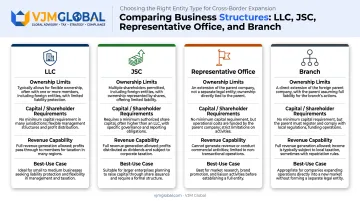
Limited Liability Company (LLC)
The LLC is the default choice for most US investors setting up long-term operations. Vietnam's Enterprise Law allows:
- Single-member LLCs — one owner, liability limited to charter capital
- Multi-member LLCs — between 2 and 50 members, generally can't issue shares
LLCs offer full operational control without needing outside shareholders, which makes them a natural fit for a wholly-owned US subsidiary.
Joint-Stock Company (JSC)
A JSC requires a minimum of 3 shareholders with no upper limit, and its capital is divided into shares. This structure fits businesses planning to raise external capital or list shares, such as larger manufacturing operations or growth-stage companies expecting future funding rounds.
Representative Office and Branch
- Representative offices (ROs) cannot generate revenue. They're built for market research and relationship-building before you commit capital.
- Branches can perform some or all of the parent company's business functions, but licensing is generally limited to specific sectors like banking, legal services, and franchising.
Other Entry Options
Lower-commitment entry points still matter in regulated or test-the-water scenarios:
- Local distributors — sell through a partner without incorporating
- Joint ventures — share ownership where a local partner helps with licensing
A local partner isn't legally required in most industries, but in conditional sectors a partner can speed up licensing.
Step-by-Step Company Setup Process
Here's where the timeline gap between "advertised" and "actual" becomes clear.
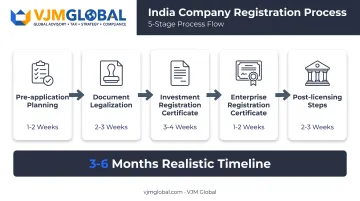
- Pre-application planning — Confirm your business lines aren't restricted, secure a lease agreement, and prepare proof of financial capacity. Skipping this step is the single biggest cause of rejected applications.
- Document legalization — US corporate documents typically need notarization and consular legalization before Vietnamese authorities will accept them. All submissions also require Vietnamese translation.
- Investment Registration Certificate (IRC) — Filed through the Department of Planning and Investment. The statutory benchmark is 15 working days for straightforward cases. Published 2025 procedural guidance puts realistic processing at 10-25 working days, and cases needing investment policy approval can take 35 days before the IRC is issued.
- Enterprise Registration Certificate (ERC) — Follows the IRC. You also register the company seal and set up corporate e-ID credentials at this stage.
- Post-licensing steps — Open a capital bank account, register for taxes, and enroll in labor and social insurance.
Realistic timeline: Banking setup and document legalization push most US-owned entities to 3 to 6 months — not the 15-day figure unofficial guides often advertise.
Tax, Legal & Compliance Obligations
Once your entity is live, ongoing compliance becomes the priority.
Vietnam-Side Tax Rates
- Corporate Income Tax (CIT): Standard rate is 20%. Under Vietnam's new CIT law (effective October 2025), smaller enterprises may qualify for 15% (turnover under VND 3 billion) or 17% (turnover between VND 3-50 billion)
- Incentive rates: Qualifying tech, renewable energy, and education projects can access 10% for 15 years, plus up to 4 years of tax exemption and a 50% reduction for the following 9 years
- VAT: Standard tiers of 0%, 5%, and 10%, with a temporary reduction on select 10% supplies to 8%
- Foreign Contractor Tax (FCT): Applies to cross-border payments to foreign contractors without a licensed Vietnam presence; deemed rates vary by activity type
Other compliance checkpoints include:
- Annual statutory audits
- Transfer pricing documentation for related-party transactions (local file, master file, and country-by-country reporting where applicable)
- Interest deductibility cap of 30% of EBITDA
The US-Side Obligations Nobody Warns You About
Forming a Vietnamese subsidiary doesn't pause your US filing requirements — it adds to them.
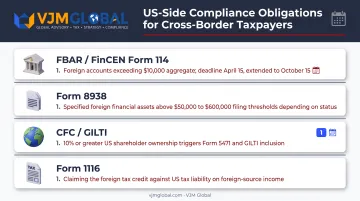
- FBAR (FinCEN Form 114): Required if your foreign financial accounts exceed $10,000 in aggregate at any point during the year. Due April 15, with automatic extension to October 15.
- Form 8938: Required alongside your annual return once specified foreign financial assets cross IRS thresholds (these vary by filing status and US residency).
- CFC and GILTI: If US shareholders own more than 50% of the Vietnamese entity, it's a Controlled Foreign Corporation. GILTI inclusions get calculated on Form 8992 and may trigger Form 5471 filing categories.
- Form 1116: Used to claim foreign tax credits against US tax on foreign-source income, helping avoid double taxation — though GILTI-category income has no carryover allowance.
These obligations run in parallel with your Vietnamese compliance calendar, not sequentially. Missing either side creates real penalty exposure.
VJM Global helps US business owners coordinate the home-country side of this compliance as their Vietnam entity comes online. That covers FBAR filings, FATCA and Form 8938 reporting, CFC/GILTI structuring, and Form 1116 foreign tax credit planning.
The firm is not a Vietnam-licensing specialist. Its focus is keeping US filing obligations from falling through the cracks while your Vietnamese entity handles local requirements.
Common Mistakes and Regional Considerations for US Investors
Two areas catch US investors out most often: early structural choices and picking the wrong region for the model.
- Choosing a structure before validating demand — locking into an LLC or JSC before market fit wastes capital and time.
- Treating Vietnam as only a low-cost labor play — ties with local partners, suppliers, and officials matter more than most US founders expect.
- Relying on outdated guides — Investment Law rules and licensing sequences shift; a guide from even two years ago may be wrong.
Match Region to Business Model
Location should follow the operating model, not only rent or wage levels:
| Region | Best For |
|---|---|
| North (Bac Ninh, Hai Phong) | Electronics, automotive components, precision manufacturing |
| Central (Da Nang) | Emerging logistics, commercial development |
| South (Ho Chi Minh City area) | Consumer goods, FMCG, long-haul export via Cai Mep-Thi Vai port |
A labor-heavy FMCG line and a precision electronics assembler need different ports, supplier density, and talent pools—choose the region that matches those needs.
Frequently Asked Questions
What are the requirements for forming a company in Vietnam?
You'll need to select a business structure, secure a lease agreement, and demonstrate financial capacity before filing for an Investment Registration Certificate and Enterprise Registration Certificate. Post-licensing, tax and labor registration follow.
How long does it take to register a company in Vietnam?
The statutory benchmark is 15-45 days depending on the approval path, but realistic timelines including banking setup and document legalization run 3-6 months.
Can US firms fully own their companies in Vietnam?
Yes, 100% foreign ownership is permitted in most sectors. Exceptions exist in telecom, defense, and select logistics activities, which require additional screening or local participation.
Do US companies need a local partner to enter Vietnam?
No, a local partner isn't legally required in most sectors. However, in regulated industries, partnering locally can meaningfully speed up licensing approval.
What is the minimum capital requirement for a foreign-owned company in Vietnam?
There's no universal statutory minimum outside conditional sectors. Your registered capital should reasonably match the scale and cost structure of your business plan.
How does setting up in Vietnam affect a US company's home-country tax filings?
Once your Vietnamese subsidiary is operational, you'll likely need to file FBAR and Form 8938 for foreign financial accounts and assets. CFC and GILTI rules may also apply depending on ownership structure.