California restricts this structure to a handful of licensed professions under Corporations Code Section 16101, and the exact requirements shift depending on your profession, your partners' licenses, and the insurance you're required to carry.
Many business owners struggle to find clear answers because most online guides written for LLCs simply don't apply. This article covers who actually qualifies, the registration steps, ongoing costs and compliance, common pitfalls, and how an LLP compares to an LLC or LP — so you don't file paperwork the Secretary of State will reject.
Key Takeaways
- Only licensed attorneys, CPAs, architects, engineers, and land surveyors can form an LLP in California
- Filing Form LLP-1 costs $70; professionals also need profession-specific insurance or financial security
- Every California LLP owes an $800 minimum franchise tax annually, regardless of profit
- Out-of-state LLPs must register within 30 days of transacting business in California
- Skipping a written partnership agreement triggers California's default 50/50 profit-and-liability split
Who Can Form an LLP in California?
Unlike LLCs or corporations, LLP eligibility in California is tied directly to a professional license. Under Corp. Code §16101, five categories currently qualify:
- Law
- Public accountancy
- Architecture
- Engineering
- Land surveying
Engineering, land surveying, and architecture authorization is set to sunset on January 1, 2034, under current law, so confirm the latest status with the Secretary of State before you file. Law and public accountancy remain permanently authorized.
One LLP, One Profession
Form LLP-1 requires selecting a single practice category. This means a CPA and an attorney can't form one shared LLP together. Each professional practice needs its own entity, staffed by people licensed in that specific field.
Ownership rules vary by profession, though:
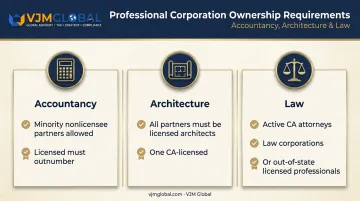
- Accountancy allows minority nonlicensee partners, but licensed partners must outnumber them (a two-partner firm can have one licensed and one nonlicensed partner)
- Architecture requires all partners to be licensed architects, with at least one holding a California license
- Law permits partners who are active California attorneys, law corporations, or professionals licensed to practice in another jurisdiction
Non-licensed investors, business managers, or financial backers can't be owners in any of these structures. That's a meaningful difference from LLCs and LPs, where non-licensed investors often hold equity freely.
Foreign LLPs Doing Business in California
If your LLP is already formed in another state, you must register with the California Secretary of State within 30 days of transacting business here. You'll also need to attach a certificate of good standing from your home state, dated within the last six months.
Ideal use case: professional service firms (think a three-partner accounting practice) that want protection from a co-partner's malpractice claims while keeping partnership-style pass-through taxation.
Step-by-Step: How to Form an LLP in California
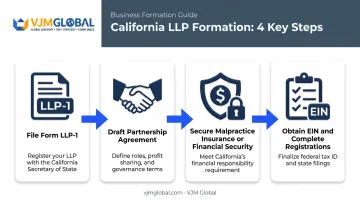
File the Application to Register (Form LLP-1)
Form LLP-1 requires:
- LLP name and place of formation
- Principal office and mailing address
- Business description and practice category
- A registered agent for service of process (with a California street address if it's an individual)
The filing fee is $70. You can submit online through bizfile Online, by mail, or in person at the Sacramento office (in-person filings add a $15 handling fee).
Your name must end with "Registered Limited Liability Partnership," "Limited Liability Partnership," "LLP," "L.L.P.," "RLLP," or "R.L.L.P." No shortcuts here: the Secretary of State will reject filings that use unapproved variants.
Draft and Execute a Partnership Agreement
Nothing in state law requires a written partnership agreement. That doesn't make it optional in practice.
Without one, California partnership law fills the gaps for you, typically defaulting to equal 50/50 profit and liability splits, regardless of who put in more capital or does more work. A solid agreement should spell out:
- Profit and loss sharing
- Partner roles and decision-making authority
- Dispute resolution procedures
- Dissolution and exit terms
Secure Required Malpractice Insurance or Financial Security
This is where LLPs diverge sharply from LLCs. Under Corp. Code §16956, every California LLP must maintain one of three forms of financial security:
- Insurance covering malpractice claims
- A bank escrow or trust arrangement
- A net-worth certification, filed annually if you go this route
The minimums differ by profession:
| Profession | Insurance/Escrow Minimum | Net-Worth Alternative |
|---|---|---|
| Accountancy | $1M (≤5 partners) + $100K per additional partner, capped at $5M | $10M |
| Architecture | Same as accountancy | $10M |
| Law | $1M (≤5 partners) + $100K per additional partner, capped at $7.5M | $15M |
This security has to stay active the entire time your LLP transacts business. If you're using claims-made insurance, you'll generally need an extended-reporting endorsement covering at least three years after dissolution, provided one is reasonably available on the market.
Obtain an EIN and Complete Local/Professional Registrations
Once your LLP-1 is approved, you still have a few boxes to check:
- IRS EIN: apply free through the IRS website for tax and banking purposes
- Franchise Tax Board: there's no separate registration form; your first Form 565 filing establishes your FTB account
- Local business license: check with your city or county
- Professional board filings: attorneys need a State Bar Certificate of Registration; accountancy LLPs need California Board of Accountancy approval before practicing; architecture firms file a Business Entity Report with the California Architects Board
Costs, Taxes & Ongoing Compliance for California LLPs
Every California LLP pays an $800 annual minimum franchise tax, whether you earn $5,000 or $5 million that year. It's non-negotiable and applies for every taxable year the LLP is registered, active, or organized in the state, according to the Franchise Tax Board.
Here's a detail many owners miss: LLPs don't pay the additional income-based fee that LLCs owe. That gross-receipts fee (which scales from $900 at $250,000 in income up to $11,790 at $5 million or more) applies specifically to LLCs under California law, not LLPs. If you're comparing quotes or advice built around LLC tax rules, this distinction matters.
Filing and deadline basics:
- File Form 565 (Partnership Return of Income) by the 15th day of the third month after your tax year closes, or March 15 for calendar-year filers
- Out-of-state LLPs registered to do business in California owe the same $800 tax and Form 565 filing obligation as domestic LLPs
- If you pay wages, register with the EDD within 15 days after paying more than $100 in wages during a calendar quarter
- File federal Form 1065 and issue Schedule K-1s to each partner annually
Juggling state franchise tax, Form 565, EDD registration, and federal filings on top of client work is a lot to manage, especially for smaller partnerships without an in-house finance team.
Many U.S. professional partnerships, including firms with international clients or cross-border business ties, outsource bookkeeping and ongoing tax compliance to specialized accounting firms. VJM Global, for instance, works with U.S.-based businesses through its CPA-led and Chartered Accountant teams, handling day-to-day bookkeeping and multi-jurisdiction compliance support so partners can focus on billable work instead of paperwork.
LLP vs. LLC vs. LP: Choosing the Right California Structure
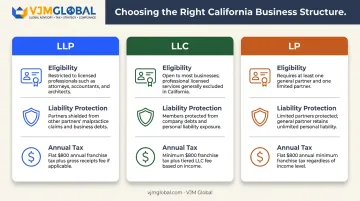
Not sure an LLP is even the right fit? Here's how the three structures stack up:
| Feature | LLP | LLC | LP |
|---|---|---|---|
| Who can form it | Licensed attorneys, CPAs, architects, engineers, land surveyors only | Any business type | Any business type |
| Liability protection | Shields partners from co-partner malpractice, not their own errors | Members generally shielded from company debts and obligations | General partners liable jointly and severally; limited partners protected |
| Annual state tax | $800 minimum franchise tax | $800 minimum franchise tax, plus income-based fee above $250,000 | Not directly comparable |
| Taxation | Pass-through | Pass-through (default) | Pass-through |
If you're not licensed in one of the qualifying professions, an LLP simply isn't available to you, so an LLC or corporation is the better route. LLCs also make more sense if you want broader personal liability protection that doesn't hinge on maintaining profession-specific insurance.
One thing that surprises people: both LLPs and LLCs pay the same $800 annual franchise tax floor in California. The real difference is eligibility and the scope of liability protection, not the base tax bill.
Common Mistakes When Forming an LLP in California
A few missteps show up again and again with LLP filings:
- Assuming any business qualifies: Form LLP-1 will be rejected if you're not in an eligible licensed profession
- Skipping the partnership agreement: leaving profit splits and dispute resolution to California's default rules, which rarely match what partners intended
- Letting insurance or security lapse: even a brief gap in required coverage under §16956 can undermine your liability protection
- Missing the $800 tax deadline or Form 565 filing date: late payments trigger penalties, and prolonged non-compliance can lead to suspension of your LLP's status
None of these mistakes are complicated to avoid. Building a compliance calendar for tax and filing deadlines, drafting the partnership agreement early, and confirming insurance coverage before filing keeps your LLP status secure from day one.
Frequently Asked Questions
Do out-of-state LLPs have to register in California?
Yes. Foreign LLPs must register with the Secretary of State within 30 days of transacting business in California, and they owe the same $800 annual tax as domestic entities once registered.
Do you have to pay the $800 California franchise tax every year?
Yes, both LLCs and LLPs owe the $800 minimum franchise tax every year they're registered in California, regardless of income or activity level.
What professions are allowed to form an LLP in California?
Current law allows attorneys, public accountants, architects, engineers, and land surveyors. Engineering, architecture, and land surveying authorization is scheduled to sunset in 2034, so confirm current status before filing.
Is a written partnership agreement legally required for a California LLP?
No, it's not legally mandatory, but it's strongly recommended. Without one, disputes default to California's general partnership law, typically an equal 50/50 split.
How long does it take to register an LLP with the California Secretary of State?
Processing times vary by filing method and current volume, sometimes taking several weeks for standard mail filings. Expedited options exist for an additional fee if you need faster turnaround.
What's the difference between an LLP and an LLC in California?
LLPs are restricted to licensed professionals and protect against co-partner malpractice liability. LLCs are open to any business type and offer broader liability protection without profession-specific insurance requirements.