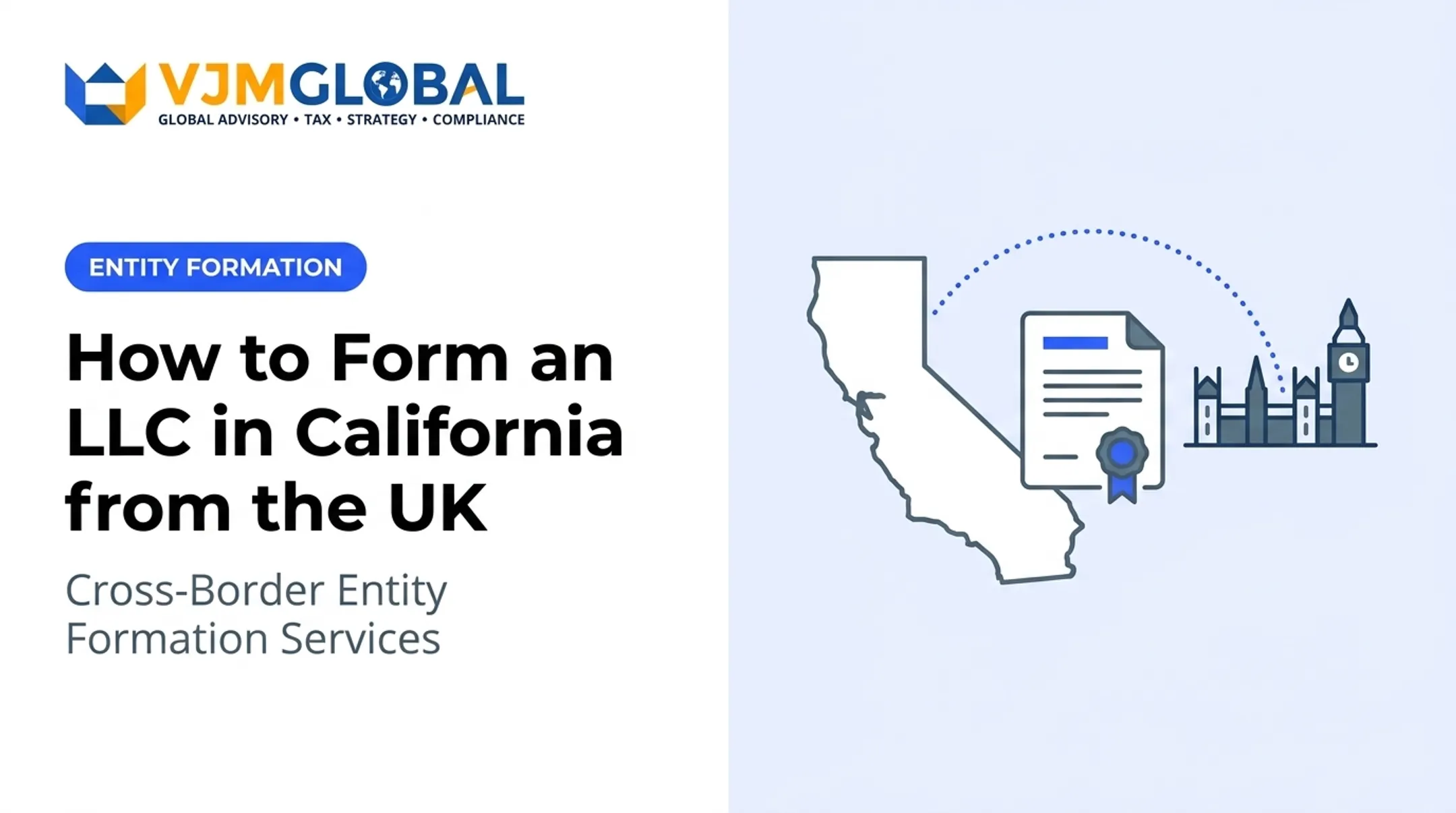
But getting there on paper is confusing. UK founders regularly get stuck on unfamiliar entity types, the difference between an EIN and a UK company number, and how on earth to open a US bank account without setting foot in the country.
This guide walks through structure choice, the exact registration steps, what it costs, and the tax obligations you'll carry on both sides of the Atlantic.
Key Takeaways
- UK citizens can own 100% of a California LLC or Corporation with no residency or visa required
- Registration with the California Secretary of State happens entirely online; no US Social Security Number needed
- An EIN from the IRS is mandatory before banking or hiring; it is separate from your California entity number
- Budget beyond filing fees for the $800 annual franchise tax, a registered agent, and currency conversion costs
- Specialist advisers can handle formation, EIN filing and ongoing compliance so you avoid delays and penalties
Why UK Entrepreneurs Choose California
Access to the World's Largest Consumer and Tech Market
California is the engine room of American tech and entertainment. The state's own high-tech ecosystem page points to deep pools of talent, research institutions and venture capital that simply don't exist at the same scale in the UK.
Beyond market size, incorporating locally carries commercial weight. US investors, customers and suppliers tend to trust a California or Delaware entity more readily than a UK Ltd selling into their market from overseas. A local entity signals commitment.
Two Separate Questions: Business Ownership vs Visa/Residency
Here's where founders get tripped up. Owning and directing a California company is purely a business and tax question. Living or working in the US is a completely separate immigration matter.
You don't need an E-2 investor visa or an L-1A intracompany transfer visa to own a California LLC or Corporation. You'd only need one of those if you planned to relocate and run day-to-day operations on US soil.
Choosing the Right Business Structure
Non-residents typically choose between two structures:
- LLC (Limited Liability Company) — suits most SMEs and e-commerce founders
- C-Corporation — suits startups planning to raise investor capital
LLC Advantages
- Pass-through taxation (profits taxed once, at owner level)
- Flexible profit-sharing arrangements between members
- Limited personal liability protection
- Lighter recordkeeping than a corporation
C-Corp Advantages
- Unlimited stock issuance, which investors and VCs generally prefer
- Cleaner cap table structure for future fundraising rounds
- Trade-off: profits face double taxation: once at corporate level, again when distributed as dividends
A critical requirement for both structures: you need a registered agent with a physical California address. This individual or registered corporate agent receives legal and state correspondence on your behalf. A PO box won't cut it.

A UK Ltd and a California LLC are not the same animal, legally or administratively. Your UK memorandum of association and filing history do not transfer over.
How to Register a Business in California from the UK: Step-by-Step
Check name availability. Use the California Secretary of State's business search and reserve your name for 60 days if it's available.
Appoint a California-based registered agent. This is mandatory for any non-resident owner and must be an individual residing in California or a registered corporate agent service.
File your formation documents. Submit Articles of Organization (LLC) or Articles of Incorporation (Corporation) online through the SOS's bizfileOnline portal, including required member or officer details.
Draft an Operating Agreement or Bylaws. LLCs need an Operating Agreement, Corporations need Bylaws. Neither is filed with the state, but both define ownership and management, and you'll need them for banking.
Apply for a federal EIN. As a UK founder without an SSN or ITIN, apply as a foreign responsible party. The IRS routes non-US applicants through phone, fax, or mail rather than the standard online form, per its Form SS-4 instructions. Apply only after your entity is legally formed. Applying too early can delay processing.
Register for state taxes and file your Statement of Information. Complete California tax registration and file the Statement of Information on the timeline required for your entity type.
Open a US business bank account. Try to open the account remotely where possible, and budget extra time for non-resident identity and formation document checks.

VJM Global supports UK founders through this sequence—from entity choice to EIN filing and registered agent arrangements—so unfamiliar paperwork is less likely to slow you down.
What It Costs to Register a Business in California
Core California filing fees are charged in US dollars (USD). Plan for:
| Item | Cost |
|---|---|
| LLC Articles of Organization (online) | $70 |
| Corporation Articles of Incorporation | $100 base fee |
| Statement of Information (LLC, every 2 years) | $20 |
| Annual Franchise Tax (LLC and Corporation) | $800 minimum |
The $800 minimum franchise tax applies to LLCs and corporations alike. It is due whether or not you have traded that year, until you formally cancel the entity.

Beyond filing fees, budget for:
- Registered agent service (required in California; billed annually)
- Business name reservation fee (optional, if you reserve the name before filing)
- Currency conversion and bank transfer charges on payments to the California Secretary of State and the IRS
Tax, EIN and Ongoing Compliance for UK Founders
Your EIN is a federal identifier issued by the IRS. You need it for banking, hiring, and tax filing. It is not the same as your California corporation number, which is a separate state-issued ID assigned when you file your Articles of Incorporation.
California State Tax Obligations
- Franchise tax: the $800 annual minimum, regardless of profitability
- Sales tax registration: required if you sell taxable goods, via a CDTFA seller's permit
- Payroll tax: triggered once you pay more than $100 in wages in a calendar quarter, requiring EDD employer registration

Ongoing California filings
Annual compliance does not stop at formation. You will still need Statement of Information filings on schedule and a registered agent maintained without gaps.
UK tax obligations
Owning a California entity does not release you from UK tax residency rules. Check the US-UK tax treaty to see how income is taxed on each side and to avoid paying twice on the same profits.
VJM Global's cross-border compliance service tracks these deadlines across both jurisdictions, which matters when you are juggling HMRC and California Franchise Tax Board timelines at once.
Common Mistakes UK Founders Make When Registering in California
UK founders often hit the same avoidable snags when setting up in California. Watch for these three:
- Treating a California LLC and UK Ltd as interchangeable. They have different documentation requirements, different filing bodies, and different tax treatments. Assuming equivalence leads to the wrong entity choice.
- Underestimating bank approval timelines. Non-resident business bank accounts often take longer to approve than expected. Plan for delays rather than assuming same-week access.
- Confusing company formation with immigration rights. Forming a California entity gives you ownership. It does not give you the right to live or work in the US. That requires a separate visa process entirely.
Frequently Asked Questions
How much does it cost to register a business in California?
LLC filing costs $70, Corporation filing starts at $100. On top of that, every entity owes an $800 annual franchise tax, regardless of profit, plus periodic Statement of Information fees.
How much does it cost to register a business name in California?
Fictitious business name (DBA) filings are handled at county level, not by the Secretary of State. Fees vary, ranging from around $40 to $55 for the first name, plus a small fee per additional name or owner.
How do I register a foreign business in California?
If you already operate a UK company, file a Statement and Designation by Foreign Corporation or LLC with the California Secretary of State, along with a certificate of good standing from Companies House.
How do I register an LLC in California online?
File your Articles of Organization directly through the bizfileOnline portal. Create an account, complete the form, pay the $70 fee, and submit electronically.
Do I need to register my small business in California?
Yes. Any business operating, selling, or hiring in California generally must register, including sole proprietors trading under a business name.
Is a California corporation number the same as an EIN?
No. Your EIN is issued federally by the IRS. Your corporation number is issued separately by the state of California when you file formation documents.