Introduction
UK businesses face mounting pressure to control operational overhead whilst maintaining financial governance quality. Rising inflation, post-Brexit compliance burdens, and tightening margins have made the full-time CFO cost—typically £250,000–£420,000 per year once employer National Insurance, pension contributions, benefits, and bonuses are factored in—increasingly difficult to justify for SMEs and scaling businesses.
Outsourced CFO services offer an obvious fix — but the India-specific case remains largely overlooked by UK decision-makers. India produced 31,946 newly qualified Chartered Accountants in 2024 alone from a professional base of 425,000 members, a talent pool with both the depth and the international orientation to serve UK clients at scale.
What follows is a direct look at what UK businesses actually gain: lower costs through the GBP-INR rate gap, dual-jurisdiction compliance expertise, and strategic financial leadership without the full-time hire.
Key Takeaways
- Cost savings of 70–95% compared to a UK full-time CFO, with equivalent expertise at mid-level finance manager rates
- Dual-framework expertise covering both UK and Indian regulations, directly relevant to the £47.4 billion UK-India trade corridor
- A 4.5–5.5 hour daily overlap supports real-time collaboration during UK afternoon hours
- Flexible models (retainer, project-based, interim) eliminate hiring risk, notice periods, and redundancy exposure
- Practical impact: faster month-end closes, improved cash flow visibility, investor-ready financials, and reduced compliance penalties
What Is CFO Outsourcing from India?
CFO outsourcing from India means engaging an India-based firm or professional to handle the strategic financial functions of a Chief Financial Officer. This covers financial planning, forecasting, cash flow management, reporting, compliance oversight, and investor relations — without placing a full-time executive on the UK payroll.
The service is most commonly applied by:
- UK SMEs without an in-house CFO (among the UK's 5.49 million SMEs, the vast majority lack dedicated financial leadership)
- UK businesses with subsidiaries or supply chains in India
- Startups preparing for funding rounds requiring investor-grade financial documentation
- Mid-market firms managing cross-border financial complexity
Cost savings matter, but they are rarely the main reason UK businesses pursue this model. The real draw is access to CFO-level financial leadership — better decision-making, cleaner governance, and the financial infrastructure to scale — at a fraction of what a full-time hire would cost.
Key Advantages of CFO Outsourcing Services from India for UK Businesses
Cost Efficiency Driven by the GBP-INR Arbitrage
The fundamental advantage is economic. UK businesses pay in GBP whilst India-based CFO professionals are compensated in INR, creating a structural cost difference rooted in labour market pricing across two different economies. This reflects different labour markets, not a difference in capability.
How this works in practice:
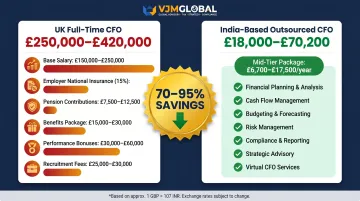
A full-time UK CFO incurs total employment costs of £250,000–£420,000 annually once salary, employer National Insurance at 15% (effective April 2025), pension contributions, benefits, bonuses, and recruitment fees are included. Base salaries alone range from £132,500 to £220,500 depending on business size and sector.
India-based outsourced CFO services, even at comprehensive strategic tiers serving cross-border clients, cost £18,000–£70,200 per year (approximately INR 1,50,000–5,00,000 monthly at the current exchange rate of 1 GBP = 128.2 INR). Mid-tier growth advisory packages typically cost £6,700–£17,500 annually.
Why this is an advantage:
The cost differential lets UK businesses access senior CFO-level expertise at the equivalent cost of a mid-level UK finance manager. The same budget simply buys a higher capability tier.
For a scaling UK SME, redirecting £50,000–£80,000 annually from a full-time CFO hire into product development, sales, or operations can determine whether growth is sustainable or stalls.
KPIs impacted:
- Overhead cost as percentage of revenue
- Finance function cost per £1 million turnover
- Headcount-related fixed costs
- EBITDA margin
When this advantage matters most:
Most impactful for UK businesses under £20 million turnover that need CFO capability but cannot justify the fixed cost. Also relevant for businesses managing seasonal cash flow variation who need flexible financial leadership without permanent commitments.
VJM Global draws on 30+ years of India-specific financial expertise and a track record with 250+ UK businesses to deliver this cost-capability balance without compromising UK compliance standards.
Access to Dual-Jurisdiction Financial Expertise
This advantage is unique to India-based CFO providers and particularly valuable for UK businesses operating across both markets. India-based CFO firms serving UK clients develop expertise in both Indian regulatory compliance (GST, FEMA, Companies Act, RBI regulations) and UK financial frameworks (HMRC, UK GAAP, IFRS, Companies House filings).
How this plays out operationally:
A UK business entering the Indian market or managing an Indian subsidiary typically struggles to maintain two separate finance functions across two jurisdictions. Standard approaches either require hiring two separate advisors — expensive and difficult to coordinate — or relying on UK advisors with limited India knowledge, which creates compliance gaps.
An India-based outsourced CFO handles both within a single engagement, providing:
- HMRC and Companies House filing coordination for UK operations
- GST compliance, FEMA reporting, and RBI approval management for Indian entities
- Transfer pricing documentation for inter-company transactions
- Multi-currency consolidation and repatriation planning
Why this is an advantage:
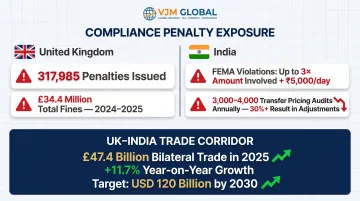
Errors in Indian regulatory filings carry real consequences. FEMA violations can result in penalties up to 3 times the amount involved, with continuing violations adding INR 5,000 per day. India conducts 3,000–4,000 transfer pricing audits annually, with over 30% resulting in adjustments.
On the UK side, Companies House issued 317,985 late filing penalties totalling £34.4 million in 2024-2025, with penalties doubling for consecutive late filings.
With bilateral UK-India trade reaching £47.4 billion in 2025 (up 11.7% year-on-year) and both countries targeting doubling trade to USD 120 billion by 2030, the volume of businesses requiring dual-jurisdiction expertise is expanding rapidly.
KPIs impacted:
- Regulatory penalty exposure
- Compliance error rate
- Time-to-close for cross-border transactions
- Finance advisory cost for dual-jurisdiction operations
When this advantage matters most:
Critical for UK businesses with Indian subsidiaries, joint ventures, or supply chain partnerships. Also highly relevant for UK companies planning India market entry who need compliant financial structuring from day one rather than fixing issues retrospectively.
Strategic Financial Leadership On Demand
Beyond cost and compliance, the third core advantage is strategic access. Outsourced CFO services from India provide UK businesses with senior financial leadership—forecasting, scenario modelling, fundraising preparation, board-level reporting—on a flexible engagement basis rather than as fixed overhead.
Engagement models available:
UK businesses can engage India-based outsourced CFOs through multiple models:
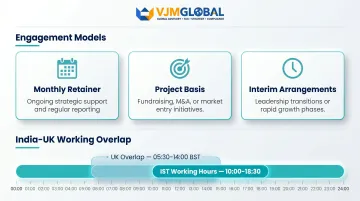
- Monthly retainer for ongoing strategic support and regular reporting
- Project basis for specific initiatives such as fundraising, M&A, or market entry
- Interim arrangements during leadership transitions or rapid growth phases
The India-UK time difference (4.5–5.5 hours) enables synchronous working during UK afternoon hours. An India-based professional working 10:00–18:30 IST covers 5:30–14:00 BST or 4:30–13:00 GMT, allowing for scheduled reviews, live discussions, and real-time collaboration without the operational friction common in other offshore arrangements.
Why this is an advantage:
The practical outcome is strategic decision-making supported by data:
- Cash flow forecasts with forward visibility
- Profitability analysis by product line or market segment
- Investor-ready financial models and due diligence preparation
- Board-level KPI tracking and variance analysis
These are outputs internal bookkeepers cannot produce and that UK SMEs have historically paid premium rates to access via UK advisory firms.
McKinsey's 2024 CFO survey shows 60% of CFOs now cite strategic planning as a top priority — up from 38% in 2023 — yet most SMEs lack the budget to hire this capability full-time.
For fundraising specifically, UK businesses face upfront costs of £7,000–£29,000, with total spend including due diligence reaching £20,000–£60,000. For raises under £250,000, professional costs can consume 9–24% of the total raised. An outsourced CFO from India provides investor-grade financial preparation at a fraction of the cost of UK-based corporate finance advisors.
KPIs impacted:
- Forecast accuracy
- Time to close funding rounds
- Monthly reporting cycle time
- Cash flow visibility (days of forward cover)
- Management decision turnaround time
When this advantage matters most:
Highest impact during rapid growth phases, pre-fundraising preparation, India market entry planning, or when the UK founding team spends excessive time managing financial operations rather than driving the business forward.
What Happens When UK Businesses Operate Without a Dedicated CFO Function
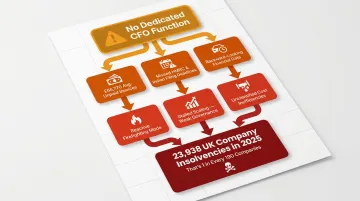
Operating without CFO-level financial leadership does not protect a business from problems — it delays them until they are harder and more expensive to fix. Without structured financial oversight, UK businesses commonly experience:
- Inconsistent cash flow management (UK SMEs are owed an average of £66,770 in unpaid invoices)
- Missed compliance deadlines for both HMRC and, for those with India operations, Indian regulatory filings
- Financial data that is accurate in hindsight but useless for forward decision-making
These gaps compound quickly:
- Reactive firefighting replaces proactive planning
- Scaling stalls because investors and lenders require financial governance the business hasn't built
- Cost inefficiencies go unidentified and unaddressed until they become structural
The UK recorded 23,938 company insolvencies in 2025 — a rate of 52.5 per 10,000 companies, or 1 in 190. Cash flow mismanagement remains a primary driver.
For UK businesses that also operate in India, the risk compounds further. Cross-border compliance failures add an entirely separate layer of exposure. Transfer pricing documentation gaps, FEMA non-compliance, and incorrect GST treatment on inter-company transactions can result in penalties, repatriation restrictions, or operational disruption that far exceeds the cost of CFO oversight.
How to Get the Most Value from India-Based CFO Outsourcing
The value from outsourced CFO services pays off when the engagement is structured with intent:
Run a financial diagnostic first. Map your current reporting, compliance, and governance gaps before defining scope. This prevents the engagement from defaulting into glorified bookkeeping rather than strategic financial leadership.
Hold monthly business reviews. Regular sessions covering actuals vs. forecast, cash position, and compliance deadlines convert CFO services from a cost line into a growth lever — but only if insights are acted on, not just documented.
Give the CFO genuine access. An outsourced CFO works best when included in the right systems, stakeholders, and decision-making conversations. Define clear decision rights upfront — what the CFO recommends vs. what UK leadership approves — to stay in control while enabling real advisory.
Verify dual-jurisdiction capability. For businesses with Indian operations or market entry plans, confirm the provider understands both UK and Indian regulatory frameworks, not just domestic Indian compliance.
Conclusion
CFO outsourcing from India gives UK businesses three structural advantages that compound over time:
- Cost efficiency — the GBP-INR differential delivers 70–95% savings against equivalent UK hires
- Dual-jurisdiction expertise — UK and Indian compliance managed within a single engagement
- Senior financial leadership on demand — previously out of reach for most SME budgets
These advantages translate into measurable outcomes:
- Lower overhead without sacrificing financial oversight
- Faster reporting cycles and investor-ready financials
- Reduced compliance risk across both UK and Indian jurisdictions
- Better-informed strategic decisions at the leadership level
With bilateral UK-India trade growing 11.7% year-on-year and India's talent pool of 425,000 Chartered Accountants expanding by roughly 32,000 annually, the capacity to meet that demand is already there.
CFO outsourcing works best as an ongoing partnership, not a one-time vendor decision. UK businesses that build in regular reviews, clear accountability, and integrated financial leadership extract far more value than those who engage reactively. That capability takes time to build — and the right moment to start is well before the next funding round or compliance deadline demands it.
Frequently Asked Questions
How much do CFO outsourcing services in India cost?
India-based outsourced CFO services range from INR 20,000–5,00,000 monthly (approximately £155–£3,900), with cross-border UK engagements carrying a 30–50% premium. This still represents a 70–95% cost reduction compared to a full-time UK CFO's total employment cost of £250,000–£420,000.
What is the salary of a startup CFO in India?
The average full-time in-house CFO salary in India is INR 63.9 lakhs annually (approximately £49,900), ranging from INR 26.3 lakhs for entry-level to INR 58.9 lakhs for experienced professionals. UK businesses gain access to that cost structure without hiring full-time staff or navigating Indian employment law.
Can an India-based outsourced CFO handle UK regulatory compliance such as HMRC filings and Companies House requirements?
Experienced India-based CFO firms serving UK clients maintain working knowledge of HMRC filings, Companies House submissions, UK GAAP, and IFRS reporting. Reputable providers coordinate directly with the UK business's existing accountants or auditors to ensure consistent compliance across both jurisdictions.
How does the time zone difference between India and the UK affect day-to-day collaboration?
The India-UK time difference is approximately 4.5–5.5 hours (India ahead), allowing meaningful real-time overlap during UK afternoon hours. Most outsourced CFO engagements are structured around scheduled reviews and asynchronous reporting rather than requiring constant live interaction, making the time zone difference operationally manageable.
What types of UK businesses benefit most from outsourcing CFO services to India?
Three business types see the clearest return:
- UK SMEs under £20 million turnover without an in-house CFO
- UK businesses with existing or planned Indian operations needing dual-jurisdiction expertise
- UK startups preparing for funding rounds requiring structured financial reporting
What qualifications do India-based outsourced CFOs typically hold?
India-based CFO professionals typically hold Chartered Accountant (CA) qualifications from ICAI, with many also carrying CPA or CFA credentials. Reputable outsourced CFO firms serving UK clients maintain familiarity with IFRS and UK GAAP reporting standards to ensure compliance with UK financial reporting requirements.