Introduction
Hiring an in-house accountant in the UK now costs between £29,500 and £58,500 for a newly qualified ACA/ACCA professional — and that's before recruitment fees. With 92% of employers reporting skills shortages and the post-Brexit workforce down by roughly 330,000 workers, 45% of accounting firms are struggling to fill roles at all. Recruitment costs are escalating: 55% of finance professionals are actively seeking new positions.
Compliance demands compound the pressure. Making Tax Digital (MTD) for VAT has been mandatory since April 2022, and MTD for Income Tax Self Assessment extends to incomes above £50,000 from April 2026 — creating a significant new workload for SMEs already stretched thin.
Outsourcing accounting to India has become a practical response: access to qualified professionals trained in UK standards, at lower cost, with 24-hour operational capability built in.
Choosing the wrong outsourcing partner exposes UK businesses to compliance failures, data risks, and service disruptions. This guide provides a practical framework to make the right choice.
Key Takeaways
- Outsourcing to India delivers significant cost savings and access to ICAI-qualified professionals trained in UK GAAP and IFRS
- The right partner must demonstrate specific HMRC knowledge, MTD compliance expertise, and UK tax law proficiency — not generic accounting capability
- UK GDPR compliance is non-negotiable: India lacks UK adequacy status, so contracts must include the UK IDTA or Standard Contractual Clauses and a Transfer Risk Assessment
- Native proficiency in Xero, Sage, and QuickBooks UK is essential to avoid migration costs and workflow disruption
- Evaluate credentials, UK-specific client references, security certifications, and formal SLAs before committing
What is Accounting Outsourcing to India?
Accounting outsourcing means delegating finance functions — bookkeeping, payroll, tax preparation, financial reporting — to a specialist firm based in India. For UK SMEs and mid-market companies, it has become a standard way to reduce overhead without compromising professional standards.
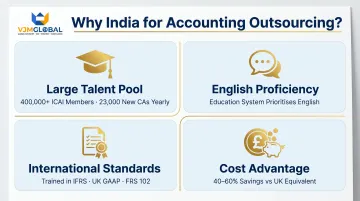
India has become the dominant offshore destination for accounting work — and the reasons are structural, not incidental:
- Large qualified talent pool: ICAI has over 400,000 members and produces roughly 23,000 new Chartered Accountants each year, and holds a direct Mutual Recognition Agreement (MRA) with ICAEW
- English-language proficiency: India's education system prioritises English, eliminating communication barriers
- International standards familiarity: Indian CAs are trained in IFRS, UK GAAP, and FRS 102, with many firms specialising in UK compliance
- Cost advantages: Typical savings range from 40–60% compared to equivalent UK in-house or local accountancy costs, without sacrificing output quality
The scope of outsourcing is flexible. UK businesses can delegate a single function (such as bookkeeping) or a fully managed finance operation. Engagement models range from a named accountant assigned exclusively to your business to shared-service models suitable for lower transaction volumes.
Why UK Businesses Are Choosing India for Accounting Outsourcing
Cost Efficiency Without Quality Compromise
The average UK accountancy professional earns £35,200, with three years post-qualification pushing typical salaries to £45,001–£50,000. Indian outsourcing firms charge a fraction of that — and the numbers make the case clearly:
| Role | UK Annual Salary | India Monthly Rate (USD) |
|---|---|---|
| Staff Accountant | £29,500–£45,000 | $1,200–$2,000/month |
| Senior Accountant | £45,001–£58,500 | $1,800–$3,000/month |
(Indian rates quoted in USD, as is standard in outsourcing contracts; approximate GBP equivalent at current exchange rates.)
For SMEs on tight margins, that gap frees up capital that would otherwise be locked into fixed payroll — money that can fund hiring, marketing, or equipment instead.
Making Tax Digital Compliance Burden
MTD for VAT has been mandatory since April 2022, and MTD for Income Tax Self Assessment follows — mandatory from 6 April 2026 for incomes above £50,000, and from 6 April 2027 for incomes between £30,000–£50,000. That means quarterly digital reporting obligations for tens of thousands of additional UK businesses within two years.
Indian outsourcing firms with UK compliance expertise can handle this evolving workload without the business needing to hire additional domestic specialists. The alternative — recruiting UK-based MTD specialists — compounds the existing talent shortage problem.
Time Zone Advantage for Overnight Turnaround
IST is 5 hours 30 minutes ahead of GMT and 4 hours 30 minutes ahead of BST. Work submitted at the end of the UK business day (5:00 PM GMT) reaches Indian teams at the start of their working day (10:30 PM IST / next morning). Processing occurs overnight, with completed work ready for UK review by 9:00 AM the following morning.
For a busy UK accountant managing month-end close or VAT deadlines, that overnight turnaround means queries answered and files processed before the morning briefing.
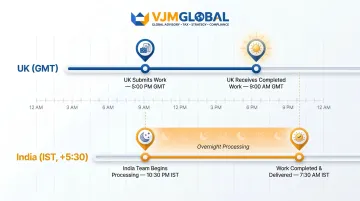
Indian teams starting earlier (6:30 AM IST) can achieve full UK business hours overlap for real-time communication when needed.
Talent Availability Contrast
The UK workforce has reduced by approximately 330,000 workers since Brexit, with 92% of employers reporting finance skills shortages. India tells the opposite story: ICAI currently has 928,557 active students pursuing the CA qualification, producing a continuous pipeline of qualified professionals.
For UK businesses that have spent months trying to fill a single finance role, that pipeline is simply not available domestically — but it is accessible through the right outsourcing partner.
Key Factors to Consider When Choosing an Accounting Outsourcing Partner in India
Not all Indian accounting firms are equally equipped to serve UK businesses. Selection criteria must go beyond cost to include compliance expertise, security standards, technical capability, and service reliability — all of which directly affect financial accuracy and regulatory standing.
UK-Specific Compliance and Tax Knowledge
The partner must demonstrate knowledge of:
- HMRC requirements and Making Tax Digital (MTD) for VAT and ITSA
- VAT filing procedures and quarterly return preparation
- Corporation Tax preparation and payment deadlines
- Self Assessment for individuals and partnerships
- Companies House obligations (annual accounts, confirmation statements)
- FRS 102 application for UK SMEs
Late VAT returns incur penalty points: once quarterly filers reach 4 points, each subsequent late return costs £200. Corporation Tax filing penalties start at £200 for returns just one day late, rising to £1,000 for repeat offences. A partner with genuine UK compliance expertise directly reduces this exposure.
Verification steps:
- Request examples of UK client work, including MTD VAT filings and Corporation Tax returns
- Ask for evidence of team training in UK GAAP, FRS 102, and HMRC procedures
- Check whether staff hold qualifications recognised by ICAEW through the ICAI-ICAEW MRA
Data Security and UK GDPR Compliance
Transferring financial data to an overseas provider requires careful due diligence under UK GDPR. India does not have UK adequacy status, meaning UK businesses must implement appropriate safeguards:
Required mechanisms:
- UK International Data Transfer Agreement (IDTA) or UK Addendum to EU Standard Contractual Clauses
- Transfer Risk Assessment (TRA) confirming the destination country's legal system does not significantly reduce protection standards
Certifications to look for:
- ISO 27001 — confirms the provider manages information security through a certified, audited system (not just internal policy)
- SOC 2 Type II — independent audit verifying that security controls actually worked over a 3–12 month period, not just that they exist on paper
A compliant provider should supply a Data Processing Agreement (DPA) and detail access controls, encryption standards, and breach notification protocols.
Accounting Software Proficiency
UK businesses predominantly use Xero, Sage, QuickBooks UK, and FreeAgent. Xero alone holds 45.11% of UK accounting software market share, with QuickBooks at 17.78% and Sage at 13.19% — and roughly 4.4 million global subscribers place the UK among Xero's three largest markets.
An outsourcing partner must work natively within the platform you already use, not require costly data migration or manual workarounds. Cloud-based platforms like Xero allow real-time visibility: UK business owners can monitor accounts live, making the partner's ability to work directly in these systems a key operational metric.
Ask prospective providers:
- Which UK platforms do you support natively?
- How many team members are certified in each platform?
- Can you demonstrate access and workflow within our existing system?
Professional Qualifications and Institutional Credentials
The team handling UK accounts should include qualified Chartered Accountants certified by ICAI with UK GAAP and IFRS training. ICAI is an IFAC founding member since 1977 and holds Mutual Recognition Agreements with ICAEW, CPA Australia, CA ANZ, and CPA Canada.
Membership in internationally recognised accounting networks — where member firms are held to shared professional standards — adds a useful layer of independent accountability when comparing providers.
Scalability and Engagement Flexibility
UK businesses face seasonal peaks: year-end accounts, VAT quarter ends, Self Assessment deadlines in January. A partner with a large team and flexible engagement models can surge capacity quickly without disrupting service quality.
Engagement model options:
- Dedicated resource model: A named accountant assigned exclusively to your business (suitable for complex operations with high transaction volumes)
- Shared-service model: Cost-effective for lower volumes, with work distributed across a team
- Hybrid arrangements: Dedicated senior oversight with shared execution resources
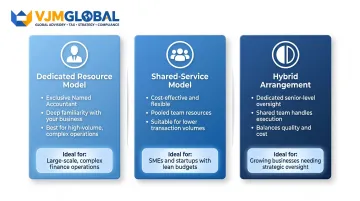
Higher transaction volumes and complex multi-entity structures typically justify the dedicated model; straightforward bookkeeping and VAT-only work suits the shared-service approach.
Communication Standards and Turnaround Commitments
Strong communication is a practical prerequisite, not a soft factor. UK businesses need:
- Defined turnaround times for deliverables (monthly bookkeeping, VAT returns, management accounts)
- Clear escalation paths when issues arise
- Regular reporting schedules aligned to UK decision-making cycles
- English-proficient account managers who understand UK business context and can engage with HMRC or auditors if needed
- Availability during overlapping UK-India business hours for real-time communication
Look for partners who offer a dedicated point of contact and a formal Service Level Agreement (SLA) with KPIs for accuracy and delivery speed. Together, these six criteria form a practical filter — any provider that falls short on compliance knowledge, data security, or communication standards introduces risk that cost savings alone cannot offset.
How to Get Started: Evaluating and Shortlisting a Provider
Vetting an India-based provider from the UK is harder than hiring locally — you can't drop by their office or easily verify claims in person. This four-step process gives you a structured way to assess providers before you commit:
1. Define scope and compliance requirements
- List the specific functions you want to outsource (bookkeeping, payroll, VAT returns, Corporation Tax, year-end accounts)
- Identify your compliance obligations (MTD VAT, MTD ITSA, Companies House filings)
- Note your current accounting software and any integrations required
2. Request proposals and assess UK-specific experience
- Shortlist 3–5 providers based on initial research
- Request detailed proposals including team qualifications, UK client references, and pricing models
- UK references matter here — US or Australian clients won't confirm familiarity with HMRC, MTD, or Companies House obligations, so ask specifically for UK business contacts
3. Run a paid trial engagement
- Before committing to a long-term contract, structure a trial period (one quarter works well)
- Use the trial to assess accuracy, communication responsiveness, and adherence to deadlines
- Actual deliverables will tell you more about their UK knowledge than any sales conversation
4. Establish a formal SLA with defined KPIs
- Document expected turnaround times, accuracy standards, and communication protocols
- Define escalation procedures and accountability mechanisms
- Include provisions for periodic review (at least annually)
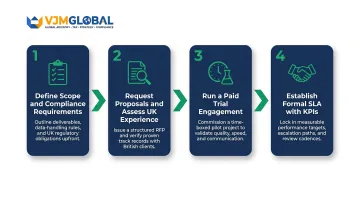
As you work through each stage, watch for these warning signs that a provider may not be the right fit for UK work:
Red flags during evaluation:
- Vague answers about HMRC or MTD knowledge
- Inability to name UK-specific software platforms used
- Absence of GDPR-compliant data handling documentation
- No formal SLA or accountability mechanism
- Reluctance to provide UK client references
How VJM Global Helps UK Businesses Choose the Right Accounting Partner
VJM Global brings 30+ years of experience serving international clients, with a track record of supporting over 250 UK businesses and a 95% client retention rate. That track record reflects a firm built around the specific compliance, reporting, and communication standards UK clients expect.
Key differentiators for UK businesses:
Service scope for UK businesses:
VJM Global covers the full range of functions UK companies commonly outsource, handled by teams already familiar with HMRC requirements and Companies House processes:
- Bookkeeping and transaction processing
- VAT return preparation and filing
- Payroll processing compliant with UK regulations
- Corporation Tax preparation and Companies House filings
- Financial reporting and management accounts
- Business advisory and CFO-level strategic support
Every engagement includes documented data security protocols and confidentiality agreements — so sensitive financial information stays protected from day one.
Conclusion
The right accounting outsourcing partner for a UK business combines UK regulatory knowledge, verifiable security standards, technical compatibility, and reliable communication — with the capacity to scale as your business grows. Size of firm and price point matter far less than fit.
Outsourcing is an ongoing relationship, not a one-time procurement decision. UK businesses should review their arrangement at least annually to assess whether the partner still meets evolving compliance requirements (such as the upcoming MTD for ITSA rollout), technology standards, and business complexity.
The regulatory landscape will keep shifting — MTD deadlines, data protection obligations, reporting formats. Choose a partner who treats compliance as a living commitment, not a checkbox at onboarding.
Frequently Asked Questions
Is outsourcing accounting to India compliant with UK GDPR regulations?
Yes, when appropriate safeguards are in place. UK GDPR permits international data transfers via the UK International Data Transfer Agreement (IDTA) or UK Addendum to EU Standard Contractual Clauses, alongside a mandatory Transfer Risk Assessment. Reputable Indian firms should provide a Data Processing Agreement and hold ISO 27001 certification.
What accounting services can UK businesses outsource to India?
Commonly outsourced functions include bookkeeping, payroll processing, VAT returns, Corporation Tax preparation, year-end accounts, financial reporting, and management accounts. Engagements can cover a single function or a full outsourced finance operation, depending on what the business needs.
How much can UK businesses save by outsourcing accounting to India?
Savings stem from labour cost differentials: Indian staff accountant salaries range from approximately £9,500–£16,000 annually, compared to UK newly qualified professionals earning £29,500–£58,500. Actual savings depend on engagement scope, service complexity, and chosen model.
How do I verify that an Indian firm understands UK tax and HMRC requirements?
Ask for specific examples of UK client work, request evidence of MTD readiness and HMRC compliance processes, and verify whether team members hold qualifications in UK GAAP, FRS 102, or IFRS — including through the ICAI-ICAEW Mutual Recognition Agreement pathway.
Which accounting software should an Indian outsourcing firm be proficient in for UK clients?
The most widely used platforms among UK businesses are Xero, Sage, QuickBooks UK, and FreeAgent. The provider should work natively within the platform you already use, without requiring system migration or manual workarounds.
How long does it take to transition to an outsourced accounting provider in India?
A structured onboarding process — including scope definition, system access setup, workflow documentation, and trial period — typically takes two to four weeks. Full steady-state operations are achievable within the first month when both parties follow a clear implementation plan.