CIPA is Botswana's official registrar for companies and intellectual property. If you're planning to operate there in any real capacity, registering with CIPA is typically the first legal step. This guide walks through the mandatory rules, the actual registration steps, what US applicants need to submit, what it costs, and what you owe every year to stay compliant.
Key Takeaways
- CIPA's Online Business Registration System (OBRS) handles nearly the entire incorporation process remotely.
- US applicants must submit passport copies and appoint a Botswana-resident company secretary within three months.
- CIPA's service standard is a 24-hour turnaround for name reservation and registration, though incomplete paperwork often slows things down.
- Annual returns are due every year in your incorporation month, and missing the deadline by 11 days risks removal from the register.
What Is CIPA and Is Registration Mandatory for US Businesses?
CIPA is a Botswana government parastatal operating under the Ministry of Trade and Industry. Established under the Companies and Intellectual Property Authority Act, Cap. 42:13, it administers the Companies Act, handles company incorporation and name reservation, and monitors post-incorporation filings.
Is CIPA Registration Mandatory?
Registering with CIPA isn't a blanket requirement before any business activity in Botswana. Several nuances matter:
- Incorporation creates legal personality. Under Section 24 of the Companies Act, a registered company becomes a legal person separate from its shareholders, which is required to operate through a Botswana entity.
- Existing foreign companies have a one-month window. An external company (an existing US business setting up a branch presence) must lodge registration documents within one month of starting business in Botswana.
- A bank account alone doesn't trigger the requirement. Botswana law specifically excludes merely holding a bank account from counting as "carrying on business."
- Unregistered transactions aren't automatically void. Failure to register doesn't necessarily invalidate contracts signed by an external company, though it does expose the business to compliance penalties.
In practice, most US founders register a private company (Pty Ltd) rather than an external company branch, since incorporation gives cleaner legal footing and easier banking relationships. Either structure typically requires appointing a Botswana-resident director or secretary.
Either structure typically requires appointing a Botswana-resident director or secretary — a detail that trips up many first-time filers and is worth confirming with a cross-border business setup advisor before submitting documents.
Step-by-Step CIPA Company Registration Process
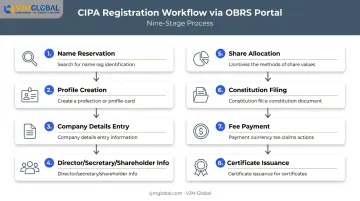
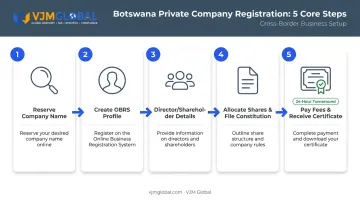
Registration happens entirely through the OBRS portal at cipa.co.bw. For a private company, the current process (per CIPA's April 2025 guide) covers nine stages, bundled into one digital workflow.
Step 1: Reserve Your Company Name
Search CIPA's name database, select your entity type, and submit a name reservation with justification. Once approved, the reservation stays valid for 30 working days, so don't reserve too early if your paperwork isn't ready.
Step 2: Create an OBRS Profile and Enter Company Details
Set up your OBRS account, then enter your company type (private company, external company, etc.), registered office address, postal address, principal place of business, and contact details.
Step 3: Provide Director, Secretary, and Shareholder Details
This step trips up most first-time applicants. You'll need:
- Full details and signed consent forms for every director
- Shareholder information for all owners
- Secretary details, if appointing one at filing (optional now, required within three months of incorporation)
- Declaration of the natural persons who ultimately own or control the company
US business owners handling this remotely often find this step the trickiest, since beneficial ownership declarations follow Botswana-specific rules that differ from US disclosure norms. Getting these details right the first time avoids delays later.
Step 4: Allocate Shares and File Your Constitution
Enter share details and allocate them among shareholders. CIPA also requires filing a constitution document. Review everything carefully here, since mismatched details between this step and your name reservation cause a large share of registration delays.
Step 5: Pay Fees and Receive Your Certificate
This final stage confirms your registration. Complete the declaration and pay your fees through one of three methods:
- Card payment
- CIPA deposit account
- FNB bank deposit
CIPA's published service standard is 24 hours for both name reservation and registration approval. Once approved, your Certificate of Incorporation is issued electronically, with no separate certification needed.
Documents and Requirements US Business Owners Need
US applicants face a slightly different document trail than Botswana citizens, mainly because there's no automated national ID (Omang) check to lean on.
Core documents you'll need:
- Valid US passport copies for every director and shareholder (used for manual non-citizen verification)
- Registered office address, postal address, and principal place of business
- Phone and email contact details for each officer
Why the Company Secretary Requirement Matters
Every company except a close company must appoint a secretary within three months of incorporation. This is often the single biggest hurdle for US founders:
- The secretary must hold a valid practicing certificate
- An individual secretary must be ordinarily resident in Botswana
- If a firm is appointed instead, at least one responsible member or director must be Botswana-resident
- A sole director cannot double as the company secretary under Section 162

If you don't know a licensed Botswana company secretary personally, this becomes the point where most US applicants either stall out or bring in local help, and the same local-knowledge gap tends to surface again with registered addresses and tax filings.
Other Considerations for US Founders
- Local registered agent or office: Even without a physical footprint, you'll need a real Botswana address for registration purposes.
- US tax reporting: Owning a foreign entity doesn't automatically trigger every US filing.
- FBAR (FinCEN Form 114) applies if you have signature authority or financial interest in foreign accounts exceeding $10,000 in aggregate value at any point in the year, per FinCEN's reporting guidance.
- Form 5471 applies only to specific officers, directors, or shareholders meeting ownership or control thresholds, per IRS Form 5471 instructions. Neither triggers automatically just because you own shares.
Given the secretary requirement and manual verification steps, most US founders pair CIPA registration with cross-border advisory support rather than navigating local compliance rules alone. VJM Global works with US businesses on exactly this kind of foreign entry logistics, from document preparation to coordinating local representation.
Costs and Timeline for CIPA Registration
CIPA's published fee schedule dates to 2019, and the current CIPA homepage adds a separate constitution-filing fee on top. Treat these as a starting reference, not gospel: always confirm the live amount at OBRS checkout before paying.
| Service | Online Fee | CIPA-Assisted Fee |
|---|---|---|
| Name reservation | P20 | P60 |
| Private/public company registration | P360 | P900 |
| Close company registration | P360 | P900 |
| Company limited by guarantee | P4,600 | P6,000 |
| External company registration | P4,600 | P6,000 |
| Constitution filing (added since 2019) | P500 | — |
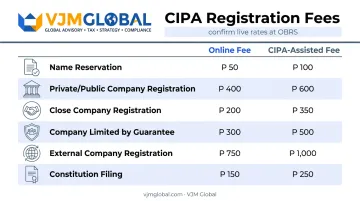
On timelines: CIPA's own 2023/24 annual report confirms a 24-hour service standard for both name reservation and registration, and states it met that standard during the reporting period. There's no verified evidence of a slower track for non-citizen new incorporations. That distinction applies to re-registration filings, not first-time incorporation.
Incomplete documentation — a mismatched name, a missing consent form, an unverified passport copy — causes most delays for first-time foreign applicants, not citizenship status itself. Working with advisors experienced in cross-border filings, such as VJM Global's business setup team, helps catch these gaps before submission and keeps registration on the standard timeline.
CIPA Annual Returns: Fees and Online Filing Guide
Every registered company must file an annual return, active or not. Skipping this is the fastest way to lose your company's good standing.
Filing timeline and consequences:
| Filing Stage | Consequence |
|---|---|
| During incorporation month | P500 (Botswana Pula) annual return fee due |
| Days 1–10 of following month | P500 late penalty added (on top of the original P500 fee) |
| Day 11+ | Company faces removal from the CIPA register |
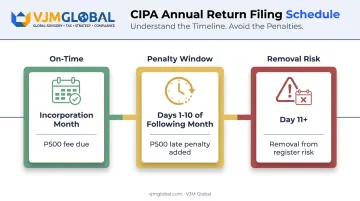
(Figures reflect CIPA's 2021 published FAQ — confirm current amounts in OBRS before paying, as fees can shift.)
How Do I File My CIPA Annual Return Online?
- Log in to OBRS and select "File Annual Return" for your company.
- Update changed details — directors, shareholders, registered address, anything that's shifted since last filing.
- Confirm the declaration attesting the information is accurate.
- Complete payment through the portal's supported methods.
If the "File Annual Return" button isn't visible, locate your company under "Filings and Maintenance" and use "Request Authority" first.
Missing the deadline costs more than a penalty. Prolonged non-filing leads to your company being struck off the register, forcing you to restart through formal restoration procedures.
For US owners managing a Botswana entity remotely, a recurring calendar reminder or a local company secretary can prevent this entirely. Either option costs far less than restoring a struck-off company.
Common Mistakes and When to Get Professional Support
The same handful of errors show up again and again with first-time foreign applicants:
- Incomplete director details — missing consent forms or inconsistent information across sections
- No secretary appointed before the three-month deadline lapses
- Mismatched name reservations — the name entered during full registration doesn't match what was reserved
- Incorrect share allocation — shares don't add up correctly across shareholders
- Missing beneficial ownership declarations — CIPA requires disclosure of who ultimately controls the company
Any one of these can bounce your application back for correction, eating into that 24-hour turnaround CIPA otherwise offers.
For US founders who can't be physically present in Botswana to chase down a licensed secretary or fix a rejected filing, this is usually where professional support pays for itself.
VJM Global has guided over 500 American business owners through cross-border company formation and compliance, coordinating documentation, verifying filings, and liaising with local authorities on their behalf. That same hands-on approach applies whenever US entrepreneurs face an unfamiliar registration system, whether it's CIPA's OBRS platform or another country's regulator.
Having someone on the ground who understands local practicing certificate rules and registration quirks often saves weeks of back-and-forth.
Frequently Asked Questions
Is CIPA registration mandatory?
Incorporation is required if you want your business to operate as a separate legal entity in Botswana. Existing foreign companies must register within one month of starting business there, though simply holding a bank account doesn't trigger this rule.
How do I register with CIPA?
Registration runs through the OBRS portal: reserve your company name, enter company and director details, appoint a secretary and shareholders, allocate shares, file your constitution, and pay the applicable fee.
What is the annual return fee for CIPA?
CIPA's last published figure was P500 (Botswana Pula), with an additional P500 late penalty if filed within the first ten days after the deadline. Confirm current rates directly in OBRS, since fees can change.
How do I file my CIPA annual return online?
Log into OBRS, select your company, update any changed director or address details, confirm the declaration, and submit payment. If the filing button isn't visible, use "Request Authority" under Filings and Maintenance first.
Can a US citizen register and own a company with CIPA?
Yes. US citizens can fully own a Botswana company but must submit passport copies for manual verification and appoint a Botswana-resident company secretary within three months of incorporation.
How long does CIPA company registration take?
CIPA's published service standard is 24 hours for both name reservation and registration approval. Delays typically come from incomplete documentation, not citizenship status, so accurate paperwork matters more than nationality.