This guide is built for US-based founders and tech companies weighing a formal Chennai entity for offshore development, SaaS operations, or a captive delivery center. FEMA, RBI, and MCA compliance aren't optional paperwork here. They determine whether you can open a bank account, pay staff, or send profits home.
Many US founders assume Indian incorporation works like a one-time LLC filing. It doesn't. Below, we cover what registration actually involves, why Chennai fits US IT businesses, the step-by-step process, real costs and timelines for 2026, and the mistakes that trip up first-time filers.
Key Takeaways
- Private Limited Company is the default structure for US-owned IT firms, since most software qualifies for 100% automatic-route FDI
- Chennai's engineering talent and mature GCC ecosystem make it ideal for offshore delivery and SaaS operations
- SPICe+ filing takes 10-20 business days once documents are ready, longer if paperwork needs apostille
- The process runs remotely via Power of Attorney and notarized documents, with no travel to India required
- Some US companies test the market with interim compliance support before committing to a full entity
What Is IT Company Registration in Chennai?
IT company registration in Chennai is the formal process of incorporating a business with the Chennai Registrar of Companies (ROC), under the Ministry of Corporate Affairs, to legally run software development, SaaS, or ITES (IT-enabled services) operations in Tamil Nadu.
Once approved, your entity receives a Certificate of Incorporation, its own PAN (Permanent Account Number), and a legal identity separate from the US parent company. That separation matters. It's what allows the Indian entity to:
- Hire staff under Indian labor law
- Invoice clients directly
- Open a corporate bank account
- Sign contracts and lease office space in its own name
This differs from hiring Indian contractors or using an Employer of Record. An EOR lets you hire without setting up anything, but there's no permanent legal presence. Registration creates that presence, along with every statutory obligation that comes with it.
Common Entity Structures for US-Owned IT Companies
Three structures come up most often for American founders:
- Private Limited Company (Wholly Owned Subsidiary): Allows 100% FDI (Foreign Direct Investment) under the automatic route for most IT and software activities. Preferred by investors and the most common choice by far.
- Limited Liability Partnership (LLP): Lower ongoing compliance burden, but fundraising is harder and FDI rules restrict certain activities.
- Branch or Liaison Office: Narrow scope, requires approval from the Reserve Bank of India (RBI), and isn't built for active service delivery or product sales.
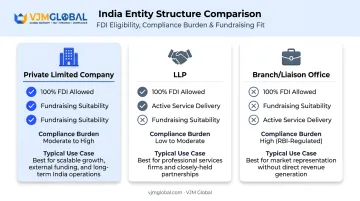
This guide focuses on the Private Limited Company route, since it's the default recommendation for nearly every US-owned IT business entering Chennai.
Why US Businesses Choose Chennai for IT Company Registration
Chennai ranks among India's largest IT and ITES hubs, with parks like Tidel Park, DLF IT Park, and the OMR corridor housing dense clusters of global capability centers. The city had 250+ GCC units employing 150,000+ professionals as of 2024, according to CBRE's research on Chennai's office leasing market.
Why does that matter for a US IT company? A handful of specific pull factors:
- Large pool of engineering and STEM graduates
- Meaningfully lower operating costs than the US
- English-speaking workforce with minimal onboarding friction
- Time-zone overlap that supports extended development coverage
What Goes Wrong Without Formal Registration
Some US companies try to operate informally in Chennai, running payroll through contractors or using a US bank account for local transactions. It rarely holds up.
Without a registered entity, you typically can't:
- Open a local corporate bank account
- Invoice Indian clients directly
- Hire staff compliantly under Indian labor law
- Repatriate profits without FEMA clearance
This isn't a best-practice suggestion. Any US company with continuous business activity or a "permanent establishment" in India is legally required to incorporate under the Companies Act and comply with FEMA. Treating registration as optional creates real regulatory exposure.
Step-by-Step Process to Register an IT Company in Chennai
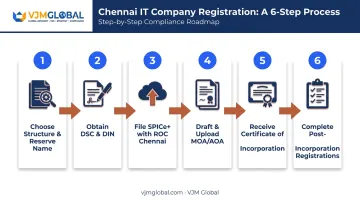
The process moves from choosing a structure and reserving a name, through digital signatures and director IDs, to filing the unified SPICe+ form with ROC Chennai, and finally completing post-incorporation registrations.
Step 1: Choose Business Structure and Reserve Company Name
Founders select an entity type, Private Limited being the standard recommendation, and reserve a unique company name through the MCA's RUN or SPICe+ Part A service. The name gets checked against existing companies and trademarks before approval.
Step 2: Obtain DSC and DIN
Every proposed director, including those based in the US, needs a Digital Signature Certificate to sign forms electronically and a Director Identification Number filed through SPICe+. Foreign nationals must submit notarized and apostilled ID and address proof.
Step 3: File the SPICe+ Incorporation Form with ROC Chennai
SPICe+ is MCA's single-window form that bundles incorporation, PAN, TAN, EPFO, ESIC, and optional GST registration into one filing submitted to the Chennai ROC office.
Step 4: Draft and Upload MOA and AOA
The Memorandum and Articles of Association spell out your company's IT or software business objectives and internal governance structure. Both documents must accompany the SPICe+ filing.
Step 5: Receive the Certificate of Incorporation
Once ROC approves the filing, your company gets its Certificate of Incorporation, along with company PAN and TAN. This is the moment the legal entity formally exists.
Step 6: Complete Post-Incorporation Registrations
Incorporation isn't the finish line. You'll still need to:
- Open a corporate bank account
- Register for GST where applicable
- File FEMA/RBI reports for the FDI received
- Register for EPF and ESI once you start hiring staff
- Register for Professional Tax and a Shops & Establishment license under Tamil Nadu rules
- Apply for STPI registration if the company will operate as a software export unit
Engaging a setup partner familiar with both US and Indian requirements helps avoid delays caused by attestation issues or MCA queries. VJM Global's team of CAs, CPAs, and business-setup professionals has guided hundreds of American businesses through comparable company registrations, from document preparation through post-incorporation compliance.
Documents, Costs, and Timeline for US Businesses
Getting the paperwork right the first time saves weeks. Here's what US directors and shareholders need to prepare.
Identity and address documents from US directors/shareholders:
- Notarized and apostilled passport copy
- Recent overseas address proof (utility bill or bank statement)
- Passport-size photographs
Registered office proof in Chennai:
- Rent agreement or ownership document
- Recent utility bill
- No Objection Certificate from the property owner
A valid Chennai office address is mandatory even if the company is run entirely remotely from the US.
What to Budget For
| Cost Component | What It Covers |
|---|---|
| DSC charges | Per-director digital signature certificates |
| MCA/ROC filing fees | Tied to authorized share capital |
| Tamil Nadu stamp duty | State-level charge on MOA/AOA, verified at filing |
| Professional fees | CA/CS or incorporation consultancy support |
Exact fee slabs shift periodically, so it's worth pulling live figures from MCA's fee calculator or a written quote from your consultant rather than relying on last year's numbers.
Realistic timeline: Most incorporations take 10-20 business days for DSC/DIN issuance, name reservation, and SPICe+ approval once documents are ready. That window stretches when foreign documents need attestation or apostille, or when MCA raises queries on the filing.
Don't stop budgeting at incorporation. Ongoing compliance, annual ROC filings, statutory audits, income tax returns, and transfer pricing documentation for transactions with the US parent add recurring costs well beyond the initial setup fee. Outsourcing these filings to a firm like VJM Global, which handles compliance and audit work for US-owned Indian entities, keeps that cost predictable.
Common Mistakes US Businesses Make
The gap between US and Indian incorporation norms trips up even experienced founders. Here's where things go wrong most often.
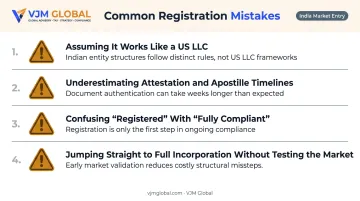
Assuming it works like a US LLC. A single filing with minimal upkeep is not how Indian Private Limited Companies work. They carry mandatory annual ROC filings, statutory audits, and board meeting requirements, regardless of turnover or activity level.
Underestimating attestation timelines. Document apostille and notarization for US-based directors is by far the single biggest cause of registration delays. Start this process early, not after SPICe+ is drafted.
Confusing "registered" with "compliant." Holding a Certificate of Incorporation doesn't mean you're GST-registered, FEMA-compliant, or cleared to hire staff under Indian labor law. Each of those is a separate registration with its own timeline.
Jumping straight to full incorporation. If you're simply testing the Chennai talent market or hiring a small team quickly, full entity setup may not be the right first move. Interim compliance support or advisory services from VJM Global can help you gauge the market before committing to the ongoing overhead of a registered entity.
Frequently Asked Questions
How to register a new IT company in India in 2026?
Choose a business structure (Private Limited is recommended), obtain DSC and DIN, reserve a company name, and file SPICe+ with the relevant ROC. Complete PAN, TAN, and GST registration post-incorporation. The full process takes roughly 10-20 business days.
Can a US company own 100% of an IT company in Chennai?
Yes. Most IT and software activities qualify for 100% FDI under the automatic route, so a wholly owned subsidiary doesn't need prior RBI approval. Standard reporting requirements still apply under India's FDI policy framework.
How long does it take to register an IT company in Chennai from the US?
Typically 10-20 business days once all documents are ready. Add extra time if apostille or notarization of US director documents gets delayed, which is the most common bottleneck.
Is a Private Limited Company or an LLP better for a US-backed IT company in Chennai?
Private Limited Companies suit businesses planning to raise funds or scale their team. LLPs work better for smaller service operations that want simpler ongoing compliance and don't need external investment.
Do I need to travel to India to register my IT company in Chennai?
No. The entire process runs remotely through Power of Attorney and notarized, apostilled documents. Directors sign electronically using their DSC without ever needing to visit India.
What compliance is required after registering an IT company in Chennai?
Expect annual ROC filings, a statutory audit, income tax returns, GST filings where applicable, and FEMA reporting for the foreign investment your company received.