Introduction
Selling to UK customers, hiring UK staff, or opening a London office sounds straightforward until the first GBP payment lands. Many US companies discover their bank's international wire service eats into margins with hidden exchange-rate markups and multi-day delays.
Cross-border payments can cost up to 10 times more than domestic payments, largely because of the processing and FX fees banks charge along the transfer chain, according to the Bank of England.
This guide breaks down the UK payment solutions available to US companies, compares the leading providers, and flags the compliance traps—FCA rules, multi-currency books, and payroll or tax reporting—that often catch American businesses off guard.
Key Takeaways
- Pick among four UK payment paths: traditional bank accounts, EMI multi-currency accounts, payment gateways, and open banking or Direct Debit
- Most US companies can open a UK payment account without a UK entity; tax obligations still follow your level of UK activity
- Prioritise FX markup and settlement speed over "zero fee" marketing claims
- Lock in entity formation and tax registration early to avoid frozen accounts and costly fixes later
Why US Companies Need the Right UK Payment Solution
US businesses rarely plan for UK payment infrastructure from day one. It usually becomes urgent once one of these triggers hits:
- Selling on UK marketplaces like Amazon UK or eBay UK, which pay out in GBP
- Hiring UK-based staff or contractors who expect payment in local currency, on local payroll terms
- Invoicing UK clients who prefer paying a UK sort code rather than wiring USD abroad
- Opening a UK subsidiary to support growing sales or a local team
Each of these creates the same underlying problem: money moving between two currencies, two banking systems, and two regulatory regimes.
The SWIFT Wire Problem
Many US companies default to their existing bank's international wire service. It feels familiar, but it's rarely efficient for ongoing UK business.
Outbound wire fees alone add up. Typical published charges include:
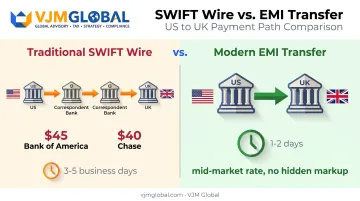
- Bank of America: $45 per international wire sent in USD
- Chase: $40 per online international USD wire
Foreign-currency wires sometimes skip the flat fee, but the bank still applies its own exchange-rate markup instead.
Beyond fees, SWIFT transfers often pass through intermediary banks before they reach a UK beneficiary. Each hop can add delay and its own charge, so funds may take several business days to clear.
That lag is tolerable for a one-off payment. For recurring payroll or supplier invoices, it becomes a real cash-flow drag.
Types of UK Business Payment Solutions Available to US Companies
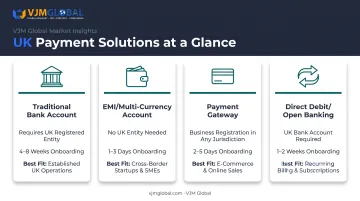
There isn't one single "best" solution. Most growing US-UK businesses end up combining two or more of the following, depending on how they collect revenue and pay suppliers or staff.
Traditional UK Business Bank Accounts
Standard UK bank accounts offer the most complete banking relationship: overdraft facilities, business credit, and FSCS-protected deposits.
The catch is eligibility:
- Barclays' standard Business Current Account requires at least one UK-resident applicant
- HSBC's small business account is positioned for UK tax residents specifically
- Neither publishes a remote-opening path for a standalone US company with no UK-resident applicant
Expect weeks of documentation review, not days, if you go this route without a UK entity already in place.
Multi-Currency Accounts and EMIs
Electronic Money Institutions (EMIs) are regulated by the Financial Conduct Authority to hold and move customer funds, though EMI balances aren't covered by FSCS deposit protection the way bank deposits are.
For US companies, EMIs typically mean:
- Local GBP account details (sort code and account number) without needing UK incorporation
- Faster onboarding than a full banking relationship
- Multi-currency wallets that hold GBP, EUR, and USD side by side
Wise, Airwallex, and Revolut all operate as FCA-authorised EMIs, and their onboarding generally runs in days rather than weeks.
Payment Gateways and Processors
Gateways like Stripe and Adyen let US companies accept card and digital wallet payments from UK shoppers online. They don't replace a bank or EMI account, though. They still need somewhere to settle funds.
Stripe supports payouts in up to 18 currencies for multi-currency settlement, but only if you have a matching bank account for each currency you want to receive. Adyen works the same way, requiring a local bank account in a country where the payout currency is legal tender.
Before assuming your EMI account will work as a settlement destination, confirm the account name, currency, and account type with the processor directly.
Direct Debit and Open Banking
For recurring UK invoicing or subscriptions, account-to-account methods often outperform cards on reliability. That includes Direct Debit and Open Banking pay-ins, which pull funds straight from the customer's bank rather than a card network.
According to GoCardless data spanning 55,000 customers and 52 million transactions, the average UK Direct Debit failure rate is about 2.9%. That lower failure rate matters for subscription businesses in particular, where a failed card payment often means a lost customer, not just a delayed one.
Top UK Payment Providers for US Companies Compared
Here's how the main options stack up on the factors that actually affect your bottom line: FX pricing, GBP account access, and onboarding speed.
| Provider | FX Model | GBP Account Access | Onboarding |
|---|---|---|---|
| Wise Business | Mid-market rate, no markup, separate transaction fee | UK sort code, account number, and IBAN | Document review usually 1-2 working days |
| Airwallex | 0.5% above interbank for GBP | Local details in 20+ currencies | No published US SLA |
| Payoneer | Wholesale rate plus fees; balance conversion 0.50% | GBP/EUR/USD receiving accounts | No published SLA |
| Revolut Business | Not disclosed for US applicants | Requires registered business entity | No published US SLA |
| Barclays / HSBC | Bank-set FX pricing | Requires UK residency or entity | Weeks for non-resident applicants |
Wise Business
Wise uses the mid-market exchange rate with no hidden markup and charges a transparent transaction fee instead. US companies get local GBP, EUR, and USD account details for holding and receiving multiple currencies.
It also connects to Xero and QuickBooks for bank-feed reconciliation, which makes it a strong default for service businesses invoicing UK clients regularly.
Airwallex
Airwallex targets e-commerce and platform businesses that need global accounts plus API access. Its GBP pricing sits at 0.5% above the interbank rate, and it issues local account details in more than 20 currencies. Companies with development resources tend to get the most value here, since Airwallex leans heavily into integrations and embedded finance tools.
Payoneer
Payoneer built its base among freelancers and marketplace sellers, and it shows in the product. It offers GBP, EUR, and USD receiving accounts with direct payout integrations for marketplaces like Amazon. Balance conversion runs at 0.50%, though withdrawal pricing varies between 1.2% and 4% depending on the method.
Revolut Business
Revolut Business appeals to companies wanting fast setup and multi-currency wallets without a heavy application process. It requires a registered business entity in the relevant region, and its US-specific GBP pricing isn't publicly disclosed, so confirm exact costs before committing.
It tends to suit lower transaction volumes better than high-frequency payment flows.
Traditional UK Banks (such as Barclays, HSBC International)
A full UK banking relationship still has advantages: business credit lines, FSCS-protected deposits, and established local credibility. But Barclays requires at least one UK-resident applicant, and HSBC's standard product targets UK tax residents.
If your business already has a UK entity and director in place, HSBC says successful standard applications average 3 business days to open. Without that structure, expect a slower, document-heavy process.
Opening a UK Payment Account as a US Company: Requirements and Compliance Considerations
Documentation requirements vary by provider type, but most follow a similar pattern.
Typical KYC/AML documents include:
- US certificate of incorporation
- Proof of ownership and director identification
- US registered business address
- UK entity paperwork, if you've already incorporated locally
Here's the key distinction: most EMIs allow non-resident US companies to open accounts without a UK entity, while traditional banks usually require UK incorporation or a local director on the application.
Permanent Establishment and Tax Exposure
Opening a payment account doesn't automatically create a UK tax obligation. But ongoing UK activity can. HMRC's fixed-place-of-business test looks for a geographically fixed location with sufficient permanence. A dependent agent acting on your behalf in the UK can also trigger a permanent establishment even without a fixed office.
VAT adds another layer. Non-established businesses making taxable UK supplies do not get the UK-resident registration threshold—registration can be required from the first taxable supply. If you ship goods directly to UK customers, the £135 rule applies to the total consignment value, not each item.
VJM Global's cross-border team often helps US companies decide whether UK entity formation is required for their model. The firm then manages Companies House filings (Confirmation Statement, annual accounts) and HMRC obligations (Corporation Tax registration, UTR, Form CT600) so the payment setup does not create a compliance surprise months later.
Why Applications Get Rejected
Per the FCA's findings on bank account access and closures, providers most often decline, suspend, or close business accounts over inactivity and financial-crime concerns. For non-resident applicants, two issues stand out:
- Incomplete beneficial-ownership documentation
- Mismatched business activity descriptions
Double-check both before you apply.
How to Choose the Right Payment Solution for Your Business
Match the solution to how your business actually makes money, not to whichever provider has the loudest marketing.
By business model:
- E-commerce sellers typically need a payment gateway (Stripe, Adyen) paired with a multi-currency account for settlement
- Service businesses invoicing UK clients usually prioritise a low-fee GBP receiving account like Wise or Payoneer
- Companies with UK payroll need a solution that plays well with PAYE processing, not just customer payments
Beyond that, three things separate a good choice from a costly mistake:
- Compare FX markup, not headline fees. A "free" transfer with a poor exchange rate can cost more than a provider charging a small transparent fee on the mid-market rate.
- Check settlement speed. Some EMIs (electronic money institutions) credit funds same-day; others take longer depending on the currency corridor.
- Confirm accounting integration. Wise and Revolut sync with Xero; Airwallex connects to QuickBooks. Skip that link and you reconcile every transaction by hand.
Frequently Asked Questions
What are the best online payment systems for small businesses in the UK?
Common options include PayPal, Stripe, Square, Wise Business, and Airwallex. The right choice depends on whether you need in-person, online, one-off, or recurring payment collection.
What are the major payment service providers in the UK?
Leading providers include Worldpay and Adyen for enterprise processing, and Stripe and PayPal for online checkout. GoCardless covers Direct Debit collection; Wise and Airwallex handle multi-currency accounts.
Can a US company open a UK business bank account without incorporating in the UK?
Electronic money institutions (EMIs) like Wise, Airwallex, and Revolut generally allow this without UK incorporation. Traditional banks like Barclays and HSBC usually require a UK entity or a UK-resident director on the application.
Do US companies have to pay UK tax on payments received from UK customers?
It depends on whether your activity creates a UK permanent establishment or triggers VAT registration, not on the payment method itself. A cross-border tax advisor such as VJM Global can assess your specific structure.
How long does it take to open a UK payment account as a US company?
EMI accounts often complete document review in 1-2 working days, though full verification can take longer. Traditional bank onboarding for non-residents typically takes several weeks due to enhanced due diligence.
What's the cheapest way for a US company to receive GBP payments?
EMI and multi-currency accounts using mid-market FX rates are generally more cost-effective than traditional bank wires or SWIFT transfers for regular, recurring GBP payments.