Registering the company itself is fast. Companies House lets you file online and get incorporated within a day. The real complexity sits elsewhere: RBI and FEMA overseas investment rules, UK bank account access for a foreign-owned entity, and cross-border tax planning between two jurisdictions.
This guide walks through the legal requirements, the step-by-step registration process, realistic costs, and the India-specific compliance steps most generic UK incorporation guides skip entirely.
Key Takeaways
- A UK Ltd can be 100% owned by an Indian company or individual — no UK-resident director is required.
- Companies House registration completes within 24 hours online.
- Indian founders must separately satisfy RBI's Overseas Investment (OI) Rules before remitting funds.
- Corporation tax runs 19% to 25% depending on profits, while the UK-India DTAA can lower withholding tax on dividends and royalties.
- Opening a UK corporate bank account, not incorporation, is typically the slowest step for Indian-owned entities.
Why Indian Companies Should Incorporate a UK Private Limited Company
A UK Ltd is a separate legal entity under the Companies Act 2006. This matters more than it sounds. It means the company can hold contracts, own property and open bank accounts independently of its Indian parent, and shareholder liability is generally limited to any unpaid amount on their shares.
Compare that to a UK branch or establishment of an Indian company. A branch is legally the same entity as the parent: its liabilities extend straight back to India. A subsidiary, by contrast, ring-fences UK risk within the UK entity. For most Indian founders testing the UK market, that distinction alone settles the decision.
Beyond liability, several commercial factors reinforce the case:
- The UK is a common-law jurisdiction with well-understood contract enforcement, useful for Indian exporters and service firms dealing with UK counterparties.
- A UK-incorporated entity often carries more credibility with UK clients, landlords and banks than a foreign branch.
- The UK-India Double Taxation Convention, in force since 1993 and amended in 2012, reduces friction on cross-border income.
- A UK-India trade agreement has also progressed, though founders should confirm its current status before relying on it for planning.
None of this removes the compliance work on the India side — it just makes the UK end of the transaction more straightforward than most founders expect.
Key Requirements for Indian Companies Setting Up a UK Ltd
Directors and Shareholders
Unlike Singapore or the US, the UK does not require a locally resident director. An Indian founder can be the sole director, run the company entirely from India, and never set foot in the UK. This single fact resolves the most common concern founders raise before they even start the process.
The baseline requirements are simple:
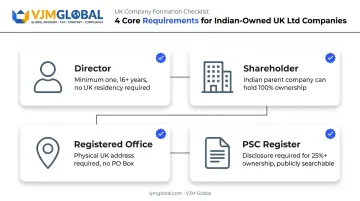
- At least one director, who must be an individual, at least 16 years old, and not disqualified from acting as a director.
- At least one shareholder — this can be the Indian parent company itself, acting as sole corporate shareholder.
- Corporate shareholders need to be recorded with their legal name, registered office, legal form and governing law.
Registered Office and PSC Register
Every UK Ltd needs a physical UK registered office address: an Indian address will not satisfy Companies House. This must be a real address where post can be received and acknowledged; a PO Box alone doesn't qualify. Most Indian-owned companies solve this through a formation agent or virtual office provider, such as VJM Global, rather than leasing UK office space they'll rarely use.
Separately, the People with Significant Control (PSC) register requires disclosure of anyone holding more than 25% of shares or voting rights. If the Indian parent owns the UK subsidiary outright, it must be listed on the PSC register as the controlling entity, and this filing is publicly searchable on Companies House.
Company Secretary and Share Capital
Two areas where UK rules differ noticeably from India's Companies Act:
- A company secretary is optional for a UK private limited company. Indian founders used to mandatory secretarial appointments often find this a relief.
- Share capital can start as low as £1, with no statutory minimum beyond issuing one share, though many founders capitalise higher for banking credibility.
One practical wrinkle: if the Indian parent company is the shareholder, its corporate documents, including the certificate of incorporation and board resolution authorising the investment, often need to be legalised for UK use.
The UK's own legalisation service cannot certify foreign-issued documents, so Indian paperwork must be legalised in India first. Check this requirement with your bank or agent rather than assuming apostille is mandatory in every case.
Step-by-Step: How to Register a UK Ltd from India
1. Choose and check your company name Use the free Companies House name checker to confirm availability and compliance with naming rules: no offensive terms, no implying government affiliation, no near-duplicates of existing companies.
2. Prepare your documents
- Director and shareholder identification
- UK registered office address
- SIC code (the UK's industry classification code)
- Apostilled or notarised Indian corporate documents, if the parent company is the shareholder
3. File online Standard digital incorporation costs £50 as of the 2024–25 fee schedule (rising to £100 from February 2026). Whether you file directly through Companies House or through a formation agent who handles document formatting, applications are usually processed within 24 hours.
4. Receive your Certificate of Incorporation Once issued, along with your company number, you can open bank accounts, sign contracts and begin trading.
5. Complete post-incorporation registrations
- Register for Corporation Tax with HMRC within 3 months of starting to trade.
- Register for VAT once taxable turnover exceeds £90,000 over a rolling 12 months, or is expected to in the next 30 days.
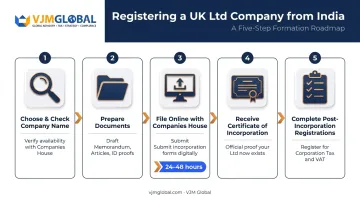
Realistic timeline: incorporation itself often completes in 24–48 hours online. Budget several additional weeks for legalising Indian parent documents.
Founders often underestimate one step: UK corporate bank account approval. This can take weeks for a foreign-owned entity with no UK trading history.
VJM Global's UK company registration and business bank account opening service sequences these steps so the bank application doesn't hold up the rest of the process.
Post-Registration Compliance & India-Specific Tax Considerations
UK-Side Obligations
Once incorporated, ongoing Companies House duties don't stop:
- File a confirmation statement every 12 months, within 14 days of the review period ending.
- Maintain statutory registers (directors, PSC, shareholders).
- Submit annual accounts within 9 months of the financial year end.
On the HMRC side, Corporation Tax is tiered: 19% on profits up to £50,000, 25% above £250,000, with marginal relief tapering the rate in between. These thresholds shrink proportionately if you have associated companies, so a UK subsidiary with sister entities elsewhere should check the adjusted figures.
The RBI/FEMA Angle Most Guides Skip
This is where Indian companies hit friction that a UK-only guide won't mention. Capitalising a UK subsidiary counts as Overseas Direct Investment (ODI) under FEMA's Overseas Investment Rules, notified in 2022. Two filings matter:
- Form FC — filed through your Authorised Dealer bank at the time of remittance, also used to obtain the foreign entity's UIN before initial investment.
- Annual Performance Report (APR) — filed every year, generally by 31 December, based on the UK subsidiary's audited financials.
Skipping either filing triggers a FEMA compliance breach, with its own separate penalty exposure.
Using the DTAA Correctly
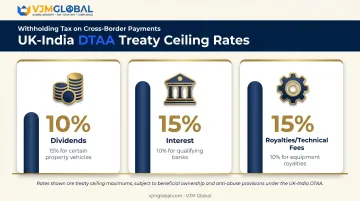
The UK-India DTAA can meaningfully reduce withholding tax when profits flow back:
| Payment Type | Treaty Ceiling |
|---|---|
| Dividends | 10% (15% for certain property vehicles) |
| Interest | 15% (10% for qualifying banks) |
| Royalties/technical fees | 15% standard, 10% for equipment royalties |
These are treaty maximums — actual relief depends on beneficial ownership and where management and control genuinely sit. Get this wrong and you risk creating a UK Permanent Establishment exposure for the Indian parent, which defeats the purpose of ring-fencing liability in the first place.
VJM Global's cross-border tax and compliance teams coordinate UK filings with Indian FEMA/RBI reporting. This keeps the CT600 filing in the UK and the APR filing with the RBI aligned on the same numbers and the same story.
Common Mistakes Indian Companies Should Avoid
Treating Companies House registration as the finish line. It's the easy part. RBI/FEMA overseas investment compliance is a separate, mandatory legal requirement: funds can't be remitted to capitalise the UK company without it, regardless of how quickly incorporation went through.
Leaving the bank account for later. Foreign-owned companies with no UK trading history routinely face extended due diligence. Founders who assume they'll "sort the bank account after incorporation" often lose weeks. Have your documentation and business rationale ready before filing, not after.
Ignoring document legalisation until it's urgent. Indian corporate documents used to evidence the parent shareholder (certificate of incorporation, board resolutions) sometimes need legalising for UK use. Founders who leave this until a bank or Companies House asks for it face avoidable delays on both fronts.
Frequently Asked Questions
Can I have a limited company in the UK and live abroad?
Yes. A UK Ltd has no residency requirement for directors or shareholders. An Indian founder can own and run the company entirely from India, using a UK registered office address for statutory purposes only.
What is a private limited company in the UK?
It's a separate legal entity limited by shares, owned by shareholders whose liability is capped at their shareholding. The company must register with Companies House and file annual accounts and a confirmation statement each year.
Do I need a UK resident director to register a UK Ltd from India?
No. Unlike Singapore, the UK doesn't require a local director. Indian directors can be appointed directly, provided they're at least 16 and not disqualified.
How does RBI approval work for an Indian company investing in a UK subsidiary?
Outward investment falls under FEMA's Overseas Investment Rules. You file Form FC through an Authorised Dealer bank at the time of remittance, then submit Annual Performance Reports each year while the investment is held.
How long does it take to register a UK Ltd company from India?
Companies House registration usually completes within 24–48 hours online. Full operational readiness (including bank account approval and RBI filings) typically takes several additional weeks.
Do I need to travel to the UK to open a company bank account?
Not necessarily. Several digital-first banks allow remote account opening. Traditional banks, however, may request extra verification or documentation for foreign-owned companies with no UK trading history.