
That's a problem, because registration cost in Mumbai isn't one fixed number. It shifts based on your business structure, your authorized capital, how many directors you have, and whether any of those directors are NRIs or foreign nationals.
This guide breaks down the exact government fees, Maharashtra stamp duty, professional charges, and the hidden costs that catch first-time founders off guard. We'll also cover how foreign investors should budget differently than resident Indian founders.
Key Takeaways
- Pvt Ltd registration with modest capital costs a few thousand rupees in fees and professional charges.
- Maharashtra stamp duty, tied to authorized capital, is usually your biggest cost variable.
- CA assistance fees vary by scope but often prevent costly resubmission delays.
- Foreign nationals and NRIs pay extra for apostille, translation, and FEMA/FDI compliance.
Company Registration Cost in Mumbai: Pricing Overview
There's no universal price tag for company registration in Mumbai. Your final bill depends on three things: the structure you pick, the authorized capital you declare, and how many directors or subscribers are on the incorporation form.
Before breaking down exact costs, it helps to flag where founders typically miscalculate. Common budgeting mistakes to avoid:
- Underestimating stamp duty as authorized capital rises
- Forgetting that DSC costs apply per director, not per company
- Treating professional fees and government fees as one lump sum, when they're billed separately
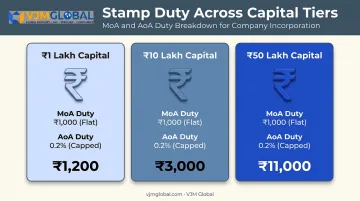
Maharashtra calculates stamp duty on your Memorandum of Association (MoA) and Articles of Association (AoA) using a fixed formula under the Maharashtra Stamp Act's Schedule I. MoA carries a flat ₹1,000 charge when filed alongside AoA, while AoA duty runs 0.2% of authorized capital, capped at ₹50 lakh.
Entry-Level Setup (OPC or Pvt Ltd with ₹1 Lakh Capital)
At ₹1 lakh authorized capital, Maharashtra stamp duty works out to roughly:
| Component | Amount |
|---|---|
| MoA stamp duty | ₹1,000 |
| AoA stamp duty (0.2%) | ₹200 |
| Total stamp duty | ₹1,200 |
Add MCA's SPICe+ filing fee (which the portal calculates based on current rules) plus PAN and TAN, which are bundled into the SPICe+ Part B filing itself. This tier suits solo founders and small startups that don't need heavy capital credibility on day one.
Mid-Range Setup (Pvt Ltd with ₹10 Lakh Capital)
Scale up to ₹10 lakh authorized capital, and stamp duty rises accordingly:
| Component | Amount |
|---|---|
| MoA stamp duty | ₹1,000 |
| AoA stamp duty (0.2%) | ₹2,000 |
| Total stamp duty | ₹3,000 |
This tier fits growing startups that expect to raise seed funding or bring in more shareholders soon. Founders often pick ₹10 lakh as a middle ground, enough capital to look credible to investors without overpaying stamp duty upfront.
High-Capital Setup (₹50 Lakh+ or Multi-Director Companies)
At ₹50 lakh authorized capital, the math changes:
| Component | Amount |
|---|---|
| MoA stamp duty | ₹1,000 |
| AoA stamp duty (0.2%, capped) | ₹10,000 |
| Total stamp duty | ₹11,000 |
Beyond ₹50 lakh, AoA duty stays capped, but the MCA registration fee itself becomes a bigger driver as capital climbs further. This tier suits subsidiaries of foreign parent companies or businesses that need higher capital credibility to attract institutional partners.
Key Factors That Affect the Cost of Company Registration in Mumbai
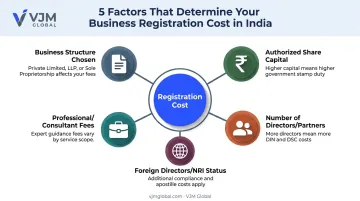
Mumbai-specific costs come down to five levers: which structure you choose, how much capital you declare, how many people sign the incorporation documents, whether any directors or shareholders are based overseas, and whether you need professional support.
Business Structure Chosen
Not all structures cost the same to register:
- Private Limited Company – Higher stamp duty and compliance burden, but easiest to raise funding for
- LLP – Generally cheaper on stamp duty side since it follows contribution-linked fee rules rather than capital-linked MoA/AoA duty
- OPC – Similar filing route to Pvt Ltd but simpler shareholder structure
- Partnership Firm – Registered through Maharashtra's Registrar of Firms, not MCA's SPICe+ system, so it isn't directly comparable in cost terms
Despite the higher upfront cost, Pvt Ltd remains the preferred structure for founders planning to raise institutional capital.
Authorized Share Capital
This is the single biggest cost variable. Maharashtra stamp duty on your MoA/AoA rises proportionally with authorized capital, capped once you cross the 0.2% threshold on ₹50 lakh. Declare more capital than you need at incorporation, and you'll pay stamp duty on capital you might not use for years.
Number of Directors or Partners
Every director needs a separate Digital Signature Certificate to sign incorporation documents electronically. MCA requires all first subscribers and directors to register as Business Users specifically to affix their DSCs. Add three directors instead of one, and you're paying for three DSCs, not one.
Foreign Directors or Shareholders (NRI/OCI Angle)
Foreign nationals bring costs domestic founders never encounter:
- Notarization and apostille of identity and address documents (or consular authentication, depending on the signer's home country)
- Translation charges if original documents aren't in English
- FDI reporting compliance — when an Indian company issues equity to a person resident outside India, the RBI requires an FC-GPR filing within 30 days of issue
These aren't optional extras. Skip them, and you risk compliance defects that delay your incorporation certificate.
Professional/Consultant Fees
CA, CS, and legal professional fees vary widely based on the firm's reputation, whether you want basic filing or end-to-end support, and how fast you need turnaround. A firm handling just the paperwork charges differently than one managing your entire entry strategy, capital structuring, and FEMA compliance together.
Complete Cost Breakdown for Company Registration in Mumbai
Total registration cost includes several components, some one-time, some recurring. Here's how they stack up:
| Component | Type | Notes |
|---|---|---|
| Digital Signature Certificate | One-time, per director | Required for every director/subscriber to sign electronically |
| Name reservation (SPICe+ Part A) | One-time | Optional but recommended; nominal MCA fee |
| Stamp duty (MoA/AoA) | One-time | Maharashtra-specific, scales with capital (see tables above) |
| PAN & TAN | One-time | Bundled into SPICe+ Part B filing |
| Professional/consultant fees | One-time | Varies by scope of service |
| Post-registration compliance | Recurring, annual | ROC filings, statutory audit, professional tax |
Professional fees vary by scope, but transparency matters here. VJM Global, for example, lists government fees and professional charges as separate line items, so founders can see exactly what they're paying for and why.
Beyond these one-time setup costs, post-registration compliance adds ongoing expenses worth planning for. Maharashtra requires companies to register for Professional Tax, with the official schedule setting the annual company amount at ₹2,500.
Statutory audit fees add another layer, since Section 139 of the Companies Act requires every company to appoint an auditor regardless of turnover. Annual ROC filings like AOC-4 and MGT-7 carry their own capital-linked fees on top of this. Budget for these as ongoing costs, not one-time setup expenses.
DIY vs Professional Company Registration – Which Saves More?
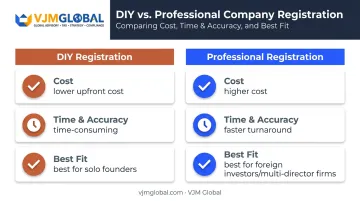
Founders often ask whether filing directly through the MCA portal beats hiring a consultant. The honest answer: it depends on your complexity.
Cost
- DIY: Lower upfront cost, but rejected filings cost time. MCA allows only one resubmission for Part A and two for Part B before you're stuck refiling from scratch.
- Professional: Slightly higher cost, but bundled service typically reduces error-related back-and-forth.
Time & Accuracy
- DIY: Time-consuming if you're unfamiliar with SPICe+ Part A/B nuances, MoA/AoA drafting, or Maharashtra's stamp duty payment interface.
- Professional: Faster turnaround from someone who already knows the portal's quirks, especially valuable for NRIs or foreign founders working across time zones.
Best Fit
- DIY works for solo Indian resident founders with simple, low-capital structures and no foreign shareholding.
- Professional support pays off for foreign investors, multi-director companies, or anyone needing FEMA/FDI compliance alongside incorporation.
Firms like VJM Global, with three decades of India market experience, coordinate DSC issuance, incorporation, and FEMA reporting under one point of contact, replacing the need to juggle separate vendors.
How to Reduce Company Registration Costs in Mumbai (& Mistakes to Avoid)
Smart budgeting comes down to a few disciplined choices:
- Keep authorized capital reasonable at incorporation. You can always raise it later through a Form SH-7 filing once you actually need the additional capital, rather than paying stamp duty on unused headroom now.
- File accurately the first time. Resubmissions cost time even when they don't add extra government fees, and delays compound fast for founders on a launch timeline.
- Don't over-hire for simple setups. A single-director OPC with straightforward capital doesn't need premium end-to-end advisory; standard filing support usually suffices.
- Budget for recurring compliance. Annual ROC filings, statutory audits, and Maharashtra Professional Tax aren't one-time costs; they recur every year, and ignoring them at the planning stage creates budget shortfalls later.
Mumbai company registration cost varies by structure and capital, but it's not unpredictable once you understand each fee component. Pairing that awareness with experienced professional support, like VJM Global's FEMA and cross-border compliance expertise, keeps the process smooth and free of unpleasant surprises.
Frequently Asked Questions
How much would it cost to register a company in India?
Costs combine MCA (Ministry of Corporate Affairs) government fees, Maharashtra stamp duty (which scales with capital), DSC charges per director, and professional fees. The exact total varies by structure and state, so check current MCA and state stamp duty schedules before budgeting.
What is the cheapest way to register a company in India?
Keep authorized capital minimal, file directly through the MCA SPICe+ portal, and choose a simpler structure like an OPC (One Person Company) or LLP. These choices reduce both stamp duty and professional service scope.
How long does it take to register a company in Mumbai?
Name reservation typically takes a few working days for approval, followed by DSC preparation and document filing. Total timeline depends on documentation completeness and current ROC (Registrar of Companies) processing speed, so treat any fixed estimate cautiously.
What is the minimum capital required to start a company in Mumbai?
There's no mandatory minimum paid-up capital requirement under the Companies Act, 2013, following the 2015 amendment that removed this threshold. You can start with whatever capital suits your business plan.
Is a Digital Signature Certificate (DSC) mandatory for company registration?
Yes. MCA requires every director and first subscriber to register as a Business User specifically to affix their DSC on incorporation documents filed through SPICe+.
Can NRIs or foreign nationals register a company in Mumbai?
Yes, subject to FEMA (Foreign Exchange Management Act) and FDI compliance requirements, including RBI's FC-GPR (Foreign Currency-Gross Provisional Return) reporting when equity is issued to a nonresident. Specialized support, like VJM Global's foreign business setup services, helps navigate document authentication and regulatory filing smoothly.