Introduction
With bilateral trade between the UK and India reaching £47.2 billion in Q2 2025, the opportunity for UK investors is hard to ignore. The UK ranks as the 6th largest investor in India, with cumulative FDI of US$36.13 billion. The IMF projects India's real GDP growth at 6.5% for FY26 — confirming its place among the world's fastest-growing major economies.
What catches many UK investors off guard is how different the registration cost structure is compared to forming a company at home. Government MCA fees are modest on their own, but professional services, FEMA compliance, apostille requirements, and state-level variations add layers that require careful planning.
This guide breaks down every cost component, structure option, and budget consideration specific to UK investors entering the Indian market.
Key Takeaways
- Typical WOS registration costs range from ₹25,000–₹80,000+ (roughly £230–£740+), depending on professional scope and capital level
- Government fees (DSC, DIN, MCA filing) are modest; the bigger variables are FEMA compliance, apostille costs, and professional advisory fees
- UK investors face added costs: apostille/notarisation of UK documents, FC-GPR filings, and resident director services
- Entity structure choice (WOS vs. Branch vs. LLP) directly impacts registration cost and ongoing compliance spend
- Annual compliance costs for UK-owned entities exceed domestic equivalents due to transfer pricing and cross-border reporting
How Much Does It Cost to Register a Company in India?
There's no single fixed registration fee—costs vary by entity type, authorised capital, number of directors, state of registration, and promoter residency status. For UK investors specifically, the total is typically higher than for domestic founders due to foreign-investor compliance requirements.
The most common mistake UK investors make is budgeting only for MCA government fees (which are low) and missing professional, notarisation, FEMA, and compliance layers that can double or triple the total outlay.
Wholly Owned Subsidiary (Private Limited Company — Most Common for UK Investors)
Estimated cost range: ₹25,000–₹80,000+ (roughly £230–£740+)
This range typically includes:
- Digital Signature Certificates (DSC) for directors
- Director Identification Numbers (DIN)
- MCA incorporation filing fees
- Stamp duty on MOA/AOA
- Professional drafting and filing services
What's typically excluded:
- UK apostille costs for identity/address documents (£35–£45 per document)
- GST registration (if applicable)
- FEMA/RBI post-incorporation filings (Form FC-GPR)
- Bank account opening advisory
- Transfer pricing setup for cross-border transactions
The WOS route allows 100% FDI under the Automatic Route in most sectors, making it the preferred route for UK investors who want full operational control without shared ownership. Firms like VJM Global, which has supported 250+ UK businesses entering India, typically handle WOS registration as part of a broader package covering FEMA structuring, tax planning, and ongoing compliance — which matters because these steps are interconnected, not sequential.
Limited Liability Partnership (LLP)
Estimated cost range: ₹15,000–₹40,000 (roughly £140–£370)
LLPs offer lower ongoing compliance costs than a Pvt Ltd company and can be an attractive option for professional services firms or partnerships. However, there's a critical constraint: LLPs require at least one designated partner who is a resident of India.
For UK-based founders without an Indian resident partner, this means either:
- Appointing a local partner (adding complexity and shared control)
- Hiring a resident nominee director service (adding ₹30,000–₹80,000 annually)
Beyond the residency requirement, the MCA fees themselves are relatively modest: ₹500 to ₹5,000 based on contribution amount, plus ₹200 for name reservation (RUN-LLP).
Branch Office or Liaison Office
Estimated cost range: ₹50,000–₹1,50,000+ (roughly £460–£1,390+)
Branch and Liaison Offices require RBI approval under the Government Route, adding significant timeline and professional fee overhead. Key factors shaping costs and timelines for this route:
- Regulatory framework: Governed by FEMA 22(R)/2016-RB and Master Direction No. 10
- Approval timeline: Typically 45 days through the Authorised Dealer bank route
- Government fees: No direct RBI application fee, but professional advisory costs are substantial
- Permitted activities: Limited to market research, liaison activities, or project-specific work — not full commercial operations
If the goal is to generate revenue in India, a WOS is almost always more cost-effective despite the higher initial setup cost.
Key Factors That Affect Registration Costs for UK Investors
Unlike registering a UK limited company—a largely online, low-cost process—India company registration for foreign investors involves multiple cost layers driven by regulatory, state-level, and capital structure variables. Unlike registering a UK limited company—a largely online, low-cost process—India company registration for foreign investors involves multiple cost layers driven by regulatory, state-level, and capital structure variables. Four variables drive the bulk of those costs: authorised share capital, director residency, state of incorporation, and FDI sector classification.
Authorised Share Capital
MCA incorporation fees and stamp duty both scale with authorised share capital. Higher capital means higher government fees.
MCA fee structure:
- Up to ₹15 lakh authorised capital: NIL incorporation fee
- Above ₹15 lakh: Fees increase progressively based on capital slabs
UK investors should start with a capital level appropriate to actual business needs rather than inflating it unnecessarily. For example:
- ₹10 lakh (roughly £9,250) is sufficient for most service businesses or small operations
- ₹25–50 lakh may be appropriate for manufacturing or capital-intensive ventures
- Higher capital levels trigger higher stamp duty and can complicate future restructuring
Number of Directors and Residency Status
Each director requires:
- Digital Signature Certificate (DSC): ₹3,814 for a 2-year Class 3 signing certificate for foreign nationals
- Director Identification Number (DIN): Free via SPICe+ form (up to 3 directors)
Additionally, UK directors must apostille and notarise identity/address documents from the UK. UK apostille costs:
- FCDO standard apostille service: £45 per document
- Next-day service: £40
- E-apostille: £35
With 2 UK directors needing passport, proof of address, and potentially additional documents apostilled, this adds £140–£180 in UK-side costs alone—an expense domestic Indian promoters never face.
State of Registered Office
Stamp duty on MOA and AOA varies significantly by state:
| State | MOA Stamp Duty | AOA Stamp Duty | Notes |
|---|---|---|---|
| Maharashtra | ₹200 per ₹5 lakh capital | ₹1,000 per ₹5 lakh capital | Higher for large capital bases |
| Karnataka | ₹5,000 flat | ₹5,000 flat | Fixed rate since 2023 amendment |
| Delhi | ₹200 | 0.15% of capital | More favourable for higher capital |
For a WOS with ₹25 lakh authorised capital:
- Maharashtra: Approximately ₹1,000 (MOA) + ₹5,000 (AOA) = ₹6,000
- Karnataka: ₹5,000 + ₹5,000 = ₹10,000
- Delhi: ₹200 + ₹3,750 = ₹3,950
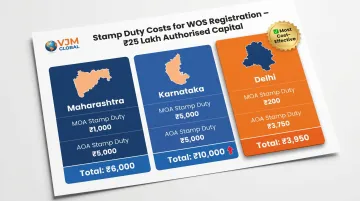
Where you headquarter your Indian operations directly affects stamp duty. Chennai, Bangalore, and NCR (Delhi/Noida/Gurgaon) each follow different structures, so the incorporation state is worth factoring into your total cost estimate early.
FDI Sector and Route (Automatic vs. Government Approval)
Most sectors allow 100% FDI under the Automatic Route, meaning no government approval is needed beyond standard MCA registration. This keeps costs low and timelines predictable (typically 7–14 days).
Sectors requiring Government Route approval include:
- Defence (up to certain thresholds)
- Broadcasting and media
- Insurance (with 74% FDI cap)
- Civil aviation (for scheduled air transport)
These restricted sectors add significant legal advisory costs: typically ₹50,000–₹2,00,000+ for application preparation, regulatory liaison, and approval follow-up. That alone can double or triple total setup costs and push timelines to 3–6 months.
Complete Cost Breakdown: Every Fee UK Investors Should Account For
The total cost of setting up an Indian company as a UK investor goes well beyond the MCA portal fees. Here's a structured breakdown across three categories.
Government and Statutory Fees
| Item | Cost (₹) | Notes |
|---|---|---|
| DSC (per director, foreign) | ₹3,814 | 2-year Class 3 signing certificate |
| DIN (up to 3 directors) | FREE | Via SPICe+ form; additional DINs ₹500 each |
| Name Reservation (RUN) | ₹1,000 | Reserve unique company name |
| MCA Incorporation Filing | NIL (up to ₹15L capital) | Slabs apply above ₹15 lakh authorised capital |
| PAN (company) | ₹1,011–₹1,017 | For foreign applicants (physical card) |
| TAN (company) | ₹77 | Tax deduction account number |
| Stamp Duty (MOA/AOA) | ₹3,950–₹10,000+ | State-specific; see table above |
Total government fees (2 directors, ₹10 lakh capital, Delhi): Approximately ₹12,000–₹15,000
Professional and Advisory Fees
Professional fees cover drafting of MOA/AOA, SPICe+ filing, FEMA/RBI compliance advisory, and post-incorporation filings (INC-20A, ADT-1). Fees vary widely by firm quality and scope.
| Tier | Typical Range | What's Included |
|---|---|---|
| Budget-oriented firms | ₹5,000–₹15,000 | Basic MCA filing only; FEMA and post-incorporation support not included |
| Full-service specialists | ₹25,000–₹60,000+ | FEMA structuring, FC-GPR advisory, tax planning, post-incorporation filings, bank account opening support |
Budget firms often require separate FEMA consultants and CAs — costs that add up quickly. Full-service firms cover the complete setup in a single engagement, which reduces coordination overhead for UK investors unfamiliar with India's regulatory requirements.
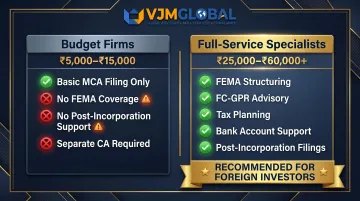
VJM Global has supported 250+ UK businesses through India incorporation, handling FEMA compliance, accounting setup, and tax registration under one roof. That structure means one point of contact from company formation through to live operations.
UK-Specific Additional Costs
| Item | Cost | Notes |
|---|---|---|
| FCDO Apostille (per document) | £35–£45 | Passport copy + proof of address required per director/shareholder |
| Apostille total (2 UK directors) | £140–£180 (~₹15,000–₹19,000) | 2 documents per person |
| FEMA / Form FC-GPR filing | ₹5,000–₹15,000 (professional fee) | No government fee; must be filed within 30 days of capital receipt via FIRMS portal |
| Resident Director Service | ₹30,000–₹80,000/year | Required if no India-based director; needed for banking, compliance sign-offs, and statutory meetings |
| Bank Account Opening Advisory | ₹5,000–₹15,000 | Banks require extensive KYC for foreign-owned entities; professional support reduces rejection rates |
Ongoing Costs and What UK Investors Frequently Miss
Registration is a one-time cost. The ongoing annual compliance burden for a UK-owned Pvt Ltd, however, runs significantly higher than most investors expect — particularly because cross-border ownership adds regulatory layers that purely domestic companies never face. Underestimating annual costs is the most consistent mistake UK investors make.
Annual Statutory Compliance Costs
Typical annual costs for a small-to-mid-size UK-owned Pvt Ltd:
- Statutory audit: ₹35,000–₹50,000+ (ICAI recommended minimums for small companies)
- ROC annual filings (MGT-7, AOC-4): ₹5,000–₹10,000 professional fees
- Income tax return filing: ₹10,000–₹20,000
- GST return filing (if registered): ₹15,000–₹30,000 annually
- DIR-3 KYC (annual director KYC): ₹500 per director + professional support
Total annual compliance (excluding GST): Approximately ₹55,000–₹90,000 (£510–£835)
These costs compound quickly when transfer pricing obligations are added — which apply to virtually every UK company transacting with its Indian subsidiary.
Transfer Pricing and Cross-Border Compliance
UK investors transacting with their Indian subsidiary—inter-company invoicing, loans, royalties, management fees—trigger India's transfer pricing regulations under the Income Tax Act.
Transfer pricing compliance requirements:
- Annual transfer pricing study and benchmarking
- Form 3CEB certification by a Chartered Accountant
- Filing deadline: November 30 following the financial year
- Threshold: Transactions exceeding ₹1 crore
- Penalty for non-compliance: ₹1,00,000
Typical transfer pricing compliance fees: ₹40,000–₹1,50,000+ depending on transaction complexity and number of cross-border arrangements.
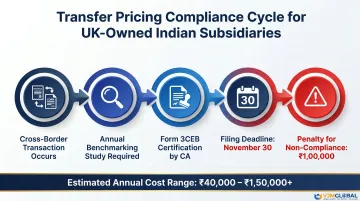
Purely domestic companies face none of these obligations — transfer pricing is an exclusively cross-border cost that catches many first-time UK investors off guard.
Costs of Getting the Structure Wrong from Day One
Choosing the wrong entity creates restructuring costs later. For example:
- Registering a Branch Office when a WOS was more appropriate requires winding down the Branch and re-registering as a WOS (total cost: ₹1,00,000–₹2,50,000+)
- Registering in a high-stamp-duty state without operational reason wastes ₹5,000–₹15,000 unnecessarily
- Inflating authorised capital beyond business needs triggers higher fees and complicates future capital restructuring
The lowest registration quote today can mean ₹2,00,000+ in avoidable restructuring costs within three years. Structure decisions made at incorporation are far harder to unwind than they appear.
How to Plan Your India Company Setup Budget
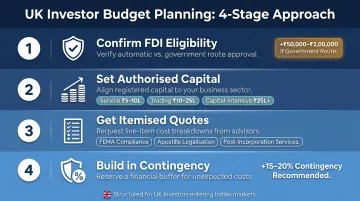
Step-by-step budgeting approach:
Confirm FDI eligibility before committing to a structure
- Verify your sector qualifies for 100% FDI under the Automatic Route
- Budget an extra ₹50,000–₹2,00,000 if Government Route approval is required
Set authorised capital based on your actual operational plan
- Service businesses: ₹5–10 lakh
- Trading/light manufacturing: ₹10–25 lakh
- Capital-intensive operations: ₹25 lakh+
Get itemised quotes that explicitly include:
- FEMA/RBI compliance and Form FC-GPR filing
- Apostille coordination or support
- Post-incorporation filings (INC-20A, ADT-1, bank account opening)
- Not just MCA filing fees
Build in contingency
- Add 15–20% for state-specific variations, document revisions, and unforeseen requirements
Why integrated advisory matters:
UK investors get the best value from a firm that combines CA, CS, and legal capabilities under one roof. Splitting work across multiple advisors typically leads to:
- Duplicated fees for coordination and document review
- Missed handoffs between FEMA, MCA, and tax compliance stages
- Compliance gaps that surface only after incorporation
VJM Global has helped 250+ UK businesses set up in India, covering company formation, FEMA compliance, accounting, and tax support from a single team. This avoids the cost of managing separate advisors at each stage.
Frequently Asked Questions
How much does it cost to register a company in India?
Total costs range from ₹25,000–₹80,000+ (£230–£740+) for a Pvt Ltd WOS, ₹15,000–₹40,000 for an LLP, and ₹50,000–₹1,50,000+ for Branch/Liaison Offices. For UK investors, the total is typically higher than for domestic founders due to FEMA compliance, apostille requirements, and professional advisory costs.
How much does it cost to register a private limited (Pvt Ltd) company in India?
For UK investors, expect ₹25,000–₹80,000+ all-in, including government fees (DSC, DIN, stamp duty), professional drafting and MCA filing, and basic FEMA advisory. Main variables are authorised capital level, state of registration, and number of directors. UK apostille costs add another £140–£180.
How much does it cost to register an LLP in India?
LLP registration costs ₹15,000–₹40,000. While LLPs are cheaper to register and maintain than Pvt Ltd companies, they require at least one resident Indian designated partner. UK-only founders must either appoint a local partner or hire a nominee service (adding ₹30,000–₹80,000 annually).
What are the annual costs to maintain a Pvt Ltd company in India?
Annual costs for a UK-owned Pvt Ltd typically cover: statutory audit (₹35,000–₹50,000), ROC filings (₹5,000–₹10,000), income tax return (₹10,000–₹20,000), GST compliance (₹15,000–₹30,000 if applicable), and transfer pricing documentation (₹40,000–₹1,50,000).
Total: approximately ₹1,00,000–₹2,50,000+ (£920–£2,300+) per year.
Can I register a company in India for free?
No. While the MCA government portal has simplified some processes and reduced fees for low-capital companies, core costs—DSC, stamp duty, professional certification, FEMA compliance—cannot be avoided. For UK investors, there is no free registration path.
What are the key steps to register a Pvt Ltd company in India?
The core steps are:
- Obtain DSC and DIN for all directors
- Reserve your company name via SPICe+ (RUN) and file MOA, AOA with MCA
- Receive Certificate of Incorporation, then complete post-incorporation steps: INC-20A declaration, bank account opening, and FEMA Form FC-GPR filing
Each step carries government and professional fees — see the cost breakdown sections above for specifics.