Registration costs for a Pvt Ltd company vary widely. Authorized capital, the state you incorporate in, how many directors and shareholders you have, and whether you go DIY or hire professionals all move the number. US businesses also face costs that resident Indian founders simply don't — document apostille, notarization, and RBI reporting among them.
This guide breaks down government fees, professional fees, hidden and recurring costs, and the compliance expenses unique to US founders. By the end, you'll know how to budget realistically instead of guessing.
Key Takeaways
- A US-owned Pvt Ltd company's realistic first-year cost typically lands between $800 and $6,000, depending on setup complexity
- MCA government fees are usually the smallest line item; professional and compliance costs make up most of the bill
- US founders pay extra for apostille/notarization and mandatory RBI reporting (FC-GPR) that Indian founders never encounter
- DIY registration rarely works for foreign shareholders because of KYC, digital signature, and FDI compliance hurdles
- Budget for recurring annual compliance, not just the one-time incorporation fee
How Much Does It Cost to Register a Private Limited Company in India?
There's no single price tag for Pvt Ltd registration. The final cost depends on your authorized capital slab, the stamp duty rules in your chosen state, how many subscribers sign the incorporation documents, and which service provider you use.
US businesses tend to misjudge cost in three specific ways:
- Underbudgeting for professional fees while fixating on the government filing charge
- Missing state-specific stamp duty, which can shift the total by tens of thousands of rupees
- Forgetting recurring annual costs entirely, then getting surprised by them a year later
Typical Cost Ranges
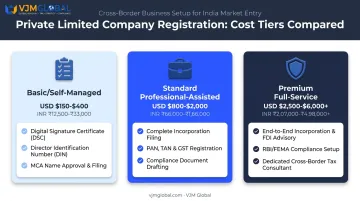
Basic/self-managed setup — Using the MCA online portal with minimal authorized capital, this route runs roughly $150 to $400 (about INR 12,000–35,000) for pure government and DSC charges. This route rarely fits US founders, since almost all deal with foreign-document requirements — apostilled certificates, notarized IDs — that self-service portals aren't built to handle.
Standard professional-assisted setup — The most common path for US-owned subsidiaries, and the tier most VJM Global clients choose. Expect $800 to $2,000 (about INR 65,000–1,65,000), covering CA/CS fees, MOA/AOA drafting, stamp duty, and GST registration.
Premium/full-service setup — For companies needing FC-GPR/RBI filing support, apostille handling, and a first-year compliance retainer, budgets typically run $2,500 to $6,000 or more (about INR 2,05,000–4,90,000+).
What Each Tier Actually Includes
| Tier | Included Services | Best For |
|---|---|---|
| Basic | MCA name reservation (RUN), SPICe+ filing, DSC for directors, PAN/TAN | Very small pilot entities with minimal India operations |
| Standard | Above + CA/CS fees, MOA/AOA drafting, state stamp duty, GST registration | Most US SMEs setting up a wholly-owned subsidiary |
| Premium | Above + FC-GPR/RBI filing, apostille handling, virtual/registered office, first-year compliance retainer | Larger US companies running a full operational subsidiary |
Key Factors That Affect the Registration Cost
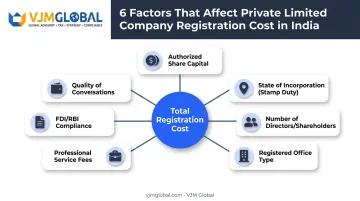
Pricing swings on structural, geographic, and compliance variables baked into Indian company law. Here's what actually moves the needle.
Authorized Share Capital
The MCA fee schedule and state stamp duty both scale with the authorized capital you declare at incorporation. Under the statutory Table I structure, fees start at INR 5,000 for capital up to INR 1,00,000, then add incremental charges as capital rises. Declaring a higher authorized capital than you need inflates cost without adding operational benefit, a common rookie mistake.
State of Incorporation (Stamp Duty Variation)
Stamp duty on your MOA/AOA differs sharply by state:
- Maharashtra: AOA duty is 0.2% of share capital, capped at INR 50,00,000
- Karnataka: INR 1,000 for every INR 10,00,000 (or part) of share capital, also capped at INR 50,00,000
- Other states: Rates and caps vary further, so confirm the current stamp duty schedule before finalizing your registered office location
Choosing your registered office state purely for convenience without checking stamp duty rules can cost you unexpectedly.
Number of Directors, Shareholders & Foreign Nationals
Every director needs a Digital Signature Certificate and a Director Identification Number. For foreign nationals, documents require notarization or apostille before submission under Rule 13(5) of the Companies (Incorporation) Rules. More foreign directors means more per-person authentication costs stacking up.
Registered Office Requirement
US companies without an Indian physical presence commonly use a virtual/registered office service rather than leasing space. Virtual office arrangements cost a fraction of a leased commercial address and satisfy the statutory registered office requirement just as well for early-stage entities.
Professional Service Fees (CA/CS/Legal)
Fees climb with complexity. Foreign shareholding structures, cross-border document verification, and FDI compliance all demand more specialized (and pricier) professional support than a standard domestic incorporation would.
FDI and RBI Compliance Requirements
Any company receiving foreign investment must file Form FC-GPR with the RBI. This is where budgets often go sideways for first-time US founders who don't build the filing cost into their initial plan.
Special Costs & Compliance Considerations for US Businesses
US entrepreneurs face registration steps that domestic Indian founders never deal with. That makes cost planning different for this segment.
Document Apostille & Notarization
US-issued documents, including passport copies, board resolutions, and powers of attorney, must be apostilled under the Hague Convention before Indian authorities accept them. Costs and lead times stack up quickly:
- Federal apostilles through the US Department of State cost USD 20 per document, with mail processing taking up to five weeks
- State-level apostilles for state-issued documents carry separate fees and timelines
- Costs multiply per document and per director, so multi-founder filings need extra budget and time built in
RBI Reporting for Foreign Direct Investment
Once your company receives foreign share capital, FC-GPR must be filed within 30 days of the equity issuance. Miss that window, and the Late Submission Fee is calculated as INR 7,500 plus a percentage of the delayed amount. That penalty can easily dwarf whatever professional fee you were trying to save.
Structure Choice Impact
A wholly-owned subsidiary (100% foreign-held capital) is administratively simpler than a joint venture, which involves multiple shareholders and often more complex shareholder agreements. JV structures generally carry higher legal drafting costs upfront.
Time Zone & Coordination Costs
US founders typically need a local representative or Power of Attorney holder in India to sign documents and liaise with the Registrar of Companies in real time. That coordination role adds to professional fees but saves weeks of back-and-forth across a 10-13 hour time difference.
Navigating these overlapping requirements is where local expertise pays off.
VJM Global's team of CPAs, Chartered Accountants, and US-compliant professionals works specifically with this segment, guiding US businesses through entry strategy, FDI compliance, and company formation in minimum turnaround time. That experience reduces the foreign-specific errors that inflate costs down the line.
DIY vs Professional-Assisted Registration — What's the Difference?
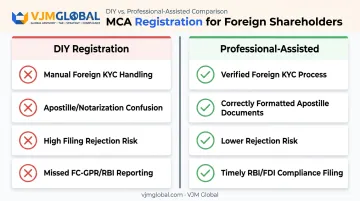
Self-filing through the MCA portal works reasonably well for resident Indian founders. For foreign shareholders, the process gets complicated fast: foreign KYC documents, notarization formats, and apostille requirements trip up first-timers constantly, leading to rejected filings and resubmissions that eat weeks.
DIY setups also frequently miss FDI and RBI reporting obligations entirely. That's the costliest mistake on this list: a missed FC-GPR filing can trigger penalties that far exceed any professional fee you thought you were saving.
An experienced compliance partner, such as VJM Global, handles these filings correctly from the start.
Common Budgeting Mistakes to Avoid
- Fixating only on the MCA registration fee and ignoring professional and compliance costs, which usually make up the bulk of the bill
- Ignoring annual ROC and audit costs that continue every year after incorporation
- Underestimating apostille turnaround time and cost, especially when multiple directors need multiple documents authenticated
Conclusion
Private Limited Company registration cost in India isn't fixed — it moves with your authorized capital, your incorporation state, and whether US-specific compliance like FDI reporting and document apostille applies to you. The government fee is rarely the number that matters most.
Understanding the full cost picture, not just the MCA filing fee, is what separates a smooth India market entry from a budget blowout six months in. VJM Global helps US businesses plan for these costs upfront.
Frequently Asked Questions
How much does it cost to register a Private Limited Company in India as a US business?
Combined government and professional fees typically range from $800 to $6,000 for the first year, depending on authorized capital, state stamp duty, and whether FDI/RBI compliance support is included.
What government fees are involved in Private Limited Company registration in India?
Government fees include MCA/SPICe+ filing charges, DSC and DIN costs for each director, and state stamp duty on your MOA/AOA. These vary by authorized capital and incorporation state.
Do US citizens or companies need special approvals to register a company in India?
Most sectors fall under the automatic FDI route, meaning no prior government approval is needed. However, RBI reporting through FC-GPR remains mandatory once foreign capital is received.
How long does it take to register a Private Limited Company in India from the US?
Incorporation itself typically takes 2-4 weeks once documents are ready. Apostille processing for US-issued documents can add several additional weeks, depending on which state or federal authority handles it.
Are there ongoing/annual costs after registering a Private Limited Company in India?
Yes. Annual costs include ROC filings (AOC-4 and MGT-7), a mandatory statutory audit, and income tax return filing (ITR-6). These recur every year regardless of incorporation cost.
Can a US company own 100% of a Private Limited Company in India?
Yes, 100% foreign ownership is permitted in most sectors under the automatic route. It still requires RBI reporting compliance through FC-GPR once shares are issued.