Introduction
Singapore is already India's second-largest FDI source country, with cumulative equity inflows of USD 155.61 billion between January 2000 and December 2023 — 23.33% of India's total FDI. Bilateral trade reached USD 35.45 billion in FY 2024-25.
That momentum makes sense: India's economy is growing at 6.2% annually, making it the world's fastest-growing major economy.
Yet many Singapore businesses underestimate the true cost of Indian market entry. Unlike Singapore's streamlined incorporation system, India layers government fees, state-specific stamp duty, foreign-entity compliance requirements, and professional charges into a complex cost structure. The registration process covers FEMA reporting, apostille requirements, transfer pricing obligations, and mandatory local director compliance — well beyond a simple form submission.
This guide covers every cost component Singapore businesses will encounter: entry structure options and their financial implications, one-time registration expenses, and the ongoing compliance burden that typically exceeds initial setup costs within two years.
Key Takeaways
- Total registration cost for a Singapore-owned subsidiary ranges from ₹25,000–₹60,000 depending on state stamp duty, authorised capital, and foreign-director documentation
- Singapore businesses face costs domestic founders avoid: apostille/notarisation fees (S$10.70–S$87.20 per document) and FCGPR penalties (₹7,500+) for missing the 30-day filing window
- Transfer pricing compliance is mandatory from year one—not an optional add-on
- Annual compliance costs exceed registration fees: ROC filings, statutory audit, tax returns, FEMA reporting, and Form 3CEB add up every year
- Structure matters: Liaison Offices can't generate revenue, LLPs require government approval for FDI in most sectors, and Private Limited Companies offer the clearest path under automatic FDI route
How Much Does It Cost to Register a Company in India as a Singapore Business?
Registration cost isn't a flat fee. It varies based on legal structure, state of incorporation, authorised capital, and the compliance layer that applies to all foreign-owned entities. Singapore founders often receive a low quote covering only certificate filing—excluding FEMA filings, DSC for foreign directors, stamp duty, and apostille costs. The total climbs fast once those layers are added.
What commonly goes wrong: A ₹15,000 quote seems competitive until you discover it excludes several line items: FCGPR filing (₹7,500 penalty if late), stamp duty (₹520–₹2,300 by state), DSC for each director, apostille of Singapore corporate documents, and first-year transfer pricing certification.
Wholly Owned Subsidiary (Private Limited Company)
The most common structure for Singapore businesses entering India. It allows 100% foreign ownership under the automatic FDI route in most sectors: IT/software, consulting, manufacturing, and e-commerce all qualify without prior government approval. Full operational freedom, immediate revenue generation, and strong investor credibility make this the default choice.
Realistic total cost range: ₹25,000–₹60,000+ for a foreign-owned Private Limited Company, depending on state and authorised capital.
Government and filing fees covered:
- SPICe+ filing (₹0 for authorised capital up to ₹15 lakh)
- Name reservation (RUN) fee (₹1,000)
- DIN allocation for up to 3 directors
- PAN and TAN application
- MOA/AOA e-filing
- State stamp duty (₹520–₹2,300+ depending on state)
- DSC for each director
- Professional fees for documentation
Costs quoted separately (common surprises):
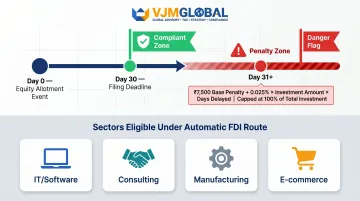
- FCGPR filing post-allotment (must be filed within 30 days; ₹7,500+ penalty for delays)
- GST registration (if business is GST-liable)
- Bank account setup
- Apostille and notarisation of Singapore corporate documents
- Nominee director fees (if no Indian resident director available)
Best for: Singapore businesses committing to the Indian market long-term, those seeking full control and scalability, and companies planning to raise investment from Indian or global investors.
LLP (Limited Liability Partnership)
FDI into LLPs requires government approval in most cases. Only sectors with 100% FDI under automatic route AND no performance conditions qualify for automatic LLP investment. This narrows your options significantly compared to Private Limited Companies.
Registration cost: ₹2,000–₹5,000 government fees (FiLLiP form) depending on contribution amount, plus professional fees.
The catch: Government approval adds 45+ days to setup time and requires AD bank processing or RBI clearance. For most Singapore businesses, a Private Limited Company avoids this entirely — no RBI approval, no wait.
Ideal for: Service-oriented businesses with an Indian designated partner already in place, or professional services firms. Not suited for Singapore businesses wanting 100% ownership without regulatory delays.
Branch Office / Liaison Office / Project Office
These are RBI-regulated structures requiring prior RBI approval before registration. Expect approximately 45 days via Authorised Dealer bank route for Singapore entities in non-sensitive sectors.
Key differences:
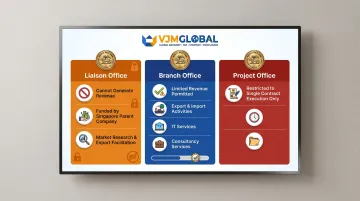
- Liaison Office: Cannot generate revenue. Used only for market research, promoting parent company exports/imports, or facilitating technical collaborations. The Singapore parent must fund all expenses via inward remittances.
- Branch Office: Can conduct limited business activities: export/import, professional/consultancy services, IT services, research. Revenue generation permitted within defined scope.
- Project Office: Limited to executing a specific contract or project only.
Setup cost: RBI charges no processing fee; AD banks charge their own fees (typically ₹5,000–₹15,000 professional charges).
Who should consider this: Singapore businesses exploring India before full commitment (Liaison Office) or executing a specific contract (Project Office). Upfront costs are lower, but operational restrictions frequently lead to expensive restructuring once the business scales.
Key Factors That Affect Registration Costs for Singapore Businesses
Beyond standard cost drivers that apply to all Indian registrations, Singapore businesses face additional variables tied to their foreign-entity status.
Authorised Share Capital
MCA government incorporation fees and state stamp duty are both calculated on authorised share capital in slabs:
| Authorised Capital | SPICe+ Fee | e-MOA Fee | e-AOA Fee |
|---|---|---|---|
| Up to ₹15,00,000 | NIL | NIL | NIL |
| ₹15,00,001–₹25,00,000 | ₹2,000 + ₹200/₹10,000 exceeding ₹15L | ₹2,000 | ₹2,000 |
| ₹25,00,001–₹50,00,000 | ₹2,000 + ₹200/₹10,000 exceeding ₹15L | ₹2,000 | ₹5,000 |
| ₹50,00,001–₹1,00,00,000 | ₹1,56,000 + ₹100/₹10,000 exceeding ₹50L | ₹2,000 | ₹10,000 |
Foreign-owned subsidiaries are typically advised to start with higher authorised capital (₹10 lakh+) to accommodate future equity rounds. This increases upfront stamp duty but avoids costly SH-7 filings later when you need to increase capital for growth.
State of Incorporation
State stamp duty is the single most variable cost in Indian registration. It ranges from under ₹600 to over ₹2,300 on identical ₹10 lakh authorised capital:
| State | Stamp Duty (₹10L Capital) | Rate Structure |
|---|---|---|
| Tamil Nadu | ₹520 | MOA: ₹200 flat; AOA: ₹300 flat |
| Delhi NCR | ₹1,710 | MOA: ₹200; AOA: 0.15% of capital (max ₹25L) |
| Telangana | ₹2,020 | MOA: ₹500; AOA: 0.15% of capital |
| Karnataka | ₹2,020 | MOA: ₹1,000; AOA: ₹500/₹10L |
| Maharashtra | ₹2,300 | MOA: ₹200; AOA: ₹1,000/₹5L (max ₹50L) |
Your operational base typically dictates state choice, but if you have flexibility, stamp duty becomes a meaningful variable. Tamil Nadu's flat ₹520 saves ₹1,500+ compared to Karnataka or Maharashtra.
Foreign Director and Document Requirements
Each director requires a DSC. Foreign directors (Singapore nationals) must provide apostilled and notarised identity and address proof before MCA filing.
Apostille costs in Singapore (Singapore Academy of Law):
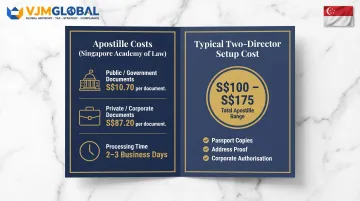
- Public documents (government-issued): S$10.70 per document
- Private/corporate documents: S$87.20 per document (includes notarisation)
- Processing time: 2–3 business days
For a typical two-director setup (one Singapore national, one Indian resident), expect apostille costs of approximately S$100–S$175 for passport copies, address proof, and corporate authorisation documents.
Indian resident director requirement: Section 149(3) of the Companies Act, 2013 mandates at least one director who has stayed in India for 182+ days in the previous calendar year. If your Singapore team has no local presence, you'll need a nominee director—professional fees typically range from ₹25,000–₹60,000 annually depending on scope.
FEMA and FDI Compliance Layer
Singapore-owned entities must file FC-GPR (Form FC-GPR) within 30 days of equity allotment to report FDI with the Reserve Bank of India—this applies to every equity allotment, regardless of amount.
Penalty for late filing (revised April 2025):
- Late Submission Fee: ₹7,500 + 0.025% of the amount involved × number of days delayed (capped at 100% of investment)
- Available only within 3 years of due date
Most sectors Singapore businesses commonly target—IT/software, consulting, manufacturing, and e-commerce—qualify for 100% FDI under the automatic route, meaning no prior government approval is required.
One point worth confirming before you file: Press Note 3 of 2020, which requires government approval for investments from countries sharing a land border with India, does not apply to Singapore. Singapore-origin investments continue under the automatic route for all eligible sectors.
Full Cost Breakdown: One-Time and Ongoing Costs
The total cost of establishing an Indian presence goes beyond the incorporation certificate. It includes both one-time setup investment and recurring annual compliance obligations you must budget from day one.
One-Time Registration Costs
Government fees (non-negotiable):
- Name reservation (RUN): ₹1,000
- SPICe+ incorporation fee: ₹0 (for authorised capital up to ₹15 lakh)
- PAN application: ₹91 (Indian address) or ₹862 (foreign address)
- TAN application: ₹77
For a typical ₹1 lakh–₹10 lakh authorised capital bracket, total government fees are under ₹2,000.
State stamp duty (variable):
- Tamil Nadu: ₹520
- Delhi NCR: ₹1,710
- Karnataka/Telangana: ₹2,020
- Maharashtra: ₹2,300
This is often the most underestimated cost—the difference between states can be ₹1,500+ on identical authorised capital.
Foreign-entity-specific costs:
- Apostille and notarisation of Singapore documents: S$100–S$175 (approximately ₹6,000–₹10,500)
- International courier: ₹2,000–₹4,000
- FCGPR filing professional fee: ₹5,000–₹15,000
- Nominee director (if needed): ₹25,000–₹60,000 annually
Professional fees: CA/CS fees for MOA/AOA drafting, SPICe+ filing, and FEMA compliance documentation are higher for foreign-company registrations than domestic due to complexity. Market range: ₹15,000–₹35,000 for a qualified firm with foreign-company experience.
VJM Global handles this full scope for Singapore businesses — from SPICe+ filing and FEMA documentation to post-incorporation compliance — under a single engagement, so registration, tax, and RBI reporting are coordinated from the start.
Ongoing Annual Compliance Costs
Statutory and tax compliance:
- Statutory audit: Mandatory for all Private Limited Companies regardless of turnover—no exemption based on size
- Annual ROC filings: MGT-7 (Annual Return) and AOC-4 (Financial Statements) filed within 60/30 days of AGM
- Income tax return and TDS filings
- Combined annual cost: ₹25,000–₹60,000 for a foreign-owned company with minimal transactions
Transfer pricing compliance (Section 92E): Form 3CEB certification from a Chartered Accountant is mandatory for all international transactions with associated enterprises, regardless of transaction value. Filing deadline: October 31 annually. Penalty for non-filing: ₹1,00,000.
Any transaction between your Indian subsidiary and Singapore parent triggers this requirement — management fees, software licences, intercompany loans, and shared services all qualify. This catches many Singapore businesses off-guard, particularly in the first year of operations.
Annual cost for basic transfer pricing documentation: ₹30,000–₹75,000 depending on transaction complexity.
FEMA/RBI reporting:
- FLA Return (Foreign Liabilities & Assets): Due July 15 annually via FLAIR portal — mandatory for every Indian company that has received FDI, even after the foreign investor exits
- Annual Activity Certificate: Due September 30 for Branch/Liaison/Project Offices
Professional fee for preparing and filing these returns: ₹10,000–₹25,000 annually.
Estimated total first-year compliance cost: ₹65,000–₹1,60,000+ for a typical foreign-owned subsidiary with standard intercompany transactions.
How to Budget for India Market Entry—and Mistakes to Avoid
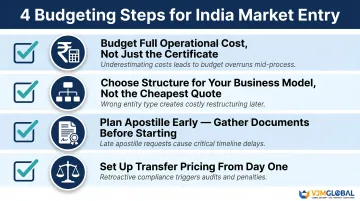
Most cost surprises in India market entry come from the same four planning gaps. Here's what Singapore founders consistently get wrong — and how to avoid them.
Budget for the full operational cost, not just the certificate. Registration fees are only one line item. A realistic budget covers incorporation fees, FEMA filings, nominee director (if needed), apostille costs, GST registration, and year-one compliance. That's your true "cost to be operational."
Choose structure for your business model, not the cheapest quote. A Liaison Office saves ₹10,000–₹15,000 upfront but cannot generate revenue — meaning you'll spend ₹50,000+ converting to a subsidiary within 12 months. An LLP introduces FDI approval complications that add 45+ days and carry rejection risk. The wrong structure costs far more to fix than to avoid.
Plan apostille early. Singapore's apostille process is fast (2–3 business days) and affordable (S$10.70–S$87.20 per document), but it catches many founders off guard. Gather passport copies, address proof, and corporate authorisation documents before you start — and budget S$150–S$200 for complete apostille coverage.
Set up transfer pricing from day one. Even routine intercompany arrangements — a management fee from your Singapore parent or a software licence to the Indian entity — trigger mandatory transfer pricing documentation and Form 3CEB filing. Build arm's length pricing policies in your first financial year to avoid ₹1,00,000 penalties and audit adjustments later.
Conclusion
Registering a company in India as a Singapore business involves more complexity than domestic incorporation. Structure choice, authorised capital, state selection, FEMA compliance, and foreign-director documentation all affect total cost — and annual compliance obligations represent a substantial ongoing commitment that typically exceeds registration costs within two years.
The right cost isn't the lowest initial quote — it's one that covers everything correctly from day one. Getting this right means addressing four priorities before you sign anything:
- Choose the correct structure (subsidiary vs. branch vs. LLP) for your Singapore entity's ownership pattern
- Confirm full FEMA compliance, including advance remittance filings and FC-GPR reporting
- Build a transfer pricing documentation framework before transactions begin
- Work with advisors experienced in RBI filings, FDI regulations, and Singapore-India cross-border compliance
Request a cost estimate that covers both registration and first-year compliance together. Advisors who quote only registration fees often leave the harder — and more expensive — compliance work unaddressed.
Frequently Asked Questions
What is the total cost of registering a company in India?
For a Private Limited Company, total realistic cost ranges from ₹25,000–₹60,000+ including government fees, stamp duty, and professional charges. For Singapore (foreign) businesses, expect the higher end due to FEMA compliance, apostille requirements, and transfer pricing setup—expect a range rather than a flat fee.
How much does it cost to start and maintain a private limited (Pvt Ltd) company in India?
Ongoing annual compliance—covering audit, ROC filings, tax returns, FEMA reporting, and transfer pricing—runs ₹65,000–₹1,60,000+ per year. For foreign-owned entities, annual maintenance costs typically exceed the one-time registration fee within the first two years.
What is the cost of LLC registration in India?
India has no LLC structure. The nearest equivalent is either an LLP or a Private Limited Company, but LLP FDI requires government approval in most cases. Private Limited Company is the practical choice for Singapore businesses; LLP government registration fees run approximately ₹2,000–₹5,000 plus professional charges.
How much does it cost to register a software company in India?
Software/IT companies register as Private Limited Companies and fall under the automatic FDI route (100% permitted), with total registration costs of ₹25,000–₹60,000. For companies billing their Singapore parent for development services, Form 3CEB transfer pricing compliance is mandatory. Budget ₹30,000–₹75,000 annually for that filing.
Is it mandatory to register a company in India?
Yes—Singapore businesses generating revenue, employing people, or owning assets in India must have a registered legal presence. Operating without registration creates significant legal and tax risk. A Liaison Office is permissible for limited non-revenue activities (market research, export/import facilitation) but still requires RBI approval before commencing operations.