That code is India's Company Registration Number, officially called the Corporate Identification Number (CIN). It's issued by India's Ministry of Corporate Affairs (MCA) the moment a company incorporates, and it shows up everywhere in Indian corporate paperwork.
Many US business owners have no idea what this string means or why it should matter to them. This guide breaks down the CIN format piece by piece, explains why it's relevant if you're doing business with Indian companies (or building one yourself), and shows you how to verify one in minutes.
Key Takeaways
- CIN is a 21-character code revealing a company's listing status, industry, state, and incorporation year
- Verify Indian vendors or partners for free via the MCA's public Find CIN portal before signing contracts
- Only companies get a CIN; LLPs receive an LLPIN, sole proprietorships get neither
- Skipping the CIN on filings triggers a ₹1,000-per-day penalty under the Companies Act, capped at ₹1,00,000
- Indian subsidiaries or branch offices set up by US firms receive their own CIN, required on every contract and filing
What Is a Company Registration Number (CIN) in India?
A CIN is the unique 21-character alphanumeric identifier that India's Registrar of Companies (ROC) assigns to a business the moment it completes incorporation. It's issued under the Ministry of Corporate Affairs and printed directly on the Certificate of Incorporation, the founding legal document for any Indian company.
Here's where terminology trips up a lot of US readers. Globally, the generic term for a business registration number is "Company Registration Number" or CRN. India uses this global concept but gives it a specific, structured name: CIN. So if an Indian counterparty mentions their "CRN," they almost certainly mean their CIN.
A CIN works like a US EIN, but carries more built-in detail. An EIN identifies a business to the IRS for tax purposes. A CIN identifies a business to the corporate registry and encodes structural facts about the company itself. One is a flat tax ID; the other is a compressed corporate profile.
Not every Indian business entity gets one. Here's the breakdown:
- Receive a CIN: Private limited companies, public limited companies, One Person Companies (OPCs), and Section 8 (nonprofit) companies
- Do not receive a CIN: LLPs (they get a separate LLPIN instead), and sole proprietorships, which aren't incorporated as separate legal entities at all
Skipping the CIN isn't a minor paperwork slip. Under Section 12 of the Companies Act, 2013, companies must display their CIN on business letters, invoices, notices, and other official communications. Failing to comply carries a penalty of ₹1,000 for every day of default, capped at ₹1,00,000, charged to both the company and any officer responsible.
Decoding the 21-Character CIN Format
The CIN follows a fixed structure, where every character block reveals something specific about the company. For a US business running due diligence on an Indian vendor, that's genuinely useful. You can confirm a company's age, location, and legal status without waiting for anyone to email you a document.
The Six Components of an Indian CIN
| Position | Length | What It Tells You |
|---|---|---|
| 1st character | 1 letter | L (listed on a stock exchange) or U (unlisted) |
| 2nd–6th characters | 5 digits | Industry or business activity code |
| 7th–8th characters | 2 letters | State code where the company is registered |
| 9th–12th characters | 4 digits | Year of incorporation |
| 13th–15th characters | 3 letters | Company type (PLC, PTC, OPC, NPL, FTC, SGC) |
| 16th–21st characters | 6 digits | Unique ROC registration serial number |
A quick note on those company-type codes:
- PLC: Public limited company
- PTC: Private limited company
- OPC: One Person Company
- NPL: Section 8 nonprofit
- FTC: Private company that's a subsidiary of a foreign company
- SGC: State government company
Example Walkthrough
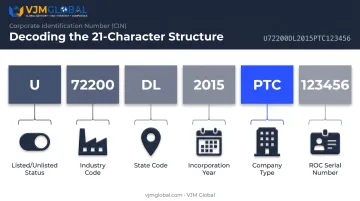
Take the sample CIN U72200DL2015PTC123456 and break it down:
- U: Unlisted company
- 72200: Industry/activity code (IT and software-related activity, in this case)
- DL: Registered in Delhi
- 2015: Incorporated in 2015
- PTC: Private limited company
- 123456: ROC's unique serial number for this registration
Once you know the pattern, you can decode any Indian company's CIN in under a minute, no lookup required. That's a fast first-pass check before you dig deeper.
Why the CIN Format Matters for US Businesses
For US companies doing business with India, decoding a CIN works as a practical due diligence tool you can use before money changes hands.
Before signing a contract or wiring a deposit, you can decode a vendor's or partner's CIN to instantly confirm:
- Whether the company is publicly listed or privately held
- Which state it's actually registered in (useful when addresses don't match)
- How long it's been in existence
- Its legal structure, so you know exactly who you're dealing with
This matters more than ever given the volume of activity between the two countries. US-India goods and services trade hit an estimated $212.3 billion in 2024, up 8.3% (roughly $16.3 billion) from the year before. That's a lot of vendor relationships, subcontracts, and joint ventures, and each one likely involves a CIN somewhere in the paperwork.
If your own company sets up shop in India as a wholly-owned subsidiary, branch office, or liaison office structured as a company, that entity gets its own CIN. From that point forward, it's mandatory on every invoice, contract, letterhead, annual filing, and regulatory submission you produce.
That CIN follows you into other processes too. You'll need to quote it repeatedly when:
- Opening an Indian bank account
- Registering for GST
- Filing with Indian tax authorities
Getting comfortable with the format early saves you from confusion later.
Here's the honest caveat: the CIN system is more layered than the single-format US EIN. Six embedded data points, state-specific codes, entity-type abbreviations: it's a lot to track if you're used to a flat nine-digit tax ID.
Many US businesses bring in local expertise, like VJM Global's business setup advisory, when they're establishing an Indian entity for the first time and want to get these details right from day one.
How to Find and Verify an Indian Company's CIN
A company's CIN typically appears in a handful of predictable places:
- Certificate of Incorporation
- Memorandum of Association (MOA) and Articles of Association (AOA)
- Invoices and letterheads
- Annual reports and regulatory filings
If a vendor hasn't shared theirs, or you want to confirm it independently, the MCA's Find CIN portal makes that quick and easy.
To verify a CIN:
- Go to the MCA's Find CIN service
- Search by company name (or registration number if you already have it)
- Choose a matching option like "Starts with" or "Contains anywhere" if you're unsure of the exact name
- Complete the captcha and review the results
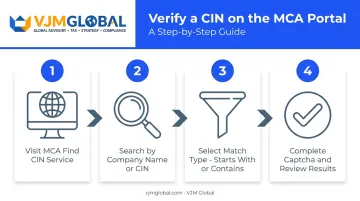
The basic company master data lookup is free and doesn't require login. Requesting copies of filed documents is a separate, paid service.
Before wiring any payment or signing an agreement, cross-check the state code and incorporation year fields against what the vendor has told you. A mismatch, like a company claiming to be five years old but with a CIN showing a 2023 incorporation date, is a quick way to catch inconsistencies before they cost you money.
CIN vs. PAN vs. TAN vs. GSTIN: Don't Confuse These Numbers
US businesses formalizing operations in India often encounter four different identifiers, and it's easy to mix them up. Here's how they differ:
| Identifier | Issued By | Format | Purpose |
|---|---|---|---|
| CIN | Registrar of Companies (MCA) | 21 alphanumeric characters | Corporate registry identity for the company |
| PAN | Income Tax Department | 10 alphanumeric characters | Tax ID for financial transactions and returns |
| TAN | Income Tax Department | 10 alphanumeric characters | ID for entities deducting or collecting tax at source |
| GSTIN | GST authorities (state-specific) | 15 alphanumeric characters | Registration for businesses crossing the GST threshold |
A few distinctions worth remembering:
- PAN is separate from CIN and required for virtually every financial transaction, from opening a bank account to filing tax returns
- GSTIN is state-specific, meaning a company operating in multiple Indian states may hold multiple GSTINs, while it only ever has one CIN
- None of these numbers replace each other. A US company setting up in India will typically need all four at various points
Registering a US Company in India and Obtaining a CIN
If you're setting up an entity rather than just working with existing Indian companies, you'll need to go through the registration process yourself to receive a CIN.
Entity options for US businesses include:
- Wholly Owned Subsidiary — a fully incorporated company, receives its own CIN
- Branch or Liaison Office — a registered presence for limited activities, structure and CIN issuance depend on legal setup
- LLP — flexible structure, but receives an LLPIN instead of a CIN
Only the company structures (subsidiary, private limited, OPC, etc.) actually receive a CIN.
The core registration steps look like this:
- Obtain a Digital Signature Certificate (DSC) for proposed directors and shareholders
- Apply for a Director Identification Number (DIN) for anyone serving as a director
- Reserve a company name and file incorporation documents through the MCA portal (via the SPICe+ form)
- Receive the Certificate of Incorporation, which includes your newly issued CIN
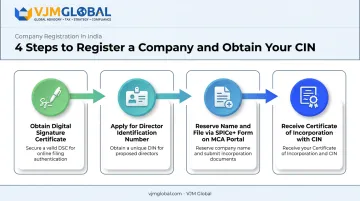
This process involves multiple government touchpoints, notarization or apostille requirements for foreign documents, and compliance details that regularly trip up first-time foreign filers.
VJM Global handles entity setup, MCA filings, and the compliance that follows for US businesses. This end-to-end support helps companies get their CIN issued correctly the first time, avoiding costly corrections later.
Frequently Asked Questions
How do I find my company registration number?
Check your Certificate of Incorporation or MOA/AOA first. If you don't have those on hand, search your company name on the MCA's Find CIN portal to pull it up instantly.
What is the difference between CRN and CIN?
CRN is the generic global term for a company registration number. CIN is India's specific 21-character version, issued by the Registrar of Companies under the MCA.
Is the Indian CIN the same as a US EIN?
Both are unique business identifiers, but they're not interchangeable. The CIN encodes six pieces of structural data across 21 characters, while an EIN is a flat 9-digit federal tax ID.
Do all registered businesses in India have a CIN?
No. Only companies, meaning private limited, public limited, OPCs, and Section 8 entities, receive a CIN. LLPs get an LLPIN, and sole proprietorships get neither.
Can a US company obtain a CIN without being physically present in India?
Yes. The DSC and DIN processes can be completed remotely, and a local corporate services provider like VJM Global can manage document handling and MCA filings on your behalf.
What happens if a CIN changes or becomes outdated?
A company's CIN updates when its listing status, registered state, or industry classification changes. Once reissued, the new CIN must be used on all future documents and filings.