This confusion isn't rare. It's the norm.
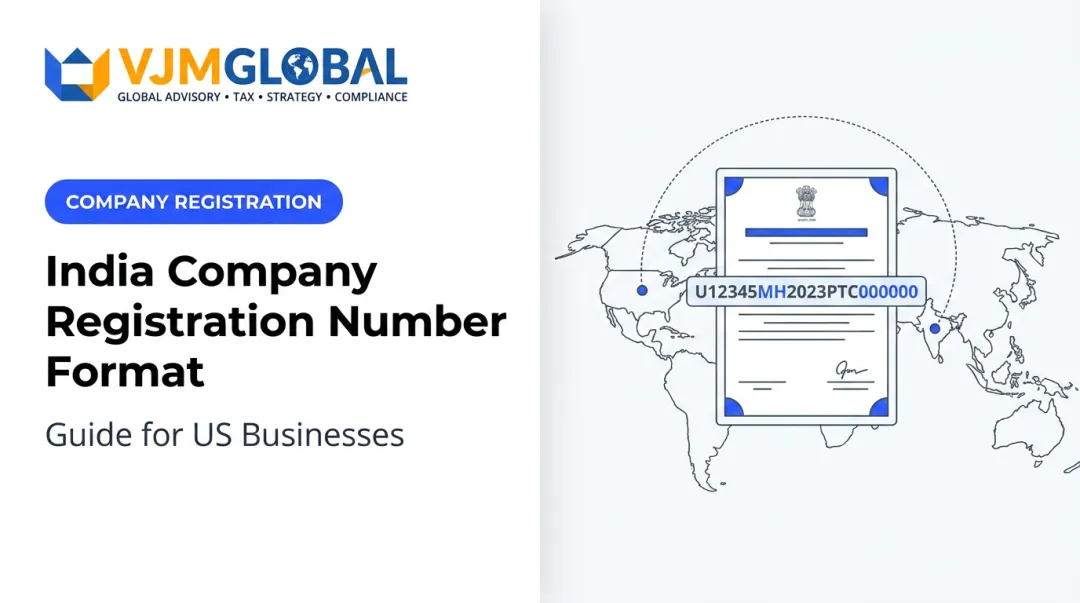
This guide breaks down exactly what a Corporate Identity Number (CIN) is, how to decode it, and the actual steps to get one. We'll also flag where foreign entrepreneurs and NRIs typically get stuck, since the process looks different when you're signing documents from abroad.
Key Takeaways
- CIN is a 21-character alphanumeric identifier issued by the Registrar of Companies (ROC) under Section 7(3) of the Companies Act, 2013, upon incorporation
- Every private limited, public limited, OPC, Nidhi, Section 8, and government company gets one, while LLPs receive an LLPIN instead
- Getting a CIN requires completing DSC, DIN, and SPICe+ filing in sequence, not a standalone application
- Skipping CIN disclosure on official documents triggers a penalty of ₹1,000 per day, capped at ₹1,00,000
- Foreign directors face extra notarization and apostille requirements depending on where they sign
What is a CIN (Corporate Identification Number)?
A CIN, or Corporate Identity Number, is the 21-character alphanumeric code the ROC assigns to a company the moment it's incorporated. Section 7(3) of the Companies Act, 2013 requires the Registrar to allot this number and print it directly on the Certificate of Incorporation.
You'll also hear it called Company Registration Number (CRN). Same number, different name: professionals and government forms use both interchangeably.
Who gets a CIN:
- Private Limited Companies
- Public Limited Companies
- One Person Companies (OPC)
- Nidhi Companies
- Section 8 Companies (non-profits)
- Government Companies
CIN vs. LLPIN: A Common Mix-Up
Here's where a lot of founders go wrong. Limited Liability Partnerships don't get a CIN. They receive a separate identifier called the LLPIN (Limited Liability Partnership Identification Number), issued under Rule 14 of the LLP Rules.
If you're structuring your India entity as an LLP rather than a private limited company, don't expect a CIN to show up anywhere in your paperwork. That's normal, not a mistake.
CIN Isn't PAN or TAN
CIN, PAN, and TAN often get lumped together, but they serve completely different purposes:
- CIN: proves your company is registered with the ROC/MCA
- PAN: your company's tax identity with the Income Tax Department
- TAN: required specifically for deducting or collecting tax at source
MCA's SPICe+ system processes CIN issuance and PAN/TAN applications as separate services during incorporation, even though they often arrive around the same time. That separation matters only at the start, though. Once issued, your CIN follows the company permanently, appearing on every statutory filing, audit report, and ROC submission from that point forward.
Decoding the 21-Character CIN
Once you have a CIN, it's not just a random string. Each segment encodes specific information about your company. Here's the general structure commonly used to interpret CINs:
| Segment | Length | What It Represents |
|---|---|---|
| 1 | 1 character | Listing status: 'L' for listed, 'U' for unlisted |
| 2 | 5 digits | Industry/economic activity code |
| 3 | 2 letters | State code (e.g., DL, MH, KA) |
| 4 | 4 digits | Year of incorporation |
| 5 | 3 letters | Company type (e.g., PTC, PLC, OPC) |
| 6 | 6 digits | Unique registration number from the ROC |
Worked example: Take a CIN like U72200DL2015PTC280123.
U— unlisted company72200— industry activity codeDL— registered in Delhi2015— incorporated in 2015PTC— private company280123— unique ROC-assigned registration number
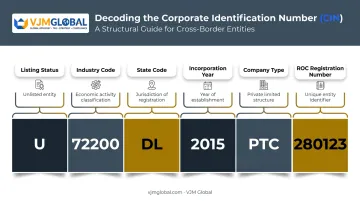
This breakdown is widely used across registration platforms and professional filings, though MCA hasn't published one consolidated data dictionary confirming every code.
Treat the state and company-type codes as practical references. Always cross-check the actual CIN against MCA's Master Data tool rather than relying on manual decoding alone — this is a step firms like VJM Global build into every compliance filing.
Why Is the CIN Important for Your Business?
Your CIN is more than a compliance formality. It's the legal fingerprint that proves your company is real, registered, and accountable to the ROC.
Where it matters most:
- Credibility — banks, investors, and vendors use your CIN to verify you're a legitimate, registered entity before signing contracts or opening accounts
- Due diligence — during funding rounds or acquisitions, investors pull your CIN to check compliance history and filing records
- Mandatory disclosure — Section 12(3)(c) of the Companies Act requires your CIN on business letters, billheads, and official publications
Skipping this isn't a minor oversight. Under Section 12(8) of the Companies Act, non-disclosure triggers a penalty of Rs 1,000 per day of default, capped at Rs 100,000, applied to both the company and every officer in default.
That's a preventable cost. Most businesses avoid it by embedding the CIN into letterhead and invoice templates from day one, instead of relying on someone to remember it later. At VJM Global, we build this into the compliance checklists we set up for clients during business registration, so the requirement never slips through the cracks.
Step-by-Step Process to Obtain Your CIN
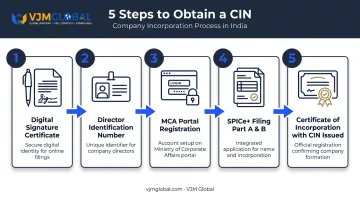
You don't apply for a CIN directly. It's issued automatically once your incorporation filing gets approved. Here's the sequence:
- Get a Digital Signature Certificate (DSC) for each proposed director from a certified agency. This is required for all electronic filings with MCA
- Apply for a Director Identification Number (DIN) for each director through the MCA portal. Foreign nationals need notarized or apostilled identity and address proof, depending on their country of residence
- Register on the MCA portal as a business user, linking your DSC for authentication
- File SPICe+ Part A and Part B, which covers name reservation, incorporation, MoA/AoA submission (e-MOA and e-AOA), identity/address proofs, and fee payment
- Receive your Certificate of Incorporation from the ROC, with your newly assigned CIN printed directly on it
That last step is the finish line. Once the ROC approves your filing under Section 7(2)-(3), the CIN isn't something you request separately. It's generated as part of the approval.
Where foreign founders get stuck: Notarizing documents correctly, applying for DIN from overseas, and navigating SPICe+ filings without an India-based signatory on hand. VJM Global's business setup team handles this entire sequence for clients across the USA, UK, and Australia, from choosing the right entry structure through final incorporation.
Where to Find Your Company Registration Number (CIN)
Once issued, your CIN shows up in a few predictable places:
- Certificate of Incorporation — printed directly by the ROC
- MCA Master Data portal — search using your company name or existing registration number to verify or retrieve your CIN
- Official documents — invoices, letterheads, annual reports, and statutory tax filings
To look it up online, use the MCA Master Data search tool rather than third-party lookup sites. It's the only source directly maintained by the Registrar.
Can't locate your CIN anywhere? That usually means either the incorporation certificate was misplaced or there's a discrepancy in company records. Firms like VJM Global that handle India business setup for foreign companies can retrieve it from MCA records within minutes.
Considerations for Foreign Investors and NRIs Setting Up in India
Getting a CIN is only one layer of the compliance stack for foreign founders. Two other pieces matter just as much.
Document authentication varies by country. Under Rule 13(5) of the Companies (Incorporation) Rules, the notarization path for overseas subscribers depends on where they sign:
- Commonwealth countries — notarization by a local notary public is sufficient
- Hague Apostille Convention countries (like the USA) — documents need notarization plus apostille
- All other countries — notarization followed by authentication from an Indian consular officer

Entity structure affects which number you get. Choosing between a private limited company, LLP, or branch office determines whether you end up with a CIN or an LLPIN. That choice carries downstream effects on FEMA compliance, repatriation rules, and RBI reporting obligations like Form FC-GPR.
Getting this structure decision right from the start avoids costly fixes after incorporation, which is why experienced guidance matters here. VJM Global has spent over 30 years helping foreign businesses navigate Indian regulatory frameworks. The firm has supported 500+ American, 250+ UK, and 250+ Australian businesses through DSC, DIN, and CIN acquisition, structuring their entry correctly from day one.
Frequently Asked Questions
What is the CIN number?
CIN stands for Corporate Identity Number — a 21-character alphanumeric code issued by the MCA/ROC when a company is incorporated. It's used to uniquely identify and track that company across all statutory filings.
Where to find company registration number in India?
Check your Certificate of Incorporation first, since the CIN is printed directly on it. You can also search the MCA Master Data portal, or find it on invoices, letterheads, and annual reports.
Is CIN the same as CRN?
Yes. CIN (Corporate Identity Number) and CRN (Company Registration Number) refer to the same 21-character identifier — the terms are used interchangeably in practice.
Do LLPs get a CIN?
No. LLPs receive a separate identifier called the LLPIN (Limited Liability Partnership Identification Number) instead of a CIN, issued under the LLP Rules.
What happens if a company doesn't mention its CIN on documents?
Under Section 12(8) of the Companies Act, the company and every defaulting officer face a penalty of Rs 1,000 for each day of default, capped at Rs 100,000.
Can foreign nationals or NRIs obtain a CIN for their company in India?
Yes. Foreign nationals and NRIs can incorporate a company and receive a CIN, though they'll need notarized or apostilled documents depending on their country of residence. A firm experienced in cross-border filings can handle document notarization and ROC coordination on your behalf.