Introduction
Wyoming has become one of the most searched U.S. states for company registration, and the reasons are not hard to find. Zero state income tax, tight privacy protections, and a straightforward filing process draw everyone from first-time founders to NRIs looking for a US business vehicle.
The paperwork looks simple on the surface, but many founders struggle with what happens next. How fast you get approved, whether banks take your application seriously, and whether you stay compliant all depend on choices made early: entity type, documentation accuracy, and clarity on non-resident requirements.
This guide walks through why Wyoming keeps winning founders over, the exact steps to register, what it costs, the mistakes that trip people up, and how it stacks up against Delaware.
Key Takeaways
- No state income tax and low fees: about $100 to file, $60 minimum annually
- Non-U.S. residents can form a Wyoming entity without an SSN, US address, or citizenship
- A Wyoming-based registered agent is mandatory for maintaining good standing
- LLCs suit pass-through taxation and operational flexibility
- Corporations suit companies planning to raise capital or issue stock
Why Register a Company in Wyoming?
Wyoming's tax structure is the headline draw. The state charges no corporate income tax, no personal income tax, and no franchise tax in the traditional sense. According to the Tax Foundation's 2026 State Tax Competitiveness Index, Wyoming ranks #1 overall, and #1 for both corporate and individual tax structure.
One clarification: Wyoming does levy an annual license tax through the Secretary of State, calculated as the greater of $60 or a small percentage of in-state assets. It's not a corporate income tax, but it's not literally $0 either.
Privacy That Actually Means Something
Wyoming's formation documents don't ask for LLC member or manager names, and corporate filings don't require shareholder names. That's a real advantage over states that publish ownership details in public databases.
Keep in mind:
- Your registered agent's name and address are public
- Organizers and incorporators listed on formation documents are also disclosed
- This is limited disclosure protection, not full anonymity
Asset Protection Through Charging Orders
Wyoming's LLC statute gives members a specific creditor shield. Under Wyoming Statute 17-29-503, a charging order is the exclusive remedy available to a judgment creditor against a member's interest. Creditors can only collect distributions. They cannot foreclose on the LLC itself or force a sale of its assets. This protection even extends to single-member LLCs.
Lower Costs, Flexible Governance
Compared to states like California or New York, Wyoming's formation and maintenance costs stay low year after year. Governance rules add flexibility too:
- A Statutory Close Corporation with 35 or fewer shareholders can skip annual meetings entirely
- There's no hard cap on authorized shares in the Wyoming Business Corporation Act
- Directors and officers aren't required to be Wyoming residents
None of this requires you to live in the state, or even in the country. Founders in India, the UK, Australia, or anywhere else can form and run a Wyoming entity entirely remotely.
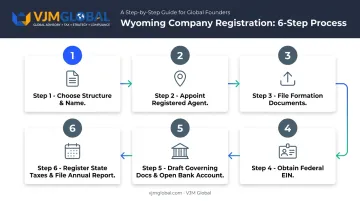
How to Register a Company in Wyoming: Step-by-Step Guide
The whole process happens online. With documents prepared correctly, most filings clear within a few business days.
Step 1: Choose Your Business Structure and Name
Decide between an LLC and a Corporation first:
- LLC: Pass-through taxation, minimal formalities, ideal for most small businesses and solo founders
- Corporation: Necessary if you plan to issue stock or raise venture capital
Once you've picked a structure, search the Wyoming Secretary of State's business database to confirm your name isn't taken. If you're not ready to file immediately, you can reserve a name for 120 days.
Step 2: Appoint a Wyoming Registered Agent
Every Wyoming entity needs a registered agent with a physical Wyoming street address; PO boxes, drop boxes, and mail-forwarding services don't qualify. This requirement matters even more for non-residents who have no address in the state at all.
Professional registered agent services typically run $125 to $300 annually, depending on the provider and whether you add compliance alerts or mail scanning.
Step 3: File Your Formation Documents
File Articles of Organization (LLC) or Articles of Incorporation (Corporation) with the Secretary of State. You'll need to include:
- Entity name and registered agent details
- Organizer or incorporator information
- Share structure (for corporations)
- Principal office address
The filing fee is $100, with a small online convenience charge (2.4%, minimum $1) if you file digitally.
Step 4: Obtain a Federal EIN
You'll need an Employer Identification Number (EIN) to open a US bank account and file federal taxes. Here's where things get trickier for non-residents:
- US-based applicants can apply online in minutes
- Non-US residents without an SSN can't use the online system and must apply by fax or mail using Form SS-4
- Per IRS instructions for Form SS-4, fax applications generally take about 4 business days, while mail applications can take around 4 weeks
This delay catches a lot of international founders off guard. Working with a firm like VJM Global, experienced in cross-border EIN acquisition for US entity formation, can shave weeks off this step.
Step 5: Draft Governing Documents and Open a Business Bank Account
Even though Wyoming doesn't require you to file an Operating Agreement (LLC) or Bylaws (Corporation) with the state, you'll need one for internal governance, and most banks will ask for it.
To open a US business bank account, expect to provide:
- Your EIN confirmation letter
- Formation documents (Articles of Organization/Incorporation)
- Operating Agreement or Bylaws
- Passport (for non-resident founders)
Step 6: Register for State Taxes and File Your Annual Report
If your business qualifies as a "vendor" selling taxable goods or services, you'll need a sales tax license through the Wyoming Department of Revenue's Excise Tax Division.
Separately, every entity must file an annual report on the first day of its incorporation anniversary month. The license tax due is the greater of $60 or a small formula based on Wyoming-located assets. Miss it by more than 60 days, and the state administratively dissolves your entity.
Wyoming Company Registration Costs and Requirements for Non-Residents
Here's a realistic cost breakdown for setting up a Wyoming entity:
| Cost Item | Typical Amount |
|---|---|
| Formation filing fee | $100–$104 |
| Annual report/license tax | $60 minimum |
| Registered agent (annual) | $125–$300 |
| Optional name reservation | $60 |
Non-US residents face no ownership restrictions when forming a Wyoming entity. You don't need a Social Security Number, a US address, or citizenship to form or manage a Wyoming LLC or Corporation. The registered agent supplies the required Wyoming address on your behalf.
Documents you'll typically need ready:
- Passport or government ID for identity verification
- Signed registered agent consent form
- Name reservation confirmation (if applicable)
Where this gets genuinely complicated is when you're running a Wyoming entity and India-linked operations simultaneously. NRIs, OCIs, and Indian promoters juggling both sides often need coordinated support across:
- EIN acquisition and bookkeeping
- Cross-border tax compliance and DTAA treatment
- FEMA reporting and transfer pricing between entities
VJM Global's business setup and accounting outsourcing team handles this integrated work, bridging US-side formation with India-side compliance so nothing falls through the cracks.
Wyoming vs Delaware: Which State Should You Choose?
Delaware still dominates when it comes to venture-backed startups and large corporations, mostly thanks to its specialized Court of Chancery and decades of established case law that investors trust.
Here's how the two compare on hard numbers:
| Factor | Wyoming | Delaware |
|---|---|---|
| Corporate income tax | None | 8.7% on apportioned income |
| LLC recurring charge | $60 minimum license tax | Flat $300 annual tax |
| Corporation formation fee | $100 | $109 minimum |
| Franchise tax | None (asset-based license tax instead) | $175–$400 minimum |
Investment funds view Delaware's governance framework as more predictable, which matters if you're pitching institutional VCs. But that predictability comes at a recurring cost.
Your choice ultimately comes down to your priorities:
- Choose Wyoming if you're a solo founder, small business, or privacy-conscious non-resident prioritizing asset protection and low fees.
- Choose Delaware if you're actively raising capital from US venture funds who expect that structure.
Common Mistakes to Avoid When Registering in Wyoming
A handful of avoidable errors cause most of the delays and compliance headaches:
- Skipping the name search: Filers are responsible for checking name availability themselves. An indistinguishable name discovered post-filing means extra paperwork and fees
- Using a non-compliant registered agent: PO boxes, UPS store addresses, and mail-forwarding services don't meet the physical-address requirement, risking filing delays or later dissolution
- Missing the annual report deadline: The due date falls on the first day of your anniversary month, not your formation date. Missing it by 60 days triggers administrative dissolution
- Assuming zero state tax means zero tax obligations: Federal taxes still apply based on your LLC's classification. Non-resident owners often owe home-country filings too, and foreign-owned entities may trigger IRS Form 5472 reporting
Conclusion
Wyoming keeps taxes simple, privacy protected, and recurring costs low. That combination makes it one of the more efficient states to register a company, especially for non-residents and international founders who don't need Delaware's fundraising ecosystem.
Even with these advantages, most problems that arise later trace back to the same root causes:
- Incomplete documentation at filing
- A missed annual report
- Underestimating how long the EIN process takes as a non-resident
Setting up a Wyoming entity often overlaps with India-side work: accounting, tax filings, FEMA compliance, cross-border structuring. Working with a firm that understands both jurisdictions saves real time. VJM Global supports founders across exactly this kind of dual-jurisdiction setup, connecting the US entity formation with the India-side compliance work that often gets overlooked.
Frequently Asked Questions
Can I form an LLC in Wyoming if I don't live there?
Yes. Wyoming allows non-residents, including international founders, to form and manage an LLC without ever living in the state, as long as you appoint a registered agent with a Wyoming address.
How much does it cost to register a company in Wyoming?
Expect roughly $100 for the initial filing fee, $60 minimum for the annual report, and $125 to $300 per year for a professional registered agent service.
How long does it take to register a Wyoming company?
Online filings are typically processed within a few business days. Mail-in filings take considerably longer, often several weeks depending on volume.
Do I need a Social Security Number to form a Wyoming LLC?
No. An SSN isn't required to form the entity. For the EIN specifically, non-residents without an SSN apply via fax or mail using Form SS-4 instead of the online system.
What's the difference between forming an LLC and a Corporation in Wyoming?
An LLC offers pass-through taxation and fewer formalities, good for most small businesses. A Corporation suits companies planning to issue stock or raise capital from investors.
Do I need to file annual reports for my Wyoming company?
Yes. An annual report and license tax are due every year on the first day of your incorporation anniversary month. Missing it risks administrative dissolution of your entity.