Introduction
Dubai's zero personal income tax has entrepreneurs from Los Angeles to London to Sydney asking the same question: how fast can I set up here?
Forming a company and using it to sponsor your own residency has become one of the most direct paths into the UAE for founders, freelance consultants, and small business owners.
But there's real confusion out there. Property purchases, employment sponsorship, and company-formation residency all lead to different visas, cost structures, and long-term outcomes. Picking the wrong one wastes months and thousands of dirhams.
This guide breaks down eligibility, jurisdiction choice, the step-by-step process, realistic costs, and family sponsorship rules, so you can make an informed decision before you file a single document.
Key Takeaways
- A licensed UAE company can sponsor its owner for a renewable 2-year Investor/Partner visa
- Free Zone companies allow 100% foreign ownership; Mainland companies gain direct UAE market access
- Residency stays valid only while your trade license remains active and compliant
- Once approved, you can sponsor a spouse, children, and in some cases parents
- Offshore companies do not qualify owners for UAE residency, a common oversight
What Is UAE Residency Through Company Formation?
The mechanism is straightforward: a legitimately licensed UAE company acts as the sponsor for its owner's residency visa. This is different from an employer-sponsored work visa, where a separate employing entity sponsors a staff member. Here, you own the business and it sponsors you.
The catch is that this residency is entirely dependent on the license. If your trade license lapses, gets suspended, or falls out of compliance, your visa is cancelled along with it. There's no separation between your business standing and your immigration status under this route.
Who Typically Applies
This pathway attracts a fairly specific set of applicants:
- Solo founders launching consulting or IT services businesses
- Freelancer-consultants who need a UAE base for client work
- Family office holders structuring assets and residency together
- Small trading or service firm owners from the US, UK, and Australia
Many of these same entrepreneurs are also expanding into India simultaneously, using the UAE as a regional base while building an India-facing arm. That dual-market approach creates its own accounting complexity, since cross-border tax and FEMA compliance don't resolve themselves. Firms like VJM Global support exactly this scenario, handling cross-border accounting and back-office compliance for founders juggling a UAE entity alongside Indian operations.
Eligibility Requirements
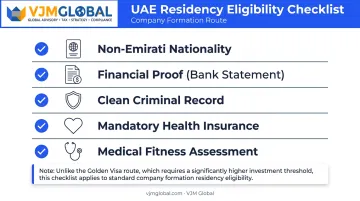
Before applying, you'll need to satisfy these baseline requirements:
| Requirement | Detail |
|---|---|
| Nationality | Non-Emirati applicant |
| Financial proof | Bank statements or evidence of invested capital |
| Criminal record | Clean certificate, sometimes from home country and UAE |
| Health insurance | Mandatory throughout residency validity |
| Medical assessment | Required fitness examination for applicants 18+ |
This differs from the Golden Visa route: company-formation residency doesn't require large investment thresholds or specialized-talent criteria. That makes it accessible to small and mid-size business owners, not just high-net-worth investors.
Choosing Your Jurisdiction: Mainland vs Free Zone vs Offshore
Your jurisdiction choice shapes everything downstream: visa quotas, shareholding rules, and how easily you can scale later. Get this wrong and you may need to restructure your entire company just to fix a visa problem.
Mainland Companies
Mainland licensing gives you direct access to the UAE domestic market and eligibility for government contracts. The tradeoff is that certain regulated activities may still require a local service agent, and you'll typically need a physical office lease rather than a shared desk.
Free Zone Companies
Free Zones offer 100% foreign ownership with sector-specific clusters and streamlined licensing. Many zones allow flexi-desk or shared workspace arrangements, which suits remote founders and small consultancies well. The limitation: selling directly into the Mainland market usually requires a licensed distributor or a dual-licensing arrangement rather than direct trade.
Offshore Companies: The Common Mistake
Offshore structures are built for holding assets or running international operations, not for residency. JAFZA offshore companies confer no right to a UAE residence visa for the owner. If residency is your goal, an offshore entity simply won't get you there, no matter how well-capitalized it is.
Here's how the three structures compare side by side:
| Factor | Mainland | Free Zone | Offshore |
|---|---|---|---|
| Foreign ownership | Up to 100% (activity-dependent) | 100% | 100% (non-operating) |
| UAE market access | Direct | Requires distributor/dual license | Not applicable |
| Office requirement | Physical lease typically required | Flexi-desk or physical, zone-dependent | Registered agent only |
| Residency eligibility | Yes | Yes | No |
Make this decision with residency in mind from the start. Retrofitting a company structure after the fact costs more time and money than getting it right the first time.
Step-by-Step Process to Obtain Residency via Company Formation
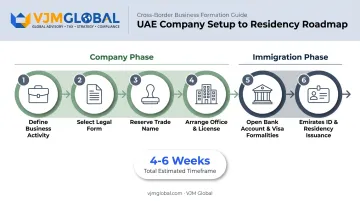
Here's the realistic sequence, broken into the company phase and the immigration phase.
Company formation phase:
- Define your business activity: IT services, trading, consulting, or otherwise, since this determines which authority approves your license, whether the Department of Economic Development (DED) for Mainland setups or a Free Zone authority for Free Zone setups
- Select your legal form: LLC, sole proprietorship, branch office, or partnership, based on ownership and liability preferences
- Reserve a trade name and obtain initial approval from DED (Mainland) or your chosen Free Zone authority
- Arrange your office (a physical lease for Mainland, or a flexi-desk for most Free Zones), then pay license fees to receive your trade license
Immigration phase:
- Open a corporate bank account, then start visa formalities: entry permit, medical fitness test, and Emirates ID registration
- Complete final residency issuance. Note that the UAE moved away from passport visa stickers in 2022; the Emirates ID and electronic residence record now serves as official proof of status
Once your own residency is issued, family members become eligible for sponsored dependent visas.
Realistic Timeframe
There's no single official nationwide timeline, but authority-specific benchmarks give a good picture:
- Company registration alone can take as little as 10 working days in some Free Zones
- Visa processing, from entry permit through Emirates ID, can complete in roughly 8 business days once documentation is complete
- Most founders with clean paperwork complete the full process, from registration to residency issuance, in around four to six weeks, though delays in document collection or medical scheduling can extend this timeline
Benefits of Choosing This Residency Route
This route offers advantages that go beyond simply having a visa:
- Zero personal income tax on profits and salary drawn from your UAE company, as confirmed by the UAE government. This doesn't exempt US, UK, or Australian citizens from home-country tax obligations
- Renewable indefinitely as long as your license stays active, unlike employment sponsorship that ends the moment you change jobs
- Stronger credibility with banks, landlords, and international partners, plus access to UAE corporate and personal banking
That last point matters more than it sounds. A UAE residency visa tied to your own company signals stability to counterparties in a way a tourist visa or short-term permit simply can't.
Costs, Visa Validity, Family Sponsorship & Alternative Routes
Visa Validity
Validity periods vary significantly depending on which route you take:
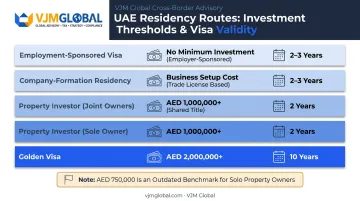
- Company-formation Investor/Partner permit — 2 years under federal law, renewable indefinitely if your license and immigration status stay in good standing
- Green Residence category — 5 years, requiring proof of substantial investment
- Golden Visa — up to 10 years, requiring roughly AED 2 million in qualifying investment, though it sits in a different eligibility bracket entirely
What It Actually Costs
There's no single nationwide total, but component benchmarks help with budgeting:
- Free Zone business setup packages have been advertised from roughly AED 14,000 upward, scope varies by authority
- Standard medical fitness examinations run around AED 250 plus center fees
- Emirates ID issuance is charged at roughly AED 100 per year of residence validity, plus smart-service charges
Add license fees, office costs, insurance, and immigration processing on top of that. Most solo founders should budget for a meaningful setup cost in year one, with lighter renewal costs afterward.
Family Sponsorship Rules
Once your own residency is approved, you can typically sponsor:
- Spouse and children — subject to a minimum income threshold, generally around AED 4,000 monthly or AED 3,000 plus provided accommodation
- Sons up to around age 25, and unmarried daughters with no stated age cap
- Parents, generally requiring a higher income threshold near AED 20,000 monthly, plus insurance and other conditions
How This Compares to Other Routes
| Route | Threshold | Validity |
|---|---|---|
| Company-formation residency | No fixed universal capital minimum | 2 years, renewable |
| Property investor visa (sole owner) | No minimum property value under current rules | 2 years |
| Property investor visa (joint owners) | AED 400,000 per owner share | 2 years |
| Golden Visa (investment) | Generally AED 2 million | Up to 10 years |
| Employment-sponsored visa | Tied to employer, no fixed capital | Tied to job duration |
The old AED 750,000 property benchmark that many articles still cite is outdated for solo owners, so verify current figures before assuming that route is cheaper.
For founders also building an India-facing business arm alongside their UAE entity, this is where things get genuinely complex. Cross-border tax exposure and FEMA compliance between India and the UAE need coordinated handling, and DTAA treaty benefits add another layer worth planning around early. VJM Global's compliance support, covering FEMA advisory, India entity setup, and transfer pricing, is built for exactly this dual-jurisdiction situation.
Frequently Asked Questions
How can I get residency in Dubai with company registration?
Form a licensed Mainland or Free Zone company, then apply for the Investor/Partner residency visa tied to that license. Eligibility depends on your business activity, license status, and meeting immigration health and financial requirements.
Can a US citizen live in Dubai permanently?
There's no outright "permanent" residency, but renewable 2-year investor visas or a 10-year Golden Visa (if you qualify) allow indefinite long-term stay. Most US citizens use the standard company-formation route since it has no large minimum investment requirement.
What is the minimum investment required to get a UAE residency visa through a company?
There's no fixed universal minimum for the standard investor visa, though you'll need to show sufficient capital or bank statements. This differs sharply from the roughly AED 2 million threshold required for Golden Visa eligibility.
Can I get UAE residency without registering a company?
Yes. Property investment, employment sponsorship, marriage, and education-based routes all exist as alternatives. This guide focuses specifically on the company-formation pathway since it suits self-employed founders best.
How long does the process take from company registration to visa stamping?
With complete documentation, most founders complete the full process, from company registration through Emirates ID issuance, within roughly four to six weeks. Delays usually stem from missing paperwork or medical test scheduling.
Do I need to live in Dubai full-time to maintain my company-based visa?
No. Full-time residence isn't required, though periodic entry into the UAE keeps your visa and Emirates ID active. Investor residence permits also face fewer absence restrictions than other visa categories.