Key Takeaways
- Dubai mainland companies register under the Department of Economic Development (DED) and can trade freely across the UAE, including government contracts
- Singapore companies own 100% of most mainland activities under UAE's 2021 reforms — no local sponsor required
- Registration runs six stages — from activity selection and trade name reservation through DED approval, MOA drafting, Ejari office lease, and license issuance
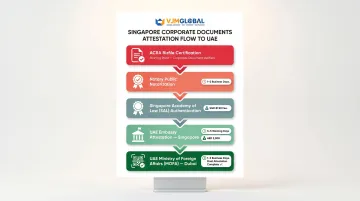
- Singapore corporate documents need four-step attestation: notarization, Singapore Academy of Law (SAL) authentication, UAE Embassy, then MOFA Dubai
- Expect AED 25,000–50,000+ (SGD 8,700–17,400+) in total costs, with standard activities completing in 2–4 weeks
What Is a Dubai Mainland Company?
A Dubai mainland company is a business entity registered directly under the Dubai Department of Economic Development (DED), authorized to operate anywhere in the UAE without geographic restriction.
Two Legal Structures for Singapore Companies:
- Limited Liability Company (LLC): Provides liability protection, operational flexibility, and is the most popular choice for foreign investors establishing a new legal entity in Dubai
- Branch of a Foreign Company: Extends an existing Singapore entity rather than creating a new subsidiary — but remains legally tied to the parent company without separate liability protection
Both structures differ from offshore entities in one key respect: they operate within the UAE economy directly. Mainland companies require physical office space, pay UAE corporate tax, and engage with local customers and government bodies — giving them full UAE market access from day one.
Mainland vs. Free Zone: Key Distinction for Singapore Companies
Free zones offer straightforward setup packages, virtual office options, and simplified administration. The trade-off is a hard restriction: free zone companies cannot sell directly to UAE customers. Accessing the local market requires appointing a local distributor, adding cost and complexity.
When mainland makes sense:
- Targeting UAE domestic clients or government contracts
- Operating across multiple emirates
- Bidding on public sector tenders (only mainland entities qualify)
When free zones work better:
- International re-export and logistics operations
- Digital services delivered outside the UAE
- Regional holding structures with no local trading requirements
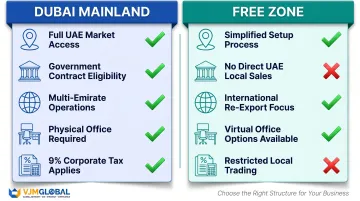
Only mainland-registered companies are eligible to participate in government tenders, covering procurement across infrastructure, education, and consulting sectors.
Why Singapore Companies Are Expanding to Dubai Mainland
Strategic Trade Corridor Access
Dubai sits at the commercial intersection of markets that Singapore companies increasingly target. UAE-Singapore bilateral trade reached SGD 27.9 billion in 2025, up from SGD 24.05 billion in 2024. The UAE ranks as Singapore's largest trading partner in MENA and 13th globally, with over 600 Singapore firms already operating there.
The broader opportunity extends well beyond bilateral trade. The GCC's combined GDP reached approximately USD 2.3 trillion in 2024, while UAE non-oil foreign trade hit a record AED 3.5 trillion (approximately USD 953 billion) in 2023.
100% Foreign Ownership Without Local Sponsors
Federal Decree-Law No. 26 of 2020, effective early 2021, eliminated the previous 51% UAE national shareholding requirement for most commercial and professional activities. Singapore investors now enjoy:
- Full equity control without sharing ownership with an Emirati sponsor
- Complete decision-making authority over operations and strategy
- Freedom to repatriate capital and profits without local partner approval
A narrow set of activities still require UAE national involvement — security/defense, telecommunications, certain financial services, commercial agencies, and natural pearl catching — though these cover a small fraction of typical business operations.
Tax Efficiency and DTAA Benefits
UAE corporate tax stands at 9% on taxable income above AED 375,000 (approximately SGD 130,000), with a 0% rate below that threshold. Singapore's headline corporate tax rate is 17%, though start-up exemption schemes reduce the effective rate for qualifying new companies.
The Singapore-UAE Double Taxation Avoidance Agreement (DTAA), ratified September 2019, provides relief from double taxation on cross-border income. Companies with operations in both jurisdictions should work with qualified tax advisors to structure their affairs correctly, as treaty benefits depend on meeting specific compliance requirements.
Government Contract Eligibility
Only mainland companies can bid on UAE federal and emirate-level government tenders. This restriction excludes all free zone entities from substantial procurement opportunities, particularly relevant for Singapore technology, engineering, and professional services firms accustomed to competing for public sector contracts.
Banking Access and Credibility
Mainland companies typically experience smoother corporate account opening with UAE banks compared to free zone entities. For companies used to Singapore's banking infrastructure, this difference becomes concrete quickly — especially when establishing trade finance facilities or managing multi-currency accounts.
How to Set Up a Dubai Mainland Company: A Step-by-Step Guide for Singapore Businesses
The setup process covers six main stages and completes within 2–4 weeks for standard business activities, provided documents are prepared correctly before submission. Singapore companies operating remotely will need a power of attorney arrangement for any in-person submissions.
Step 1: Choose Your Business Activity and Legal Structure
The DED classifies over 2,000 licensed activities. Selecting the correct activity code determines:
- License type (commercial, professional, or industrial)
- Additional approvals from sector regulators (Central Bank for finance, MOHRE for recruitment, DHA for healthcare)
- Permitted business operations under your trade license
The wrong code triggers re-filing fees, regulatory delays, and license restrictions that can block your intended operations from day one.
Legal Structure Selection:
Most Singapore companies opt for an LLC structure for its liability protection and operational flexibility. Those extending an existing Singapore entity may consider a branch registration — the key difference being that a branch is not a separate legal entity from the Singapore parent, meaning liabilities flow directly to the parent company.
Step 2: Reserve Trade Name and Obtain DED Initial Approval
Trade Name Rules:
- Must be unique and not previously registered
- Cannot reference religion, government bodies, or external organizations
- Must reflect the business activity and include the legal form suffix (LLC, EST, PJSC)
Singapore company names often use "Pte Ltd" suffixes. The Dubai equivalent must use LLC or branch-appropriate suffixes in the UAE trade name, though Singapore brand names can be retained as trade names subject to DED compliance rules.
Once initial approval is granted, you have formal government clearance to proceed — the MOA can be drafted and office lease negotiations can begin in parallel, which helps compress the overall timeline.
Step 3: Prepare MOA, Secure Office Space (Ejari), and Collect Trade License
Memorandum of Association (MOA):
The MOA must be drafted in Arabic or bilingual format, signed by all shareholders, and notarized. Singapore-based shareholders who cannot travel to Dubai must provide a notarized and attested power of attorney authorizing a local representative to sign on their behalf.
Physical Office Requirement:
A physical office with a valid Ejari-registered lease is mandatory for all mainland companies. Co-working spaces and flexi-desks are acceptable for license purposes — a practical option for Singapore companies testing the market before committing to a full office.
Annual office costs range from approximately AED 15,000 for basic Deira locations to AED 80,000+ for premium Business Bay addresses.
Trade License Issuance:
Once the office lease, MOA, and DED approval letter are submitted with payment, DED issues the trade license. This license enables:
- Legal commercial operations throughout the UAE
- Hiring employees and processing employment visas
- Opening UAE corporate bank accounts
- Issuing commercial invoices
- Bidding on government contracts
Documents Singapore Companies Need to Prepare
Corporate Documents (from Singapore):
- ACRA Bizfile company profile or Certificate of Incorporation
- Memorandum and Articles of Association
- Board Resolution authorizing Dubai entity formation and naming authorized signatories
- Shareholder Certificates
- Good Standing Certificate (if required)
Attestation Chain for Singapore Documents:
Despite Singapore joining the Hague Apostille Convention in September 2021, the UAE is not a member. Singapore corporate documents require full legalization:
- ACRA Certification — Computer-generated documents certified by ACRA
- Singapore Notary Public — Documents notarized with Notarial Certificate issued (1-2 days)
- SAL Authentication — Singapore Academy of Law authenticates the Notarial Certificate (fee: SGD 87.20 including GST)
- UAE Embassy in Singapore — Embassy verifies SAL legalization (3-5 working days, AED 2,000 for commercial documents)
- UAE MOFA Attestation in Dubai — Final validation with digital QR code attestation (1-3 business days)
Personal Documents (for each shareholder and director):
- Valid passport copies (minimum 6 months validity)
- Proof of residential address
- Passport-size photographs
UAE-Side Documents:
- Trade name reservation certificate
- DED initial approval letter
- Signed and notarized MOA in UAE-accepted format
- Ejari-registered office lease agreement
- No Objection Certificates (NOCs) for regulated activities
Most Common Documentation Pitfall:
Documents not in English require certified translation before submission. Singapore-format corporate documents often differ structurally from UAE expectations, so working with advisors familiar with both jurisdictions prevents costly re-submissions and delays.
Costs, Timeline, and Post-Setup Compliance
Cost Breakdown (Approximate AED Figures):
| Item | Cost (AED) | Cost (SGD) |
|---|---|---|
| Trade license issuance | 10,000–18,000 | 3,470–6,250 |
| Office lease (annual) | 15,000–80,000+ | 5,200–27,800+ |
| MOA drafting and notarization | 1,000–2,500 | 350–870 |
| Immigration and establishment card | ~3,000 | ~1,040 |
| Visa costs (per person) | 4,000–7,000 | 1,390–2,430 |
| Total starting budget | 25,000–50,000+ | 8,700–17,400+ |
Exchange rate: 1 SGD = approximately 2.88 AED (May 2026 average)
Timeline (Standard Activities):
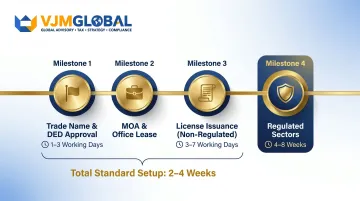
- Trade name approval and initial DED approval: 1–3 working days
- License issuance (non-regulated activities): 3–7 working days
- Regulated sectors (finance, healthcare, education): 4–8 weeks for additional approvals
- Total standard setup: 2–4 weeks (assuming documents prepared before starting)
Post-Setup Compliance Obligations:
Once the license is issued, ongoing obligations kick in immediately — and this is where Singapore companies most often get caught off guard:
- Renew your trade license annually; payment vouchers must be settled within 30 days of receipt
- Register for UAE corporate tax and file returns within 9 months of financial year-end (9% applies on taxable income above AED 375,000)
- Register for VAT once annual turnover exceeds AED 375,000 (voluntary registration available from AED 187,500)
- Maintain structured accounting records for 7 years under UAE commercial law
- Process employee visa and labor card renewals annually for each staff member
Many Singapore companies engage professional advisory firms to handle these requirements rather than building in-house administrative functions in Dubai. VJM Global, for example, works with multinational companies on cross-border accounting and compliance management — covering outsourced bookkeeping, intercompany reconciliation, and management reporting across the full operating lifecycle.
Frequently Asked Questions
What is a mainland company in Dubai?
A mainland company is registered under the Dubai Department of Economic Development (DED) and can operate anywhere in the UAE without geographic restrictions. Unlike free zone companies, mainland entities trade directly with local customers and bid on government contracts.
Can a foreigner set up a business in Dubai?
Yes, foreigners including Singapore nationals and companies can set up businesses in Dubai. Under UAE's 2021 ownership reforms, 100% foreign ownership is permitted for most commercial and professional activities on the mainland without requiring a local Emirati sponsor.
How to set up a mainland company in Dubai?
The process involves six stages: select business activity and legal structure, reserve trade name, obtain DED initial approval, draft and notarize MOA, register office lease (Ejari), and collect trade license. Standard activities complete in 2–4 weeks.
What is required to register a company in the UAE?
Core requirements are:
- Valid trade name reservation and DED initial approval
- Notarized MOA and registered office lease
- Passport copies and corporate documents from all shareholders
- Government fee payment
Foreign company shareholders must also have home-country documents attested by the UAE Embassy.
Is an LLC mainland or freezone in Dubai?
An LLC can be registered as either mainland or free zone depending on where it's incorporated. A mainland LLC registered under the DED provides full UAE market access, while a free zone LLC operates under specific free zone rules with restrictions on local market trading.
What businesses can I start with 50,000 AED in Dubai?
AED 50,000 (approximately SGD 17,400) typically covers a professional services license, consultancy, or small trading activity — including trade license fees, basic office costs, and one visa. Singapore companies should add a separate budget for document attestation costs, which are not included in DED fees.