But here's the problem: most US business owners have no idea how UAE company law actually works.
Ownership rules, licensing categories, tax registration, UBO filings, the differences between a "branch" and an LLC. It's a lot to untangle, especially when the rules changed dramatically just a few years ago. This guide breaks down UAE company formation structures, the 2021 Companies Law overhaul, and the compliance steps that matter most for US businesses making the move.
Key Takeaways
- The 2021 UAE Commercial Companies Law permits up to 100% foreign ownership in most mainland sectors, removing the old local sponsor requirement.
- US businesses can pick between Mainland, Free Zone, and Offshore structures, each with distinct tax and operational rules.
- Post-formation compliance—UBO registration, AML checks, tax filing, and audits—is mandatory regardless of company size.
- Your choice between a branch office and an LLC determines liability exposure from day one.
Understanding UAE Company Formation Structures
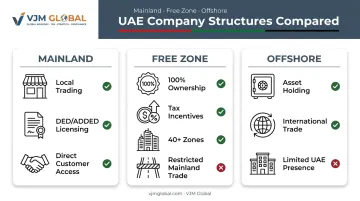
Every UAE company sits in one of three jurisdictions: Mainland, Free Zone, or Offshore. This single decision determines where you can operate, who can own the business, and what tax treatment applies. The structures differ sharply in ownership rules, market access, and cost, so getting this choice right upfront saves significant restructuring headaches later.
Mainland Companies
Mainland companies are licensed through the Department of Economic Development (DED) in Dubai or ADDED in Abu Dhabi. Since the 2021 reform, full foreign ownership of commercial companies is permitted across most sectors.
- Trade freely anywhere in the UAE and internationally, no restrictions
- Best suited for businesses needing direct access to local customers — retail, F&B, consulting, contracting
- A short list of "strategic impact" activities (defense, banking, energy) still require government-approved ownership structures
Free Zone Companies
Free zones offer 100% foreign ownership, generous tax incentives, and no currency restrictions. The UAE government confirms more than 40 free zones currently operate across the country, giving foreign investors an unusually wide menu of sector-specific options.
The catch: free zone companies can't trade directly on the mainland without a distributor, a mainland branch, or additional licensing under Dubai's 2025 free zone-mainland integration rules.
Two zones stand out for US businesses:
- ADGM (Abu Dhabi Global Market) – applies English common law directly, including equity principles
- DIFC (Dubai International Financial Centre) – an English-language common law jurisdiction, popular for financial services and holding structures
Offshore Companies
Offshore entities like JAFZA Offshore and RAK ICC exist mainly for holding assets, international trade, or tax planning, not for running day-to-day operations inside the UAE.
Important nuance: the old assumption that offshore companies get zero UAE presence isn't fully accurate anymore.
Under current JAFZA Offshore regulations, a qualifying property-owning offshore company can apply for UAE residence visas, with its registered office at an approved freehold property. RAK ICC's Premium product similarly links offshore structures to onshore operations through RAKEZ facilities. The traditional "no visa, no premises" rule now depends heavily on which specific product you choose.
Quick comparison for US business goals:
| Goal | Best-fit structure |
|---|---|
| Retail store or local service business | Mainland |
| International trading or holding company | Free Zone or Offshore |
| Financial services with common law contracts | DIFC or ADGM |
| Testing UAE market before committing | Free Zone or representative office |
The New UAE Companies Law: What US Businesses Need to Know
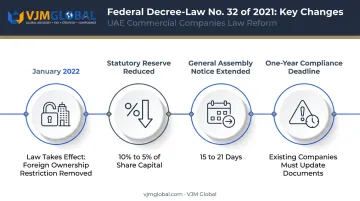
Federal Decree-Law No. 32 of 2021 took effect on 2 January 2022, replacing the older Companies Law and fundamentally reshaping how foreign investors can operate in the UAE.
The headline change: the mandatory 51% UAE national ownership requirement is gone for most commercial activities. Foreign investors, including US citizens, can now hold full control of a mainland LLC without a local sponsor. Only activities the Cabinet designates as having "strategic impact" still carry ownership or management restrictions.
Key LLC Changes Under the New Law
The 2021 law also adjusted several operational rules for LLCs:
- Statutory reserve cut from 10% to 5% of annual net profit, and partners can stop contributing once the reserve hits 50% of share capital
- General assembly notice period extended from 15 to 21 days
- First-meeting quorum reduced from 75% to 50% of represented capital (a second meeting proceeds regardless of quorum if the first one fails)
New Vehicles for M&A and Structured Financing
The law introduced formal recognition of SPACs (Special Purpose Acquisition Companies) and SPVs (Special Purpose Vehicles). For US investors exploring mergers, acquisitions, or structured financing deals in the UAE, these vehicles offer familiar tools under a regulated framework. SCA-classified SPACs and SPVs, however, sit outside certain standard Companies Law provisions.
These new structures gave companies more flexibility, but the law also came with a hard compliance deadline for entities already operating in the UAE.
Existing companies had just one year from January 2022 to bring their governance documents in line with the new law. Companies that didn't comply risked being treated as dissolved, with no grace period or extension process available.
Core Compliance Requirements After Company Formation
Forming the company is the easy part. Staying compliant is what keeps a US business legally operating in the UAE year after year.
Trade Licence Renewal and UBO Registration
Trade licences in Dubai and Abu Dhabi are typically issued for one year and must be renewed annually through DET or ADDED (via the TAMM platform). Missing a renewal window can trigger penalties or licence suspension.
Alongside licence renewal, companies must register Ultimate Beneficial Owner (UBO) information. Under Cabinet Resolution No. 109 of 2023, a UBO is any natural person owning or controlling 25% or more of the company's capital or voting rights. Businesses must:
- Maintain UBO and shareholder registers
- File data with the relevant registrar
- Report any changes within 15 days
AML/CFT and Financial Reporting Obligations
The UAE overhauled its anti-money laundering framework with Federal Decree-Law No. 10 of 2025, which replaced the 2018 law effective 14 October 2025. It imposes risk assessments, customer due diligence, and suspicious-transaction reporting duties.
These obligations apply primarily to financial institutions and designated non-financial businesses (DNFBPs), not every ordinary trading company by default.
Separately, audited annual financial statements are required for most mainland joint-stock companies and LLCs under Article 27 of the Companies Law, along with annual audit submissions for most free zone entities.
UAE Corporate Tax for US-Owned Businesses
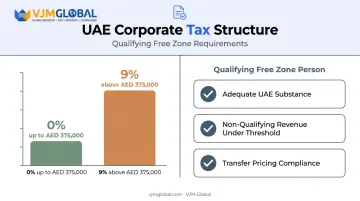
Since June 2023, the UAE applies a federal corporate tax structure:
- 0% on taxable income up to AED 375,000
- 9% only on the portion of taxable income exceeding that threshold
- All juridical persons, including free zone companies, must register with the FTA and obtain a Corporate Tax Registration Number
Free zone companies aren't automatically exempt. Only a Qualifying Free Zone Person gets 0% on qualifying income, and this requires maintaining adequate UAE substance, keeping non-qualifying revenue under the lower of AED 5 million or 5% of total revenue, and meeting transfer pricing documentation rules.
Don't forget your US obligations. UAE tax registration doesn't erase US reporting duties. US citizens and entities generally still need to consider:
- FATCA disclosure requirements
- Form 8938 for specified foreign financial assets above IRS thresholds
- Form 5471 for US persons with ownership stakes in a foreign corporation crossing 10% vote or value thresholds
This is exactly the kind of dual-country compliance web where things go wrong. Coordinating UAE filings with the corresponding US tax forms early, rather than after a deadline is missed, is what keeps both sides of the structure in good standing.
Establishment vs LLC: Choosing the Right Structure
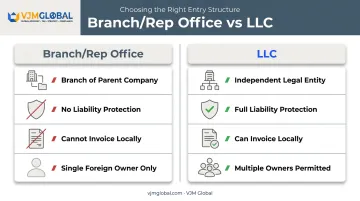
A branch or representative office ("establishment") shares its parent company's legal identity. It's not a separate entity. That means the parent bears full liability for whatever the branch does in the UAE.
A representative office is even more limited — it can only promote and market the parent's business. It cannot sign local contracts, invoice UAE clients, or generate direct revenue.
An LLC, by contrast, is a distinct legal person. Liability is capped at each partner's capital contribution, and one person alone can form and own the entire company.
The table below breaks down the practical differences:
| Factor | Branch / Rep Office | LLC |
|---|---|---|
| Legal identity | Same as parent company | Separate legal entity |
| Liability | Parent bears full liability | Capped at capital contribution |
| Revenue generation | Rep office cannot invoice clients | Full contracting and invoicing rights |
| Ownership | Extension of parent only | Single owner or multiple partners allowed |
Which one fits your business?
- Choose an LLC if you want full operational independence, local liability protection, and the ability to sign contracts directly
- Choose a branch or rep office if you're testing UAE demand before committing capital, or if you just need a liaison presence
Practical Compliance Tips for US Businesses Entering the UAE
Getting the structure right is only half the job. Here's what keeps US businesses out of trouble after formation:
- Engage a local formation consultant early. Emirate-specific documentation, notarization requirements, and licensing procedures vary more than most first-timers expect.
- Budget for hidden costs. Office leasing is often mandatory, even for free zone companies. Add visa costs, annual audit fees, and licence renewal charges to your first-year budget.
- Keep meticulous records from day one. Your MOA, board minutes, and UBO filings should be audit-ready at all times, not assembled reactively when a regulator comes knocking.
- Coordinate UAE and US tax timelines. Corporate tax registration deadlines in the UAE don't align with US filing deadlines. Missing either creates penalty exposure on two fronts.
Businesses that treat compliance as an afterthought tend to pay for it later, through fines, licence delays, or messy audits. A structured approach from the start avoids most of that pain, turning compliance from a recurring cost centre into a routine part of operations.
Frequently Asked Questions
What is the new company law in the UAE?
Federal Decree-Law No. 32 of 2021, effective 2 January 2022, replaced the older Companies Law. Its biggest impact: removing the mandatory 51% UAE national ownership requirement for most commercial activities.
What is the difference between an establishment and an LLC in the UAE?
An establishment (branch or representative office) shares its parent company's legal identity with limited independence. An LLC is a separate legal entity, with liability limited to each partner's capital contribution.
Can a US citizen fully own a company in the UAE?
Yes. 100% foreign ownership is now permitted in most mainland sectors and nearly all free zones. Only activities designated as having "strategic impact" retain ownership restrictions.
What is the corporate tax rate for US-owned businesses in the UAE?
The UAE applies 0% tax on profits up to AED 375,000 and 9% only on profits above that threshold. Qualifying free zone entities may access 0% on qualifying income if they meet substance and revenue conditions.
Should a US business choose mainland or free zone in the UAE?
Mainland suits businesses needing direct access to UAE customers and local trading rights. Free zones work better for international trading, holding structures, or specific regulated sectors like finance.
Do US businesses in the UAE still need to file US tax returns?
Yes. US citizens and entities remain subject to US reporting obligations, including FATCA disclosures and Form 5471 for foreign corporation ownership, regardless of UAE tax registration. Missing this dual-filing obligation can trigger steep IRS penalties, even when no UAE tax is owed.