That's a problem, because "PLC" doesn't mean the same thing in India as it does back home. UK founders often assume the rules mirror what they know from Companies House, which leads to the wrong structure and, sometimes, expensive restructuring later.
This guide covers what an Indian PLC actually is, whether UK citizens and companies can start one, the full registration process, and how it stacks up against a Private Limited Company.
Key Takeaways
- An Indian PLC needs at least 3 directors and 7 shareholders, with no upper limit on shareholders
- UK nationals and companies can hold up to 100% ownership in most sectors via the FDI automatic route
- SPICe+ incorporation takes longer than a Private Limited because of extra documentation
- Choose a PLC only when your plan justifies the heavier compliance burden
What Is a Public Limited Company in India?
Under the Companies Act 2013, a public company can invite the public to subscribe for its shares and does not face the membership cap that binds a private company. India and the UK both use the "Public Limited Company" label, but the structural rules diverge sharply.
Core features of an Indian PLC:
Minimum 3 directors (Section 149(1)(a))
Minimum 7 subscribers/shareholders, with no maximum member cap (Section 2(71))
Power to raise capital from the public
Mandatory "Limited" suffix in the company name
One point that trips up many UK founders: since the Companies (Amendment) Act 2015, India has had no statutory minimum paid-up capital. You do not need a set rupee balance in the bank before you incorporate.
Subscribed capital must still be paid in over time, and stamp duty still applies on authorised share capital—so "no minimum" is not a free pass.
Listed vs Unlisted Public Limited Companies
Incorporating as a PLC does not put your shares on a stock exchange. Listing on the NSE or BSE is a separate, later decision—not an automatic result of the PLC structure. That distinction surprises most UK founders we advise.
Most UK-promoted PLCs in India stay unlisted permanently. They choose the PLC structure for governance reasons or shareholder-count flexibility, not because they want to go public tomorrow.
So when does a UK company actually need a PLC rather than a Private Limited Company?
- You plan to bring in more than 200 shareholders (the Private Limited Company cap)
- You're structuring a large joint venture with multiple institutional partners
- You have genuine IPO ambitions further down the line
If none of those apply, a Private Limited Company will almost certainly serve you better.
Can a UK Citizen or Company Start a Public Limited Company in India?
Yes. UK citizens and UK-incorporated companies can set up and own an Indian PLC, most commonly through the FDI automatic route, which allows up to 100% foreign ownership in most sectors and activities. No prior approval from the Indian government is needed for these activities.
Automatic Route vs Government Route
FEMA and the Consolidated FDI Policy split foreign investment into two tracks:
- Automatic route – no government sign-off required; investment flows in directly through banking channels
- Government route – requires prior approval, typically for sensitive sectors like defence, media, and multi-brand retail
The government's FDI policy confirms that foreign direct investment up to 100% is permitted under the automatic route across most sectors. Sectoral caps and specific conditions still apply depending on your line of business.
The Resident Director Requirement
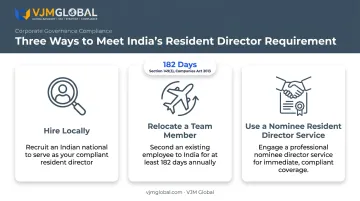
This is the part UK founders most often miss. Under Section 149(3) of the Companies Act 2013, at least one director must have stayed in India for 182 days or more during the financial year. This is a residence test, not a citizenship test, but it still needs solving before incorporation.
Practical options include:
- Hire locally and appoint that person as a director
- Relocate a team member to India for the required period
- Use a nominee resident director service through a firm experienced in cross-border structuring
Every UK-based director and subscriber also needs the following before SPICe+ filing can proceed:
- Apostilled passport copy
- Apostilled proof of address
- Digital Signature Certificate (DSC)
- Director Identification Number (DIN)
Apostille turnaround from the UK is usually the step that catches people out.
How CETA and the DTAA Help
The India-UK trade deal doesn't touch company registration procedures directly, but it does smooth the wider commercial picture. India is removing or reducing tariffs on 90% of tariff lines for UK goods, with 64% going tariff-free immediately.
On the tax side, the India-UK Double Taxation Avoidance Agreement caps dividend withholding at 10% for most cases. Royalty and technical service fees sit at 10-15%, which helps groups avoid an unplanned double-tax hit.
Trade and tax terms only help if the entity is formed correctly in the first place. Resident director coverage, DIN, DSC, and apostille logistics still need tight coordination between the UK and India. VJM Global supports UK founders through that cross-border setup and ongoing compliance.
Step-by-Step: How to Register a PLC in India as a UK Company
UK companies register an Indian PLC through the SPICe+ route, with extra steps for foreign-director KYC and FDI reporting. Complete the sequence below in order—DSC and apostille work is the step that most often stalls the timeline.
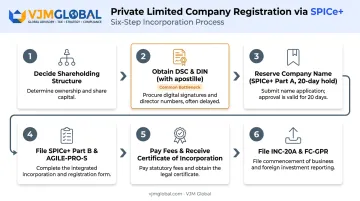
Decide the shareholding structure. Confirm at least 7 subscribers to the Memorandum of Association and 3 directors, then map out exactly who on the UK side holds what percentage.
Obtain DSC and DIN for all directors. For UK-based individuals, complete apostille and notarisation first. Leave this too late and it becomes your biggest bottleneck.
Reserve the company name through SPICe+ Part A. Approved names are held for 20 days. While you wait, prepare the electronic Memorandum and Articles of Association with PLC-specific clauses built in.
File SPICe+ Part B along with AGILE-PRO-S. This single integrated filing generates your PAN and TAN and links to GST, EPFO, ESIC, and bank account opening.
Pay registration and stamp duty fees. Amounts depend on authorised share capital and the state of incorporation. Once cleared, the Registrar issues the Certificate of Incorporation, usually slower than a Private Limited because of the extra shareholder documentation.
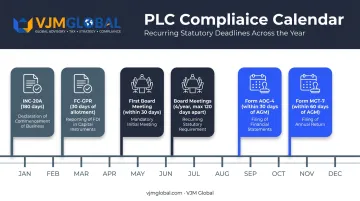
File Form INC-20A within 180 days. Use it to declare commencement of business once subscribed capital has reached your Indian bank account. Separately, report the FDI inflow to the RBI on Form FC-GPR within 30 days of share allotment.
Post-incorporation deadlines to lock in:
- INC-20A — within 180 days of incorporation
- FC-GPR — within 30 days of share allotment
Miss the FC-GPR deadline and you face compounding penalties under FEMA. Put both filings on your post-incorporation checklist so neither slips.
PLC vs Private Limited Company: Which Structure Fits Your UK Business?
| Factor | Public Limited Company | Private Limited Company |
|---|---|---|
| Minimum directors | 3 | 2 |
| Minimum shareholders | 7 | 2 |
| Maximum shareholders | No cap | 200 |
| Minimum paid-up capital | None (post-2015) | None (post-2015) |
| Can raise funds from the public | Yes | No |
| Relative compliance burden | Heavier | Lighter |
Most UK companies entering India for trading, hiring, or day-to-day operations choose a Private Limited Company. It's simpler, cheaper to run, and the 200-shareholder cap rarely matters for an operating subsidiary.
Choose a Private Limited Company when:
- You need an operating subsidiary for trading, hiring, or local contracts
- You want lighter compliance and lower ongoing costs
- Your investor base will stay well under 200 shareholders
Choose a PLC when:
- You're planning large-scale capital raising beyond a small shareholder base
- Your structure needs more than 200 shareholders or investors
- You have concrete listing ambitions, not a "maybe someday" plan
If you're still unsure, you likely don't need a PLC yet. You can convert later.
Compliance, Costs & Timelines for an Indian PLC
Statutory audit under Section 139 and board meetings under Section 173 apply to private companies as well. A PLC still carries a heavier load: more shareholders, denser filings, tighter governance formality, and prospectus rules if you raise public funds.
Budget and calendar planning should cover both setup spend and the recurring MCA cycle.
What to budget for (amounts vary by state, capital and advisor scope):
- Incorporation fees tied to authorised share capital
- Stamp duty on incorporation documents (state-specific)
- Professional fees for ongoing ROC, RBI/FEMA and GST compliance
Those line items sit alongside fixed filing clocks you cannot miss:
- First board meeting within 30 days of incorporation, then at least 4 meetings a year, no more than 120 days apart
- Form AOC-4 (financial statements) within 30 days of the AGM
- Form MGT-7 (annual return) within 60 days of the AGM
MCA deadlines plus RBI/FEMA reporting and GST returns are easy to miss from a UK time zone. VJM Global has supported 250+ UK businesses on this multi-jurisdiction calendar so ROC, RBI and GST dates stay aligned.
Frequently Asked Questions
Can a UK citizen start a business in India?
Yes. UK citizens can start a business in India, typically through the FDI automatic route, subject to sector-specific caps. Most structures, including a PLC, also need at least one India-resident director.
What is a public limited company in India?
Indian PLCs are companies with a minimum of 3 directors and 7 shareholders that can raise capital from the public. They can be either listed on a stock exchange or remain unlisted.
What is the minimum capital required to start a PLC in India?
There's no statutory minimum paid-up capital since the 2015 amendment. Subscribed capital must still be paid up over time, and stamp duty applies on authorised capital.
How long does it take to register a PLC in India from the UK?
Registration usually takes longer than a Private Limited Company because of extra shareholder documentation. Apostille and DSC processing for UK-based directors often add several more weeks.
Does a UK company need a local resident director to set up an Indian PLC?
Yes. At least one director must be India-resident for 182+ days per Section 149(3). UK founders usually satisfy this by hiring locally, relocating a team member, or using a nominee resident director service.
Can a UK company own 100% of an Indian Public Limited Company?
Yes, 100% foreign ownership is allowed in most sectors under the automatic route. Certain sensitive sectors require prior government approval instead.