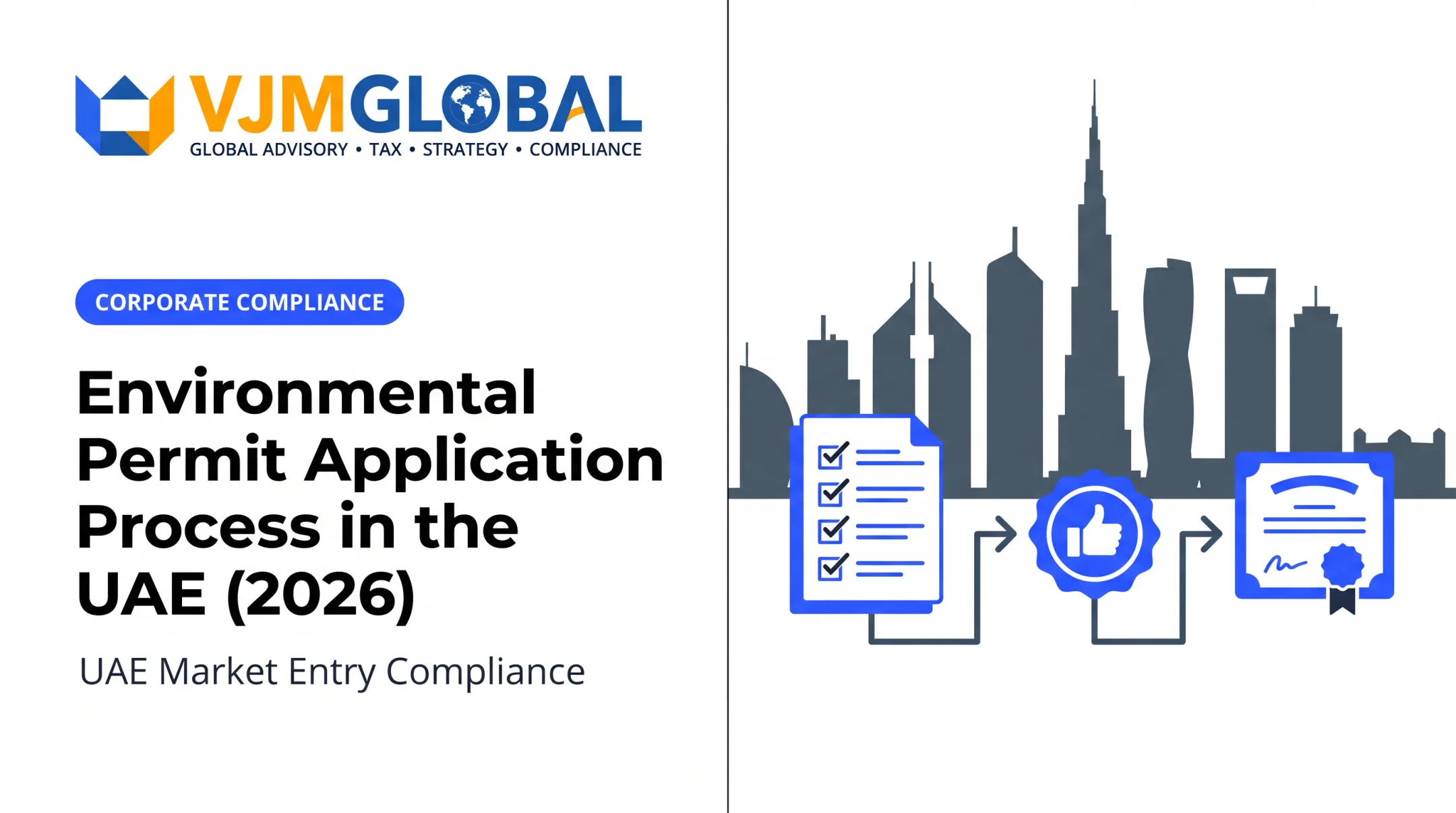
This guide is for developers, industrial and commercial businesses, facility operators, investors, contractors, and project teams planning activities in Abu Dhabi. The permit decision touches project design, construction sequencing, commissioning dates, ongoing operations, and how you handle modifications down the line.
"Environmental permit" gets thrown around a lot, but rarely with the practical detail people actually need: who approves it, what studies are required, and what happens after you get the green light. This article walks through the application path, the documentation involved, and the compliance obligations that continue well past day one.
Key Takeaways
- Environment Agency – Abu Dhabi (EAD) is the main regulator; still confirm the competent authority for your project.
- Required studies and documents depend on activity, site, emissions, waste streams, and local environmental effects.
- Environmental approval should be secured before construction, operation, expansion, or modification begins.
- A granted permit isn't the finish line — monitoring, reporting, and renewals continue throughout the project lifecycle.
- Always confirm current requirements through official EAD and TAMM channels rather than outdated checklists.
What the Abu Dhabi Environmental Permit Process Is and Why It Matters
An environmental permit is a regulatory approval that determines whether a project may proceed from an environmental protection standpoint, and under what conditions. On TAMM, Abu Dhabi's government services portal, EAD refers to this instrument as an Environmental Licence for industrial and commercial facilities. Older EAD materials also reference "environmental permit" and "construction NOC," so confirm the exact terminology for your service before you submit anything.
The purpose is simple in concept: identify foreseeable environmental impacts, require prevention or mitigation measures, and set conditions that let EAD monitor performance over time.
Not the Same as Your Trade Licence
This trips up a surprising number of applicants. An environmental licence is separate from:
- Your commercial or economic licence (issued by the Department of Economic Development)
- Building permits and planning approvals
- Construction approvals
- Waste-management licences
- Discharge consents and operational approvals
Holding one of these doesn't mean you hold the others. A mainland business, for instance, typically operates under an LLC licensed by the relevant Department of Economic Development, but that licence says nothing about whether your facility meets environmental requirements for emissions, discharges, or waste handling.
Why EAD Gets Involved
EAD assesses pollution risks, emissions, wastewater, hazardous materials, noise, resource consumption, land disturbance, and marine or biodiversity effects where relevant. Federal Law No. 24 of 1999, cited by EAD as part of its licensing framework, states that an establishment must not start its activity before obtaining the required environmental licence.
Starting work without the required approval creates real exposure: stop-work directions, delayed commissioning, corrective-action orders, and enforcement action. This isn't hypothetical: EAD suspended operations at two industrial facilities in 2025 for violating environmental regulations. A submitted application is not authorisation to begin work.
Treated properly, though, the process can improve project planning. Early engagement often surfaces design changes, control equipment needs, and resource-efficiency opportunities before capital is committed. Addressing issues on paper is far cheaper than fixing them after construction.
How the Abu Dhabi Environmental Permit Application Works
The route and terminology can differ by sector, location, and project stage, so treat this as a practical framework rather than a fixed script.
Step 1: Confirm the Project Scope and Competent Authority
Before selecting an application route, define:
- The activity, site, and production or service capacity
- Construction activities, utilities, and transport movements
- Emissions, discharges, waste streams, and hazardous substances
- Nearby sensitive environmental receptors
Then verify whether EAD, a free-zone interface (such as KEZAD), a municipal authority, or a sector regulator holds jurisdiction. Applications for industrial and commercial facilities generally go through TAMM, Abu Dhabi's government services platform, using UAE PASS for sign-in.
Step 2: Determine the Assessment and Approval Pathway
EAD may screen or classify your project according to its potential environmental impact. Depending on the outcome, you might be asked for a preliminary environmental review, an environmental impact assessment (EIA), a management plan, or specific technical studies.
Specialist studies can include:
- Air-quality modelling
- Wastewater or marine water-quality assessment
- Noise impact modelling
- Waste management plans
- Hazardous-material controls
- Ecological surveys
- Traffic or construction-impact analysis
Only pursue the categories confirmed in current official guidance. Don't assume a prior project's pathway applies to yours.
Step 3: Prepare the Application Dossier
Your dossier typically needs to cover:
- Applicant and ownership details: trade licence, ownership structure, site and land documents
- Project description: layout drawings, engineering plans, process flow, equipment list
- Resource and output data: raw materials, energy and water use, emissions, discharges, waste arrangements
- Management commitments: mitigation measures, monitoring programme, risk assessment, emergency procedures
Keep drawings, technical reports, calculations, and mitigation commitments consistent across the whole submission. Incomplete, contradictory, untranslated, unsigned, or outdated documents are the single biggest source of clarification requests and resulting delays.
Step 4: Submit, Respond to Review, and Obtain the Decision
The general flow runs: submission through the approved channel, completeness screening, technical review, requests for clarification, possible coordination with other authorities, then issuance, rejection, or conditional approval.

Maintain a document register throughout. Respond to EAD's comments in a controlled, tracked manner, preserve every revised version, and check whether a scope change requires a fresh application rather than a minor amendment.
Step 5: Implement Conditions Before Construction or Operation
Approval conditions commonly require pollution-control equipment, monitoring points, licensed waste contractors, operating limits, inspection access, and incident-reporting procedures. Treat these as confirmed requirements only once your specific approval letter states them. Don't assume another facility's conditions apply to yours.
A basic pre-construction checklist:
- Permit validity dates and conditions documented
- Approved plans on-site and accessible
- Contractor responsibilities assigned in writing
- Monitoring equipment installed and calibrated
- Reporting deadlines and renewal dates logged
Step 6: Maintain, Amend, Renew, or Close the Approval
Expansions, process changes, new equipment, increased capacity, altered waste streams, or ownership changes may trigger a notification requirement, technical review, or formal amendment. TAMM lists a dedicated modification service for industrial-facility environmental licences, separate from the initial application.
Monitoring, inspections, environmental reporting, and record retention continue after the permit is granted. This isn't a one-time administrative box to tick.
Where Environmental Permits Are Applied in Abu Dhabi
Environmental approvals touch a wide range of sectors, including:
- Manufacturing and chemical processing
- Energy, utilities, and desalination
- Construction and infrastructure
- Logistics, ports, and dredging
- Waste management and recycling
- Food processing and agriculture
- Resource extraction
This list isn't exhaustive — verify sector coverage for your specific activity rather than assuming inclusion or exclusion.
Different Stages, Different Approvals
Approval needs can arise at multiple points:
- Pre-construction — initial environmental licensing, before any site work
- Post-construction, pre-operation — a separate operating licence, issued after construction but before startup
- Routine operations — periodic reporting, waste permissions, incident notifications
- Change events — modifications, renewals, decommissioning
TAMM treats the industrial pre-construction licence and the post-construction operating licence as distinct services — don't assume one covers the other.
Special Contexts Change the Route
Certain conditions shift the evidence required or the authority involved:
- Protected habitats, mangroves, or coastal and marine areas
- KEZAD and similar industrial zones — zone handles submission (per a 2013 agreement); EAD still reviews and decides
- Hazardous waste projects — separate Tadweer waste-infrastructure NOC and professional-practice licensing
- ADNOC concessions — a 2025 assessment confirmed no EAD permit is required; ADNOC's environmental division governs instead
Not every Abu Dhabi project follows the same EAD route. Jurisdiction turns on location, ownership structure, and sector.

Key Factors That Affect the Application and Practical Preparation
A handful of variables shape how complex your application becomes:
- Project inputs — raw materials, fuels, chemicals, water demand, energy use, waste types, emissions, noise, transport movements
- Site conditions — proximity to residential areas, groundwater, coastlines, mangroves, or other regulated facilities
- Operating conditions — production volume, operating hours, discharge characteristics, accident scenarios
- Equipment and controls — pollution-control systems, monitoring points, spill containment, emergency infrastructure
- Scale and frequency — construction footprint, project duration, whether the activity is permanent, temporary, or expanding
- Regulatory constraints — EAD technical guidance, federal and Abu Dhabi environmental legislation, land-use restrictions
Preparing Before You Submit
A few practical steps make the difference between a smooth review and months of back-and-forth:
- Appoint a single project owner for the submission end-to-end
- Build an environmental aspects register covering every input, output, and discharge
- Gather reliable baseline data early, rather than estimating under deadline pressure
- Map approval dependencies against other authorities involved
- Build a compliance calendar for reporting deadlines and renewal dates
What Causes Delay or Rejection
The most common culprits:
- Starting the process too late in the project timeline
- Choosing the wrong service route
- Submitting generic, templated studies
- Omitting secondary emissions or waste streams
- Inconsistent drawings across the dossier
- Weak mitigation measures or poor contractor controls
- Failing to answer EAD's technical comments promptly
Common Misconceptions Worth Clearing Up
- An economic licence is not an environmental permit
- Approval of a study is not always the same as approval to operate
- Outsourcing waste disposal does not remove the generator's own responsibility
- Receiving a permit does not eliminate ongoing monitoring or inspection duties
Some activities with negligible impact, or minor changes already covered by an existing approval, may not require a full new process. Only EAD can confirm an exemption. Don't self-assess your way out of a requirement.
A Note on Cross-Border Support
VJM Global supports entity formation, tax, payroll, and compliance for businesses operating in the UAE, as part of its multi-country advisory work.
Australian and other foreign companies entering Abu Dhabi (for example forming a local entity, managing cross-border tax, or coordinating back-office compliance) may find that support useful alongside the environmental workstream.
Abu Dhabi environmental permit requirements themselves should be confirmed directly with EAD or a qualified local environmental adviser. That work sits outside general business-setup and tax advisory scope.
Conclusion
The Abu Dhabi environmental permit process connects project planning, environmental assessment, technical documentation, regulatory review, approval conditions, and ongoing monitoring. The correct pathway for your project depends on activity, location, scale, environmental risk, and the current requirements of EAD and any other relevant authority.
Early classification, complete documentation, evidence-based mitigation, and controlled responses to EAD comments are the core of the application—not steps to rush. Compliance doesn't end at approval; it continues for as long as the facility operates.
Frequently Asked Questions
How do I comply with an environmental permit in Abu Dhabi?
Compliance means following every permit condition, maintaining required controls and records, completing monitoring and reporting, allowing inspections, and reporting incidents or changes. Apply for amendments or renewals when circumstances change, and check current EAD requirements regularly.
What is TPD approval in Abu Dhabi?
No clear, currently verified definition of "TPD approval" appears in EAD's published procedures or current TAMM service listings. If you've encountered this term for a specific project, confirm its meaning and relationship to environmental permitting directly with EAD or the relevant authority.
What is the name of the environmental agency in Abu Dhabi?
The Environment Agency – Abu Dhabi (EAD) is the emirate's environmental regulator. Applicants should still confirm the current service channel and any other authority involved, since some sectors and zones use additional interfaces.
What documents are required for an environmental permit in Abu Dhabi?
Expect to provide applicant and site details, project drawings, process descriptions, environmental studies, emissions and waste information, mitigation plans, and monitoring arrangements. The exact checklist is activity-specific, so confirm it through the relevant TAMM service listing.
Do I need an environmental permit before starting construction or operations in Abu Dhabi?
Yes — environmental approvals should generally be secured before regulated construction, commissioning, operations, expansion, or modification begins. Verify the project-specific sequence with EAD and any other competent authority involved in your project.