For US companies following that path, the Private Company Limited by Shares (LTD) is almost always the structure of choice. It's flexible, well understood, and closely resembles a US LLC or Inc. But it comes with obligations American founders rarely anticipate.
This guide breaks down the real pros, cons, requirements, and tax mechanics US companies need to weigh before incorporating in Ireland.
Key Takeaways
- Ireland's 12.5% corporate tax rate and EU market access make the LTD attractive to US companies
- All-US boards typically lack an EEA-resident director, a common Irish formation hurdle
- The US-Ireland tax treaty limits double taxation, though GILTI and CFC rules still apply stateside
- Annual returns, public filings, and beneficial ownership registration make Irish compliance heavier than a US LLC
- A cross-border formation partner helps first-time filers avoid costly missteps
What Is a Private Limited Company (LTD) in Ireland?
Under the Companies Act 2014, an LTD is a separate legal entity with limited liability, no objects clause, and between 1 and 149 shareholders. It operates under a single-document constitution rather than the older memorandum-and-articles setup.
Think of it as Ireland's rough equivalent to a US LLC or Inc. It's the structure most American companies choose over a Designated Activity Company (DAC) or a branch office, mainly because it's simpler to run and doesn't restrict the company's business activities.
Key identifiers US founders should know:
- Minimum of one director required (no maximum)
- A company secretary is mandatory, and a sole director cannot also serve as secretary
- No minimum share capital — many companies issue a nominal amount, such as €100, split across shares
That last point often surprises American founders used to state-specific LLC rules. Ireland doesn't care how much capital you put in, only that at least one share gets issued.
Pros of Forming an Irish LTD for US Companies
EU Market Access and a Competitive Tax Regime
Once incorporated, an Irish LTD sits inside the EU customs union, meaning no tariffs or customs duties apply when trading goods across EU member states. For a US company trying to sell into Germany, France, or the Netherlands, that's a meaningful cost advantage over shipping directly from American soil.
Ireland's tax profile adds to the appeal:
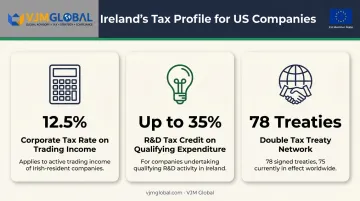
- 12.5% corporate tax rate on trading income (25% on non-trading income like rental or investment returns)
- R&D tax credits of up to 30% on qualifying expenditure, rising to 35% for later accounting periods
- Access to 78 signed double tax treaties, 75 of which are currently in effect
That combination, a low headline rate plus a deep treaty network, is why so many US companies use Ireland as their EU hub rather than incorporating elsewhere on the continent.
Liability Protection and a Familiar Legal System
Beyond tax efficiency, the LTD structure delivers a second concrete advantage: liability protection. As a separate legal person, if the Irish subsidiary racks up debt or faces litigation, the US parent company's assets stay protected in almost all circumstances, barring fraud or improper conduct.
Ireland is also the only EU member state that's fully common law and English-speaking. For a US legal team, that means:
- Contracts read the way they're used to, and court precedent works similarly to American case law
- No translation costs or civil-law learning curve
Post-Brexit, this status matters even more: with the UK now outside the EU, Ireland is the bloc's only common-law, English-speaking member state left. For US legal and finance teams comparing EU entry points, that continuity often tips the decision in Ireland's favor.
Credibility, Funding, and Simple Governance
This liability protection and legal familiarity also translate into tangible credibility. An "Ltd" designation carries weight with European banks, landlords, and grant bodies in a way a branch office often doesn't. It also opens doors to:
- EU grant and innovation funding programs
- Local business banking and credit facilities
- Easier vendor and partner onboarding across the EU
- Stronger positioning when bidding on EU-funded contracts
Governance stays light, too. A single-director company is permitted, and single-member companies can dispense with holding an AGM altogether. For a lean US-backed startup testing the European market, that's one less recurring obligation to manage.
Cons and Challenges for US Companies Setting Up in Ireland
The EEA-Resident Director Requirement
Here's where most all-American boards hit their first snag. Irish law requires at least one director to be resident in the EEA. A typical US leadership team has zero.
The workaround is a Section 137 bond, which provides €25,000 in coverage against Companies Act fines and certain tax liabilities, with a minimum validity of two years. One 2025 market benchmark put the total cost of arranging this bond at approximately €1,600 for a two-year term, including premium, levies, and processing fees. Pricing varies by provider, so treat this as a reference point, not a fixed tariff.
Compliance and Filing Obligations
Running an Irish LTD means signing up for ongoing statutory paperwork that a US LLC simply doesn't require:
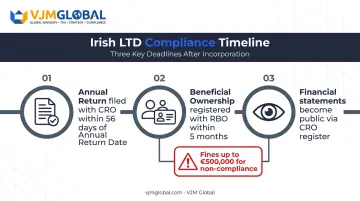
- Annual returns filed with the CRO within 56 days of the Annual Return Date, with financial statements attached after the first year
- Beneficial ownership registration with the RBO within five months of incorporation
- Public financial filings — once submitted, your company's accounts become accessible through the CRO's public register
Skipping the RBO filing isn't a minor slip. Non-compliance can trigger a fine on summary conviction, or climb to €500,000 on indictment for serious breaches, with continuing violations potentially treated as a daily offense.
Costs and Cross-Border Tax Complexity
Formation and upkeep aren't free. Market benchmarks from Irish formation providers suggest:
- Outsourced LTD formation from roughly €249, including the CRO's €50 filing fee
- Company secretarial support around €275–€595 plus VAT per year
- Annual accounting support ranging from €800 to €3,500+ per year, depending on transaction volume and complexity
On top of Irish filings, the US parent still has to manage GILTI, Subpart F, and CFC reporting back home. A foreign corporation generally becomes a Controlled Foreign Corporation once US shareholders own more than 50% of vote or value, triggering Form 5471 and Form 8992 filings. Skipping local expertise here rarely ends well, which is why many US companies bring in cross-border specialists like VJM Global to coordinate Irish compliance with US CFC reporting.
Key Requirements and Tax Considerations for US Companies
Setting Up: Directors, Secretary, and Beneficial Ownership
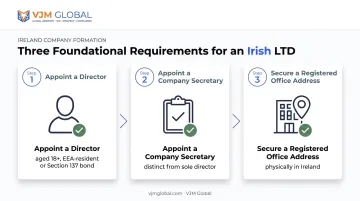
Every Irish LTD needs three things in place before it can operate cleanly:
- At least one director (18 or older) — an EEA resident, or a Section 137 bond as the alternative
- A company secretary, distinct from a sole director
- A registered office address physically located in Ireland
Add to that the RBO filing, due within five months of incorporation. This anti-money-laundering requirement catches out a surprising number of US-owned entities that assume it's optional or informal. It isn't. VJM Global's Ireland team typically files the RBO registration and Form TR2 directly with Revenue for US clients, keeping this deadline from slipping.
Tax Residency, Treaty Protection, and Registration
The US-Ireland Double Taxation Treaty, signed in 1997, is designed to stop profits and dividends repatriated to the US parent from being taxed twice. Foreign tax credit mechanisms generally apply, though the exact benefit depends on your structure and elections.
If a director relocates to Ireland to run day-to-day operations, the 183-day rule matters personally, not just corporately:
| Time in Ireland | Tax Residency Outcome |
|---|---|
| 183+ days in one tax year | Individual becomes Irish tax resident |
| 280+ days combined across two consecutive tax years | Same effect applies |
Finally, corporation tax and VAT registration happen through Form TR2 with Revenue, giving you a Tax Reference Number. Trading income sits at 12.5%, non-trading income at 25%. VAT registration thresholds currently stand at €42,500 for services and €85,000 for goods, with a standard VAT rate of 23%.
How VJM Global Supports US Companies Expanding into Ireland
Getting the paperwork right the first time matters more in Ireland than in most US states, where LLC formation is comparatively forgiving. VJM Global handles entity formation, tax registration, and ongoing compliance for Irish LTDs, backed by 30+ years of tax, audit, and advisory experience across 100+ countries, including Ireland.
The firm has already worked with 500+ American business owners navigating cross-border entity setup. That experience translates into hands-on familiarity with:
- Navigating Irish CRO filing procedures (Form A1, Constitution) and Revenue registration via ROS
- Managing the Section 137 bond process for boards without an EEA-resident director
- Addressing US-side reporting concerns like GILTI and CFC exposure that run parallel to Irish filings
Support doesn't stop once the company is registered. VJM Global's cross-border tax planning services extend into ongoing accounting, payroll administration, and statutory filings, letting US founders focus on growing the business rather than chasing CRO deadlines.
Frequently Asked Questions
Can a US citizen open a private limited company in Ireland?
Yes. US citizens can fully own and register an Irish LTD without being Irish residents. The company just needs an EEA-resident director (or a Section 137 bond) and a registered Irish office.
What is the 183-day rule in Ireland for tax residency?
An individual becomes Irish tax resident by spending 183 or more days in Ireland during one tax year, or 280 or more days combined across two consecutive tax years. This matters most for directors who relocate to manage the company directly.
Do I need to live in Ireland to open and run a company there?
No. Physical residency isn't required to own or direct an Irish LTD. You do need at least one EEA-resident director (or a Section 137 bond) and a registered office address in Ireland.
How long does it take a US company to register an Irish LTD?
CRO's accelerated Fé Phráinn scheme targets incorporation within five working days once documents are correct, while the standard online scheme targets around ten working days. Tax registration with Revenue typically adds further time on top.
Will my Irish company's profits be taxed twice, in Ireland and the US?
The US-Ireland tax treaty and foreign tax credit mechanisms are designed to prevent double taxation. That said, US CFC and GILTI rules still require coordinated reporting alongside your Irish filings.
Is there a minimum share capital required to form an Irish LTD?
No. There's no statutory minimum share capital for an LTD. Many companies simply issue a nominal amount, such as €100, split across one or more shares to satisfy the subscriber requirement.