Yet many exporters still mix up two very different rulebooks. GST decides whether your service export is zero-rated. FEMA decides whether you've actually complied with India's foreign exchange law. The confusion has gotten worse as RBI phases out the 2015 export regulations in favor of a new 2026 framework.
This guide breaks down what "export of services" means under FEMA, how the rules are changing, what documentation you need, and what happens if proceeds don't come home on time.
Key Takeaways
- No declaration is required today, but monthly EDF filing becomes mandatory from October 1, 2026.
- Realization timelines are set to lengthen from October 2026: 15 months standard, 18 months for INR-invoiced exports.
- Proceeds not realized within the deadline restrict future exports and trigger closer RBI monitoring.
- Specialist FEMA advisory keeps documentation, timelines, and bank reporting aligned so exporters avoid penalties.
What is Export of Services under FEMA?
FEMA, 1999 defines "export" broadly. Under Section 2(l)(ii), export includes the provision of services from India to any person outside India. That's the starting point, and it's wider than most exporters assume.
The declaration obligation for services sits separately from goods. Section 7(1)(a) applies to goods exporters, requiring a true declaration of export value. Services are governed by Section 7(3), which requires exporters to furnish, in the form and manner specified, a declaration containing accurate particulars relating to payment for those services.
Here's the part that trips people up:
- IEC is generally not required for service exports, unlike goods, unless the provider claims Foreign Trade Policy benefits such as SEIS (Service Exports from India Scheme).
- Even without any declaration form, a service exporter remains legally obligated to realize and repatriate the foreign exchange due to India.
- FEMA 23(R)/2015-RB, Regulation 3(3) confirms exports can proceed without a prescribed declaration form, though repatriation duty still stands; software exports remain governed separately under SOFTEX.
FEMA vs. GST: Don't Confuse the Two
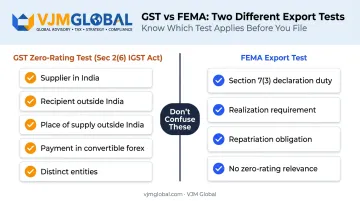
GST's export of services test, under Section 2(6) of the IGST Act, looks at five conditions:
- Supplier located in India
- Recipient located outside India
- Place of supply outside India
- Payment received in convertible foreign exchange (or INR where RBI permits)
- Supplier and recipient not merely establishments of the same entity
FEMA doesn't ask these same questions. It cares about repatriation and reporting, not zero-rating eligibility.
Treating the two frameworks as interchangeable is one of the most common compliance mistakes exporters make.
Common Examples of Service Exports Covered
Services falling under this framework span a wide range:
- IT and IT-enabled services (ITES)
- Management and business consulting
- Professional services, including accounting and tax advisory
- Financial and advisory services
- Engineering, design, and technical services
Firms delivering these services to overseas clients are exporters under FEMA the moment an invoice goes out.
VJM Global provides accounting outsourcing, tax compliance, and advisory support to businesses across the USA, UK, and Australia. Every cross-border invoice it raises for an overseas client counts as a service export requiring realization and repatriation under this exact framework.
FEMA Regulations for Export of Services: 2015 Framework vs New 2026 Rules
The 2015 Regulations (FEMA 23(R)/2015-RB, notified January 12, 2016) have governed service exports for a decade. Under the original text, Regulation 9 set a 9-month general realization period for goods, software, and services. The 15-month period was never a general rule; it applied narrowly to goods held in an RBI-approved overseas warehouse.
An RBI amendment dated June 5, 2026 reaffirmed this by substituting "nine months" back into Regulation 9, so the realization clock currently runs at 9 months.
That's about to change. RBI has notified the Foreign Exchange Management (Export and Import of Goods and Services) Regulations, 2026, dated January 13, 2026 and gazetted two days later. This regime consolidates goods and services exports into a single framework and takes effect October 1, 2026.
| Aspect | Current Rules (until Sep 30, 2026) | New Rules (from Oct 1, 2026) |
|---|---|---|
| Service declaration | None required for ordinary services; SOFTEX for software | Monthly EDF within 30 days of invoice month-end |
| Multiple clients | Not applicable | One EDF can cover several overseas recipients in a month |
| Realization period | 9 months (general) | 15 months standard, 18 months for INR-invoiced exports |
| Extension authority | RBI directions apply | AD banks explicitly empowered to extend both EDF and realization deadlines |
Two changes stand out. First, the monthly Export Declaration Form (EDF) becomes a genuine new obligation for service exporters, not a formality inherited from goods. Second, the realization window nearly doubles once the new regulations kick in.
What This Means for Service Exporters
The trade-off is straightforward: reporting becomes more structured (a monthly EDF instead of no declaration at all), but exporters gain nearly double the time to bring proceeds home. AD banks also get clearer authority to grant extensions when delays are genuinely beyond an exporter's control.
The flip side? Once the deadlines are codified this precisely, "we didn't know" stops being a viable excuse during an RBI review.
Compliance Requirements for Exporting Services under FEMA
Export Declaration Form (EDF) Filing
From October 1, 2026, service exporters must file an EDF within 30 days from the end of the month in which the invoice was raised. Filing happens through your Authorized Dealer (AD) bank, and a single EDF can cover multiple overseas clients billed in the same month, cutting down on paperwork volume.
Realization & Repatriation of Proceeds
The core obligation hasn't changed, only the timeline has. Exporters must realize the full value of services in convertible foreign exchange within the prescribed period:
| Rule | Realization Deadline |
|---|---|
| Current rule | 9 months |
| From October 2026 (standard) | 15 months |
| From October 2026 (INR-invoiced) | 18 months |
Extensions beyond these windows require AD bank approval or, in some cases, direct RBI approval.
Invoicing & Manner of Receipt
Export contracts must be denominated in a freely convertible currency or Indian Rupees. Payment can reach you through:
- An AD bank's Nostro account
- International credit card reimbursement, certified as received in foreign exchange
- Regulated Online Payment Gateway Service Providers (OPGSPs), which route funds through the AD bank's Nostro collection account
Documentation to Maintain
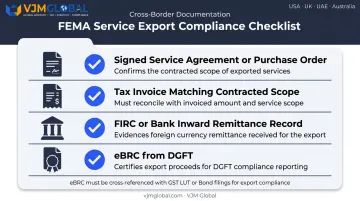
RBI doesn't prescribe one rigid checklist for every ordinary service export, but sound practice (and every bank query you'll ever face) points to keeping:
- The signed service agreement or purchase order
- Tax invoices matching the contracted scope
- FIRC (Foreign Inward Remittance Certificate) or the bank's inward remittance record
- eBRC (Electronic Bank Realization Certificate) from DGFT, which confirms realization and cross-references cleanly with your GST LUT/Bond filings for zero-rated supply
Advance Receipts, Non-Compliance & Penalties
Advance payments against future exports come with strings attached. Under the current Master Direction, the one-year completion clause and the reference-rate-plus-100-basis-points interest cap are drafted specifically for goods shipment. Service exporters receiving advances should confirm exact terms with their AD bank rather than assuming the goods timeline applies automatically.
From October 1, 2026, Regulation 10(4) introduces a cleaner, unified interest cap tied to the all-in-cost ceiling for trade credit, applying across both goods and services.
Not all export proceeds arrive on time, though. When proceeds stay unrealized for more than one year past the due date, Regulation 13 kicks in: further exports to that buyer are permitted only against full advance payment or an irrevocable Letter of Credit. This creates a genuine operational hurdle, directly limiting future orders from that buyer.
There's relief for smaller transactions, though. An RBI circular dated October 1, 2025 permits AD banks to close eligible EDPMS/IDPMS entries up to ₹10 lakh per bill based on a self-declaration. From October 2026, this becomes a standing rule under Regulation 4(2).
Ignore all of this, and Section 13 of FEMA imposes real financial consequences:
- Penalty up to three times the quantifiable amount involved in the contravention
- Flat ₹2 lakh penalty when the amount can't be quantified
- Additional ₹5,000 per day for each day the violation continues
Who Ensures FEMA Compliance & How VJM Global Can Help
Responsibility starts with the exporter. Whether you're an individual, a partnership, or a company, you're on the hook for declaring transactions accurately, realizing proceeds, and repatriating them within the timeline.
AD Category-I banks and RBI sit above that as supervisors, not participants:
- Banks monitor EDPMS/IDPMS entries and flag overdue bills
- Banks grant extensions where justified
- RBI escalates persistent non-compliance, including enforcement action
The stakes are real. VJM Global's tax team recently reviewed a FEMA appellate case where a non-realization penalty was reduced from ₹75 lakh to ₹5 lakh on appeal. That's still a substantial cost for what often starts as a missed deadline rather than deliberate evasion.
Avoiding that outcome starts with the right advisor. With 30+ years of experience and a team of 100+ professionals, VJM Global has supported over 500 American, 250 UK, and 250 Australian businesses with cross-border compliance.
On the FEMA side, that support covers:
- Statutory compliance advisory and RBI permissions
- EDPMS/IDPMS e-filings and documentation structuring
- Representation in compounding matters when deadlines slip
For exporters juggling GST rules on one side and FEMA timelines on the other, having one advisor who understands both keeps you from filing accurately for one law while breaching the other without realizing it.

Frequently Asked Questions
What is export of services under FEMA?
Under Section 7 of FEMA, 1999, export of services means providing services from India to a person outside India. Proceeds must be realized in convertible foreign exchange and repatriated within the prescribed timeline.
What are FEMA's export of services regulations for 2026?
The Foreign Exchange Management (Export and Import of Goods and Services) Regulations, 2026 consolidate goods and services rules and introduce monthly EDF filing. They also extend realization periods to 15 months (18 months for INR transactions), effective October 1, 2026.
What export declaration is required under FEMA for services?
From October 1, 2026, service exporters must file an Export Declaration Form (EDF) through their AD bank within 30 days of the month-end in which the invoice was raised. One EDF can cover multiple overseas clients billed that month.
Who is responsible for ensuring FEMA compliance when exporting services?
The exporter, whether an individual, firm, or company, holds primary responsibility for declaring, realizing, and repatriating proceeds. AD banks and RBI supervise compliance and can grant extensions when justified.
Is IEC mandatory for export of services under FEMA?
No, an Import Export Code is not mandatory for most service exports. It is only required when the exporter claims benefits under the Foreign Trade Policy, such as SEIS.
What happens if export proceeds are not realized within the stipulated time?
Beyond one year past the due date, future exports to that buyer are permitted only against full advance payment or an irrevocable Letter of Credit. Extended delays can also trigger RBI penalties under Section 13 of FEMA.