Introduction
Every rupee that crosses India's border, whether it's a foreign investor funding a startup or an exporter collecting payment from a US buyer, falls under the Foreign Exchange Management Act, 1999.
The Reserve Bank of India administers FEMA, and it governs FDI, external commercial borrowings, export-import realization, overseas investments, and NRI transactions alike.
This isn't a box you check once and forget. A missed filing or a wrong classification can freeze an entire funding round, trigger penalties running into lakhs, or stall a deal at the worst possible moment.
This article breaks down what private limited companies, foreign subsidiaries, startups, exporters, and NRIs actually need to track. We'll cover the core filings, how to read your compliance status honestly, and the mistakes that trip up even experienced finance teams.
Key Takeaways
- FEMA compliance spans FDI reporting, ECB, export/import realization, ODI, and NRI transactions
- Core forms include FC-GPR, FC-TRS, FLA return, APR, and Form ECB-2, all with fixed deadlines
- Penalties can reach three times the amount involved, plus daily fines for continuing violations
- Calendar-based tracking with AD bank coordination prevents most contraventions
What You Need for FEMA Compliance
Before any cross-border transaction hits an Indian bank account, a company needs its registrations, banking relationships, and documentation systems already in place. Most filing failures trace back to gaps here, not to the actual reporting step.
Documents and Registrations Required
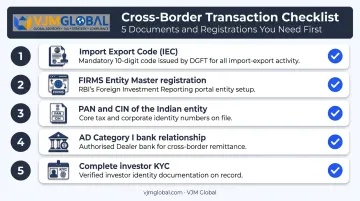
Set these up first, not after the money arrives:
- Import Export Code (IEC) from DGFT, mandatory before any shipment leaves or enters India
- Entity Master registration on RBI's FIRMS portal, required before the company can accept its first FDI inflow or file any Single Master Form reporting
- PAN and CIN of the Indian entity
- A working relationship with an Authorised Dealer (AD) Category I bank, since RBI routes almost all FDI, ECB, and trade reporting through these banks
- Complete KYC of every foreign investor or remitter, including identity, address proof, and beneficial ownership declarations, collected before funds are accepted
Skip the FIRMS Entity Master step and RBI will simply block further foreign investment reporting until it's fixed. Complete this registration before the first inflow arrives to keep the filing clock accurate.
Preconditions and Setup
Three checks matter before you touch the money:
- Classify the transaction correctly — current account or capital account. This decides which RBI form and approval route applies to you.
- Confirm sectoral FDI caps. Some sectors allow 100% automatic-route investment; others require government approval or are prohibited outright.
- Verify the business isn't in a restricted category before accepting any commitment from a foreign investor.
Foreign-invested businesses that engage a specialist firm early tend to avoid the scramble that comes later in the filing cycle. Setting up FIRMS registration and AD bank documentation before the first inflow lands makes that difference.
VJM Global works with foreign investors and multinational subsidiaries on exactly this front-loaded setup, so the reporting clock never starts against an incomplete file.
FEMA Compliance Checklist by Category
FEMA compliance spans multiple category-specific obligations, and which ones apply depends entirely on the nature of the cross-border transaction.
FDI and Share Allotment Compliance
| Step | Deadline |
|---|---|
| Verify FDI eligibility and pricing guidelines | Before accepting funds |
| Allot equity instruments | Within 60 days of receiving consideration |
| Refund unallotted funds | Within 15 days after the 60-day window closes |
| Obtain valuation certificate (CA, SEBI-registered Merchant Banker, or practicing Cost Accountant) | Before pricing the issue |
| File Form FC-GPR | Within 30 days of allotment |
| File Form FC-TRS for resident/non-resident share transfers | Within 60 days of transfer or remittance, whichever is earlier |
Miss the 60-day allotment window and don't refund within 15 days? That holding becomes a reportable contravention under RBI's foreign investment notification, full stop.
External Commercial Borrowings (ECB) Compliance
- Confirm both borrower and lender meet eligibility criteria under the current ECB framework
- Check maturity period and end-use restrictions before signing loan documents
- Submit Form ECB through your AD bank to obtain a Loan Registration Number before drawdown, not after
- File Form ECB-2 monthly, within seven working days of month-end, including nil returns where there's no activity
Export-Import (Trade) Compliance
- Register for IEC before the first shipment, no exceptions
- Realise and repatriate export proceeds within nine months of the export date
- Settle import payments within six months of shipment via Form A2, barring approved deferred-payment arrangements
- File the export declaration form (EDF) for goods and SOFTEX for software exported in non-physical form
Overseas Direct Investment (ODI) and Annual Filings
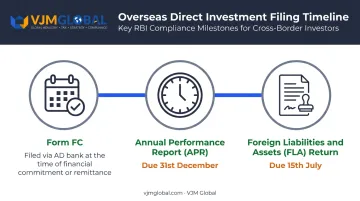
- File Form FC through the AD bank at the time of financial commitment or remittance for overseas investment
- Submit the Annual Performance Report (APR) for each foreign entity by 31st December every year
- File the Foreign Liabilities and Assets (FLA) return by 15th July if the entity had outstanding FDI or ODI as of 31st March.
This requirement applies only when a balance actually exists, not merely because flows occurred during the year, per the RBI's FLA FAQ page.
NRI and Individual Compliance
- Route funds only through NRE, NRO, or FCNR(B) accounts, never a resident savings account
- Skip agricultural land, plantation property, and farmhouses; NRIs and OCIs can't buy these under general permission
- Stay within the USD 1 million per financial year repatriation limit for eligible sale proceeds from NRO balances, inherited property, or legacy assets
How to Interpret Your FEMA Compliance Status
Knowing where you actually stand against your filing calendar determines whether your next funding round closes smoothly or gets stuck in diligence.
Fully compliant. Every form filed within its statutory window, FIRC and valuation documents on file, no pending AD bank queries. Keep running the same calendar-driven process for every new transaction.
Minor gaps. A filing landed a few days late, or documentation is incomplete but recoverable. Self-file the missing pieces with your AD bank immediately and watch for any follow-up RBI query. Don't wait for the bank to chase you.
Out-of-compliance or high risk. This is where it gets serious:
- FLA or APR deadline missed entirely
- FDI funds unallotted beyond 75 days (60-day window plus the 15-day refund grace period)
- Export proceeds unrealized beyond nine months
If you're here, consult a FEMA specialist, such as the advisory team at VJM Global, and consider a compounding application with RBI before an enforcement notice arrives. Acting first changes the entire tone of the conversation with regulators.
Common FEMA Compliance Mistakes and Best Practices
The same handful of errors show up again and again across foreign-invested and export-oriented businesses:
- Filing FC-GPR after the 30-day window closes
- Pricing FDI shares without an independent valuation certificate
- Leaving KYC incomplete for foreign investors until the AD (Authorized Dealer) bank flags it
- Forgetting Entity Master registration before the first inflow
- Missing the FLA return deadline entirely, not just filing it late
Buffer time: Set calendar reminders 5-10 days before every statutory deadline, FC-GPR, FC-TRS, FLA, APR, ECB-2, to account for AD bank processing time. Banks don't process instantly, and RBI counts the date they receive the form, not the date you send it.
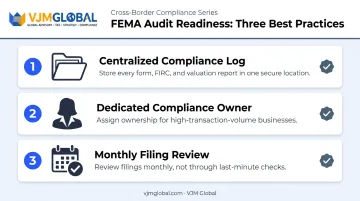
A few habits separate companies that sail through audits from those that don't:
- Maintain a centralized compliance log with every form, FIRC, and valuation report in one place
- Appoint a dedicated compliance owner for export-heavy or high-transaction-volume businesses
- Review pending filings monthly, not just when a deadline is days away
Companies without in-house regulatory expertise often lean on an advisory firm for this. VJM Global supports foreign investors and multinational companies with FEMA filings, RBI liaison, and ongoing compliance tracking, including representation in RBI compounding proceedings when a contravention has already occurred.
Conclusion
FEMA compliance follows a company through every FDI round, ECB drawdown, trade transaction, and NRI investment while it operates in India. Treating it as a one-time checklist at incorporation invites penalties and RBI scrutiny down the line.
Checklist-based tracking of deadlines and documentation separates companies that close funding rounds without friction from those facing penalties. VJM Global's FEMA advisory team helps foreign investors and NRIs build that calendar, turning compliance into a predictable part of operating in India.
Frequently Asked Questions
What is FEMA compliance in India?
It means following RBI-mandated rules and reporting requirements under the Foreign Exchange Management Act, 1999, for any transaction involving foreign exchange, including FDI, ECB, trade, and remittances.
What are the FEMA rules in India for NRIs?
NRIs must use NRE, NRO, or FCNR accounts, cannot buy agricultural land or farmhouses, and face a USD 1 million per financial year repatriation limit on eligible sale proceeds.
Who needs to comply with FEMA in India?
Any company receiving FDI, raising ECBs, exporting or importing, or transacting with non-residents must comply, regardless of company size or DPIIT recognition status.
What are the penalties for FEMA non-compliance?
Penalties can reach three times the amount involved (or ₹2,00,000 if the amount isn't quantifiable), plus ₹5,000 per day for continuing violations like a missed FLA return.
What is the deadline for filing the FLA return?
It's due annually by 15th July, filed by any Indian resident company with outstanding FDI or ODI as of 31st March that year.
Can FEMA violations be compounded?
Yes. Under Section 15 of FEMA, companies can resolve most contraventions by paying a monetary penalty through a compounding application to RBI, avoiding prosecution entirely.