Add to that a common blind spot: new entities have no AECB credit history, since the UAE's credit bureau only tracks businesses once they're operating locally. This guide walks through the financing types available, what US-owned businesses specifically need to qualify, and how to pick the right option without wasting months on the wrong application.
Key Takeaways
- UAE financing spans six categories: bank loans, Islamic financing, government schemes, fintech/P2P lending, invoice financing, and equity funding
- US owners face added KYC/UBO scrutiny, and most banks require 6-12+ months of UAE operating history before extending credit
- Free zone companies can access nearly every financing type, though some lenders require proof of economic substance
- Choosing financing that fits your business stage and cash flow cycle matters more than chasing the lowest rate
Understanding Business Financing Options in the UAE
Business financing in the UAE means capital sourced from banks, Islamic institutions, government-backed programs, or alternative lenders to fund setup costs, working capital, expansion, or trade activity.
It's available to mainland and free zone entities alike. Since the UAE's 2021 ownership reforms, 100% foreign-owned companies can now access most of these channels directly, without a local sponsor holding equity.
That said, financing isn't a menu you pick from randomly. It's a toolkit that has to match your company's ownership structure, license type, and the residency status of its founders. A mainland trading company with a UAE-resident director will qualify for different products than a free zone consultancy run entirely by non-residents.
Why It Matters for US Businesses Expanding to the UAE
Many US founders assume their American credit history or business credit score will carry weight with UAE lenders. It won't. UAE banks rely almost entirely on:
- AECB (Al Etihad Credit Bureau) reports, which track three years of payment history, court obligations, and bounced cheques
- Trade license validity and business activity match
- UAE bank account history and transaction volume
Without preparation, applications get rejected for reasons that have nothing to do with business viability. Common culprits include incomplete UBO documentation, thin local banking history, or a loan-purpose narrative that doesn't match what the trade license actually permits.
This matters because the opportunity is real. UAE foreign direct investment inflows hit $45.6 billion in 2024, up nearly 49% year-over-year, according to UNCTAD's World Investment Report 2025. That capital influx has pushed lenders and government programs to compete harder for quality SME borrowers, including foreign-owned ones, but only if the paperwork is right from the start.
Types of Business Financing Available to US Businesses in UAE
Financing in the UAE isn't one-size-fits-all. Options differ by cost, collateral requirements, approval speed, and whether they're Sharia-compliant. Eligibility also shifts depending on whether you're a brand-new entity or one with a UAE trading track record.
Traditional Bank Loans & Credit Facilities
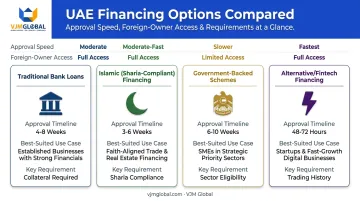
Banks like Emirates NBD, ADCB, Mashreq, and RAKBANK offer term loans, working capital facilities, overdrafts, and trade finance lines. International banks such as HSBC UAE often provide smoother account verification for US-owned entities, since they already maintain KYC infrastructure across both markets.
Best suited for: businesses with 6-12+ months of UAE trading history, steady turnover, and willingness to offer collateral or personal guarantees.
Strengths and limitations:
- Rates vary by product and borrower risk profile; RAKBANK, for example, publishes an SME Prime Rate of 15.50% per annum as its benchmark
- Approval typically runs 4-12 weeks depending on documentation completeness
- Expect strict paperwork: trade license, financial statements, bank statements, and often a business plan
Islamic (Sharia-Compliant) Financing
Dubai Islamic Bank, ADIB, and the Islamic windows of conventional banks offer three core structures:
- Murabaha – the bank buys goods you need and resells them at cost plus an agreed profit margin, typically over a 90-180 day tenor
- Ijara – asset leasing, with ownership transferring to you once all payments complete
- Musharaka – a partnership structure where capital and risk are shared between bank and borrower
These are profit-based rather than interest-based and usually asset-backed, which appeals to ethically-conscious US founders or those trading with partners in Islamic-finance markets.
Best suited for: equipment or property purchases, trade finance, and businesses wanting a partnership-style capital structure instead of a straight loan.
Limitations: additional Sharia compliance documentation, and processing can run slightly longer than a conventional facility.
Government-Backed & Innovation Financing Schemes
Three programs dominate this category:
| Program | Focus | Foreign-owner access |
|---|---|---|
| Khalifa Fund | Emirati entrepreneurship, Abu Dhabi SMEs | Direct funding generally excludes wholly foreign-owned firms |
| MBRIF Guarantee Scheme | Non-dilutive loan guarantees for innovative businesses | Open to any nationality per its published FAQ |
| Emirates Development Bank | Manufacturing, healthcare, renewables, tech | Available to residents, subject to sector and credit review |
Best suited for: innovation-driven startups or SMEs in priority sectors seeking subsidized rates and mentorship alongside capital.
Limitations: competitive selection, approval timelines of 8-16 weeks, and eligibility rules that can shut out entities without UAE resident ownership or management.
Alternative & Fintech Financing (P2P, Invoice Financing, Equity/VC)
Digital lenders like Beehive and Funding Souq offer invoice-backed working capital and Sharia-compliant SME finance, often disbursing funds within days of final approval rather than the weeks a bank might take. Merchant cash advances and receivables factoring fill similar gaps for businesses with strong sales but slow-paying clients.
On the equity side, UAE-focused VC firms including BECO Capital, Wamda Capital, and Shorooq Partners fund high-growth ventures willing to trade ownership for capital.
The market backing this is substantial: UAE startups raised $1.1 billion across 207 deals in 2024, representing roughly 33% of all MENA venture funding, per MAGNiTT's 2024 UAE Venture Investment Report.
Best suited for: startups without established UAE credit history, or founders open to dilution in exchange for speed and growth capital.
Trade-off: faster access and less reliance on lengthy credit checks, but often higher effective cost or loss of ownership control.
How to Choose the Right Financing Option for Your US Business
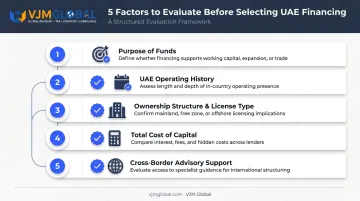
The "best" option depends on your business stage, ownership structure, and what the money is actually for, not on popularity or the lowest headline rate. Run through these five factors before applying:
Five Factors to Evaluate
- Purpose of funds – working capital, asset purchase, and expansion each point toward a different product. A term loan doesn't suit equipment purchases the way Ijara leasing, an asset-based lease structure common in the UAE, does.
- UAE operating history – startups under six months of trading typically rely on fintech or invoice financing; firms with a year or more of clean banking history can pursue bank credit.
- Ownership structure and license type – mainland versus free zone status affects lender risk appetite. A 100% foreign-owned free zone entity may need to show extra proof of local economic substance.
- Total cost of capital – compare interest or profit rates alongside processing fees, early settlement penalties, and any currency conversion costs baked into the deal.
- Cross-border advisory support – founders often compare UAE financing against their broader global expansion strategy, sometimes weighing it against alternative hubs like India. This is where cross-border advisory support proves especially valuable, translating these trade-offs into a clear recommendation for your specific situation.
VJM Global has supported more than 500 American business owners with entity structuring, accounting, and compliance work as they expand internationally. That kind of cross-border perspective helps founders see how financing decisions in one market affect tax exposure, reporting obligations, and cash flow in another, rather than evaluating the UAE in isolation.
Key Considerations and Mistakes to Avoid Before Finalizing Financing
A few missteps show up again and again with foreign-owned applicants:
- Overcomplicating the ask. Giving up equity through VC funding when a straightforward bank loan or government scheme would cover the actual need costs you ownership for no good reason.
- Overlooking documentation. Incomplete UBO (Ultimate Beneficial Owner) disclosures, missing AECB (Al Etihad Credit Bureau) credit history, or a trade license that doesn't match your real business activity are the top rejection triggers for US-owned entities.
- Ignoring the long-term cost. Prepayment penalties, USD-to-AED conversion costs, and ongoing compliance or reporting obligations add up well beyond the headline interest rate.
Before signing anything, map out the full lifecycle cost, not just the monthly repayment figure.
Conclusion
The UAE's financing ecosystem is genuinely diverse, spanning conventional bank credit, Islamic structures, government-backed schemes, and a fast-growing fintech and VC scene. None of it is automatically off-limits to US-owned businesses.
What determines approval odds and cost efficiency comes down to matching the financing type to your business stage, ownership structure, and how ready your documentation actually is.
Businesses managing operations across the US, UAE, and India face added compliance complexity. If your UAE venture also touches Indian operations, an experienced cross-border advisory partner such as VJM Global can help keep the financial and compliance picture clear while you focus on growth.
Frequently Asked Questions
What are the best financing options for a business in the UAE?
The best mix usually combines bank term loans for established firms, Islamic financing for asset purchases, government schemes for startups, and fintech or P2P lending for fast, flexible capital.
Can I get a loan to start a business in the UAE?
Pure startups face stricter scrutiny, but options like government-backed guarantee schemes, invoice financing, or founder-backed alternative lenders remain accessible even with limited UAE trading history.
Can a US-owned free zone company get a business loan in the UAE?
Yes. Free zone companies can access most financing types, though lenders may request additional proof of economic substance and an active UAE banking relationship before approving credit.
What documents does a US business need for UAE financing applications?
Core requirements include your trade license, UBO and KYC documents, 6-12 months of UAE bank statements, a business plan, and financial projections. Missing or inconsistent documentation is the top reason for rejection.
How does Islamic financing differ in cost from conventional UAE bank loans?
Islamic profit rates are often comparable to conventional interest rates, typically mid-single to low double digits depending on the product. Sharia compliance can add processing time and extra documentation.
How long does it take to secure financing for a UAE business as a foreign owner?
Digital and fintech lenders can approve funding within days once your file is complete. Bank loans and government schemes usually take 4-16 weeks, depending on how ready your documentation is.