But here's what many Indian business owners miss: setting up a UAE entity isn't just a Dubai problem. It's an RBI problem, a FEMA problem, and a cross-border tax problem, all at once.
Skip the compliance homework and you risk remittance freezes, penalty notices, or a UAE company that can't legally send money home. This guide walks through setup options, real costs, documentation, and the tax roadmap Indian founders need on both sides of the Arabian Sea, with insights from VJM Global's cross-border advisory experience.
Key Takeaways
- Dubai offers 100% foreign ownership and 0% corporate tax on the first AED 375,000 of net profit.
- Indian residents need RBI approval (ODI or LRS) before funding a UAE entity.
- Match your Mainland, Free Zone, or Offshore structure to your target market, not just your budget.
- The India-UAE DTAA avoids double taxation only with a valid Tax Residency Certificate.
- UAE Corporate Tax registration is mandatory, even with zero tax liability.
Why Indian Companies Are Expanding to Dubai
The numbers tell the story. India-UAE bilateral trade hit US$100.05 billion in FY2024-25, and Indian outbound investment into the UAE has crossed US$16.5 billion since 2000, according to the Consulate General of India in Dubai. Dubai Chamber alone added 12,142 new Indian-owned companies in just the first nine months of 2024.
That growth isn't accidental. Several forces are converging:
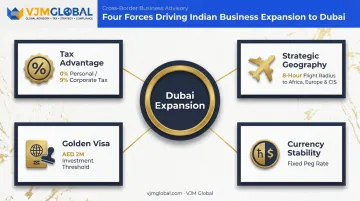
- Tax structure favours lean businesses. UAE charges 0% personal income tax and just 9% corporate tax above AED 375,000 in profit, versus India's 25-30% standard corporate rate.
- Geography puts Dubai within reach of key markets. It sits within an eight-hour flight of Africa, Europe, and the CIS region, making it a natural re-export hub for Indian traders.
- The Golden Visa simplifies residency. Investors putting in AED 2 million, or entrepreneurs with a project worth AED 500,000+, can secure long-term residency for themselves and their families without a local sponsor.
- Currency stability protects margins. The dirham has stayed pegged to the US dollar at 3.6725, per the Central Bank of the UAE, shielding Indian founders from rupee volatility on dollar-denominated contracts.
Business Setup Options in Dubai for Indian Entrepreneurs
The first decision every Indian founder faces is choosing between Mainland, Free Zone, and Offshore structures, not the company name. This choice shapes everything downstream: ownership rules, market access, tax treatment, and even how many visas you can sponsor.
Mainland Company Setup
Mainland companies are licensed by Dubai's Department of Economy and Tourism and can trade directly with the local UAE market, bid on government contracts, and operate anywhere in the emirate.
Most activities now permit 100% foreign ownership, a major shift from the old 51% local-sponsor requirement. The trade-off: mainland setups need a physical office with a registered Ejari tenancy contract, which pushes up first-year costs. This makes mainland the natural fit for founders chasing government tenders, retail storefronts, or B2B contracts with UAE-based corporates.
Free Zone Company Setup
Free zones remain the default choice for Indian IT firms, consultants, and traders who don't need direct mainland access. The appeal is straightforward:
- 100% foreign ownership as standard, not an exception
- 0% tax on qualifying income, though this comes with conditions under UAE Corporate Tax law
- Single-window processing for licensing, visas, and registration through one authority
However, free zone companies generally cannot trade directly with mainland UAE customers without a distributor or additional licensing arrangement. A free zone company is still a taxable person under UAE Corporate Tax; the 0% rate applies only to income that qualifies under the Qualifying Free Zone Person rules, not automatically to everything the company earns.
Offshore Company Setup
Offshore structures, such as JAFZA offshore, exist for holding assets, structuring IP, or facilitating international trade. This route works well for Indian promoters who want a UAE holding vehicle without running day-to-day operations there. It cannot, however, conduct commercial business directly with persons inside the UAE.
Match your license type (Commercial, Professional, or Industrial) to your actual business activity. Mismatched licensing is one of the most common compliance headaches Indian founders discover only after their bank starts asking questions.
| Structure | Best for | Ownership | Main limitation |
|---|---|---|---|
| Mainland | Direct UAE market trade, government contracts | 100% (most activities) | Higher setup and office costs |
| Free Zone | Exports, IT, consulting, trading | 100% standard | Restricted mainland market access |
| Offshore | Holding, IP, international trade | 100% | Cannot trade with UAE persons |
Step-by-Step Setup Process, Documentation & Costs
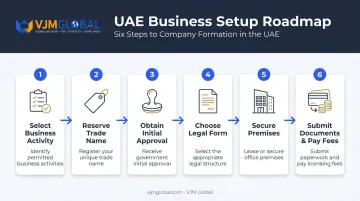
Once you've picked a structure, the process follows a fairly predictable sequence:
- Select your business activity from the relevant authority's approved list
- Reserve a trade name that complies with naming conventions
- Obtain initial approval from the licensing authority
- Choose your legal form (sole establishment, LLC, branch, and so on)
- Secure premises — Ejari registration for mainland, or a flexi-desk for free zones
- Submit final documents and pay fees to receive your license
Documentation Indian Applicants Need
Expect to submit passport copies, passport-sized photographs, a business plan, and, where relevant, attested professional qualifications. Indian-specific documents must also clear a multi-step attestation chain before they're accepted in the UAE:
- State-level pre-authentication in India
- MEA (Ministry of External Affairs) attestation
- UAE Embassy legalisation
- UAE Ministry of Foreign Affairs attestation once the document reaches the UAE
Routing the Investment Through RBI
This is where many Indian founders stumble. Individual investors must route funds through RBI's Liberalised Remittance Scheme, capped at US$250,000 per financial year. Indian companies instead use the Overseas Direct Investment route through a designated authorised dealer bank, generally capped at 400% of net worth under the automatic route.
What Year One Actually Costs
Published fee schedules from free zones like DMCC give a useful benchmark:
- License and registration: roughly AED 10,000-20,000 depending on activity
- Flexi-desk or office space: AED 16,000-19,000 for free zones; mainland offices typically cost more due to mandatory Ejari tenancy
- Employee visa (2-year): around AED 3,000 per visa
- Emirates ID and medical fitness test: AED 350-400 combined per person
There's no single "mainland always costs more" rule, but the mandatory physical office requirement usually tips mainland setups higher than a comparable free zone flexi-desk package.
Beyond these setup and visa costs, timing often hinges on one more step: opening a corporate bank account. Bank account opening is often the real bottleneck. UAE banks apply full due diligence, verifying legal structure, ownership, business purpose, and source of funds, before approving a corporate account. A clean, well-documented business profile speeds this up considerably; a vague one can add weeks to your timeline.
Taxation, RBI Compliance & Accounting Support for Indian-Owned UAE Companies
Getting the license is the easy part. Staying compliant across two tax jurisdictions is where most Indian-owned UAE companies need real support.
UAE Corporate Tax Registration & DTAA Treaty Benefits
Every juridical person subject to UAE Corporate Tax, including free zone entities, must register and obtain a Corporate Tax Registration Number, regardless of whether they owe any tax. A small consultancy earning AED 200,000 in net profit still has to register, even though its effective liability is zero.
The India-UAE Double Taxation Avoidance Agreement, in force since 1993, prevents this same business income from being taxed twice once it flows back to India. To claim treaty benefits, Indian residents generally need:
- A Tax Residency Certificate (TRC) from the relevant authority
- Form 10F with prescribed details not covered in the TRC itself
- Supporting documentation such as incorporation records and audited financials
Ongoing RBI Reporting Obligations
Holding an ODI in a UAE entity isn't a one-time filing. Indian residents and companies must generally submit an Annual Performance Report by December 31 each year, based on the foreign entity's audited financials. Missing this deadline can restrict future remittances until RBI regularises the default through its late-fee mechanism.
For example, a promoter who skips two consecutive APR filings may lose the automatic route entirely, needing RBI's prior approval for any further outward remittance.
Where Accounting Support Actually Matters
Between UAE-side VAT filings, payroll records, and bookkeeping, and Indian-side income tax and GST reconciliation, the paperwork adds up fast. Inconsistent books on either side create mismatches that complicate both TRC applications and RBI reporting.
VJM Global's team of Chartered Accountants and cross-border tax advisors handles this bookkeeping, VAT filing, and compliance workload end-to-end for Indian-owned UAE entities, so founders aren't reconciling two countries' tax calendars manually.
Why Partner with VJM Global for Your Dubai-India Business Journey
Cross-border structuring rewards firms that understand Indian regulations and UAE requirements with equal depth.
VJM Global brings 30+ years of tax, audit, and advisory experience, with a track record serving 500+ US businesses, 250+ UK companies, and 250+ Australian firms navigating international structuring. That cross-border experience across three continents translates into practical know-how for the emerging India-UAE corridor.
What sets the engagement apart:
- A 100+ member team of Chartered Accountants and business setup professionals who understand both Indian regulatory nuances (FEMA, RBI, GST) and international structuring
- Transparent pricing with no hidden fees buried in fine print
- 24/7 support for time-sensitive filings and remittance deadlines
- A single point of contact managing entity setup alongside ongoing accounting and tax compliance across both jurisdictions

For Indian founders juggling an RBI reporting deadline in December and a UAE Corporate Tax registration in the same quarter, that single point of contact keeps both deadlines on track. It prevents overlapping filings from spiraling into compliance chaos.
Frequently Asked Questions
How much does it cost to set up a business in UAE?
Year-one costs typically range from AED 25,000-50,000+, covering license fees, office space, visa processing, and Emirates ID/medical fees. Mainland setups cost more due to mandatory physical office requirements.
What does "full-service" business setup support include?
Full-service support covers licensing, visa processing, PRO services, and bank account assistance from start to finish. VJM Global provides this complete package alongside ongoing accounting and tax compliance.
Can an Indian citizen own 100% of a company in Dubai?
Yes, most Mainland and Free Zone activities now permit full foreign ownership. A short list of strategic-impact sectors, such as defence and currency printing, still carry restrictions.
Do I need RBI approval to invest in a UAE company from India?
Yes. Individuals route investment through the Liberalised Remittance Scheme, while companies use the Overseas Direct Investment framework via a designated bank. Required reporting forms must be filed accordingly.
Does the UAE's 9% corporate tax apply to small Indian-owned businesses?
The 9% rate only applies above AED 375,000 in net profit. However, registration remains mandatory for all UAE entities regardless of profit level.
How does the India-UAE DTAA benefit Indian business owners?
The DTAA prevents the same income from being taxed in both India and the UAE. Claiming this benefit requires a valid Tax Residency Certificate along with supporting documentation like Form 10F.