Introduction
Indian entrepreneurs are registering companies in Dubai in growing numbers. In 2025 alone, 18,486 new Indian-owned companies joined the Dubai Chamber of Commerce — an 11% year-over-year increase that placed Indian businesses at the top of all foreign nationalities for new registrations. The appeal is clear: zero personal income tax, a location that bridges Indian and international trade routes, and a regulatory environment permitting 100% foreign ownership in most business sectors.
Yet one question consistently trips up first-time registrants: How much does it actually cost to register a company in Dubai? Costs range widely — from under AED 15,000 for a budget free zone setup to over AED 80,000 for a premium mainland LLC. The actual figure depends on jurisdiction, business activity, and — critically for Indian entrepreneurs — compliance obligations under India's Foreign Exchange Management Act (FEMA).
This guide covers everything you need to budget accurately before you begin:
- Pricing broken down by jurisdiction (free zone, mainland, offshore)
- Every cost component, including India-side fees most Dubai setup guides skip
- FEMA and Double Tax Avoidance Agreement (DTAA) requirements explained
- AED-to-INR conversions so numbers translate to real planning figures
Key Takeaways
- First-year setup costs start at AED 12,000–25,000 (₹3.1 lakh–6.4 lakh) for offshore, AED 15,000–50,000 (₹3.9 lakh–12.9 lakh) for free zones, and AED 30,000–80,000+ (₹7.7 lakh–20.6 lakh+) for mainland
- Key cost drivers: jurisdiction choice, trade license type, number of visas, and office space requirements
- Indian entrepreneurs carry extra compliance costs: FEMA/RBI reporting, advisor fees (₹30,000–₹1,50,000), and bank minimum balance requirements
- Free zones offer the best balance of cost, 100% ownership, and tax efficiency for IT, consulting, and service businesses
- Annual renewals run 60–80% of first-year setup fees — budget for this from day one
How Much Does It Cost to Register a Company in Dubai?
There's no single fixed cost. Dubai company registration expenses depend on four primary variables: jurisdiction (Mainland, Free Zone, or Offshore), trade license type, office solution, and visa requirements. Misunderstanding this leads Indian entrepreneurs to underbudget by 30–50%, choose unsuitable structures, or face expensive restructuring within 18 months.
Offshore Company Setup (Budget Tier)
Cost range: AED 12,000–25,000 (~₹3.1L–6.4L)
Offshore entities like RAK ICC International Business Companies cost AED 3,250 for incorporation plus AED 12,500 annually for a registered agent, totaling approximately AED 15,750 in year one. This package includes:
- Company registration certificate
- Memorandum and Articles of Association
- Registered agent and UAE address
- Up to 3 business activities and shareholders
Best for: Indian entrepreneurs needing a UAE holding company, international trading vehicle, or asset protection structure — provided UAE residency is not a requirement. Offshore entities cannot sponsor UAE residence visas; physical presence requires a separate arrangement.
Free Zone Company Setup (Mid-Range Tier)
Cost range: AED 15,000–50,000 (~₹3.9L–12.9L) first year
Free zones deliver the right cost-ownership-compliance balance for most Indian startups:
| Free Zone | License Cost | What's Included |
|---|---|---|
| RAKEZ | AED 14,000 | License + 1 visa + coworking access + 10 activities |
| IFZA | AED 14,900–16,900 | License + 1–2 visa allocations |
| Meydan | From AED 12,500 | Flexi-desk package (calculator-based pricing) |
| DMCC | AED 20,340+ | Registration + service/trading license |
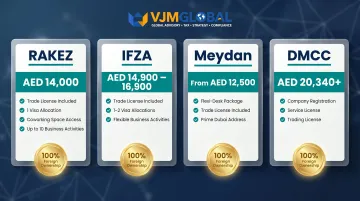
All free zones permit 100% foreign ownership with no local sponsor requirement. Flexi-desk or coworking space (AED 5,000–20,000/year) satisfies the mandatory office requirement without the Ejari-registered lease burden of mainland setups.
Best for: Indian entrepreneurs in IT/tech, consulting, e-commerce, professional services, or general trading who want full ownership, tax efficiency, and visa eligibility at the lowest entry cost.
Mainland Company Setup (Premium Tier)
Cost range: AED 30,000–80,000+ (~₹7.7L–20.6L+)
Mainland setup grants unrestricted access to the UAE domestic market but demands higher investment:
- Commercial/Trading License: AED 10,000–20,000
- Professional License: AED 10,000–18,000
- Industrial License: AED 15,000–25,000+
- Physical Office (Ejari-registered): AED 15,000–50,000+/year
- Local Service Agent (for professional activities): AED 8,000–20,000/year
Since the 2021 Commercial Companies Law reforms, 100% foreign ownership is permitted for most mainland activities. The exception: professional licenses (consulting, IT, accounting, engineering, education, medical) still require a Local Service Agent, a UAE national who handles government liaison but holds no equity stake.
This structure suits Indian entrepreneurs targeting UAE consumers directly — retail, F&B, construction — or those pursuing government contracts that free zone entities cannot access.
Key Factors That Affect Dubai Company Registration Costs for Indian Entrepreneurs
Dubai's company registration costs vary widely — and for Indian entrepreneurs, several India-specific factors add layers that most general setup guides ignore entirely. Beyond standard fees, your jurisdiction choice, FEMA compliance obligations, and how the India-UAE DTAA applies to your structure all affect the true cost of getting started.
Jurisdiction and Business Activity Type
The Mainland vs. Free Zone vs. Offshore choice determines 60–70% of total cost variance. Further, business activity nature — professional (consulting/IT), commercial (trading), or industrial (manufacturing) — dictates license type and approval authorities. Industrial licenses involve facility inspections and higher fees.
Office Space Requirements
Office requirements differ significantly by structure:
| Setup Type | Office Requirement | Typical Annual Cost |
|---|---|---|
| Mainland | Physical office, Ejari-registered lease | AED 15,000–50,000+ |
| Free Zone | Flexi-desk or coworking membership | AED 5,000–15,000 |
Free zones are the more cost-effective option for startups and solo entrepreneurs who don't need a physical storefront.
Number of Visas Required
Each UAE residence visa adds AED 3,500–7,000 to the budget, covering:
- Employment visa processing (AED 3,330–3,930)
- Medical fitness test (AED 320–850)
- Emirates ID biometric registration (AED 270)
- Establishment card (AED 1,800 annually)
Visa quotas tie to office size in most free zones. Indian entrepreneurs often underestimate costs when planning family relocation or hiring initial staff.
Local Sponsor or Service Agent Requirements
For mainland professional licenses, a Local Service Agent remains mandatory despite 100% ownership reforms — costing AED 8,000–20,000/year. This is a purely administrative role with no equity sharing, but it is non-negotiable for IT consultancies, management advisory firms, and educational services, which are among the most common sectors for Indian entrepreneurs in Dubai.
India-Specific Compliance Costs
Indian residents (distinct from NRIs/OCIs) must comply with FEMA regulations when remitting funds for overseas business investment:
- Invest up to USD 250,000 per financial year under the Liberalised Remittance Scheme (LRS), cumulative across all purposes
- File Form FC within 30 days of remittance through an Authorized Dealer bank
- Obtain a Unique Identification Number (UIN) before making your first remittance
- Submit an Annual Performance Report (APR) by December 31 each year

Each of these steps typically requires a Chartered Accountant or legal advisor in India, adding ₹30,000–₹1,50,000+ in professional fees that most Dubai setup guides omit entirely.
Note that Indian entities operate under different rules: total overseas investment cannot exceed 400% of net worth under the automatic route.
Complete Cost Breakdown: What Indian Entrepreneurs Are Actually Paying For
Total Dubai company registration cost extends far beyond the trade license fee. Understanding one-time setup costs, annual recurring costs, and India-side compliance fees defines the true budget. Here's what each category actually costs — broken down by component, so nothing catches you off guard.
| Cost Category | Type | Approximate Range (AED) |
|---|---|---|
| Trade Name Registration | One-time | 620–2,000 |
| Trade License | Annual | 10,000–20,285 |
| Office / Flexi-Desk | Annual | 5,000–50,000+ |
| Visa & Government Fees | Per person | 3,500–7,000 |
| Bank Minimum Balance | Ongoing reserve | 25,000–50,000 |
Trade Name Registration and Initial Approval
Registration runs AED 620–2,000 depending on language and jurisdiction:
- Arabic trade name (DED mainland): AED 620
- Non-Arabic or foreign name: AED 2,000
- DMCC initial approval: AED 1,035
Foreign-language names carry surcharges. Budget for the higher range if registering a brand name in English or another non-Arabic language.
Trade License Fee
The trade license is your largest annual recurring cost — and it renews every year without exception:
- Free zone service/trading license (DMCC): AED 10,285–20,285
- Mainland commercial license: AED 10,000–20,000
- Mainland professional license: AED 10,000–18,000
- Budget free zones (RAKEZ/IFZA): bundled in AED 14,000–16,900 packages
There is no workaround for this fee. Letting it lapse means your company operates illegally.
Office Space and Flexi-Desk Fees
A registered UAE address is mandatory even if you operate entirely from India. Office costs vary widely by setup type:
- Budget free zone flexi-desk: AED 5,000–10,000/year
- Premium free zone coworking (DMCC): AED 15,000–20,000/year
- Mainland physical office: AED 15,000–50,000+/year (location-dependent)
For Indian entrepreneurs in the early stages, a flexi-desk satisfies the address requirement at the lowest possible cost.
Visa and Government Processing Fees
Per-person visa costs run AED 3,500–7,000, broken down as follows:
- Employment visa: AED 3,330–3,930
- Medical fitness: AED 320–850
- Emirates ID: AED 270
- Establishment card: AED 1,800/year
One detail many Indian entrepreneurs miss: biometric registration for the Emirates ID requires physical presence in the UAE. Plan for at least one trip — typically 3–5 days — during the setup process.
Share Capital and Bank Account Minimum Balance
Share capital requirements are straightforward: free zones have no minimum, while mainland LLCs typically declare AED 50,000 in the Memorandum of Association (stated on paper, not physically deposited).
Bank account minimum balances are a different matter — this is real cash you must keep parked:
- RAKBank: AED 25,000 average monthly balance
- Emirates NBD / Mashreq / ADIB: AED 50,000
That's up to AED 50,000 in locked reserves on top of all setup fees. Factor this into your total capital requirement from day one, not as an afterthought.
Free Zone vs Mainland vs Offshore: Which Suits Indian Entrepreneurs Best?
| Dimension | Offshore | Free Zone | Mainland |
|---|---|---|---|
| First-year cost | AED 12,000–25,000 | AED 15,000–50,000 | AED 30,000–80,000+ |
| Ownership | 100% foreign | 100% foreign | 100% foreign (LSA for professional) |
| Market access | International only | Free zone + distributor model | Full UAE market |
| Visa eligibility | ✗ No | ✓ Yes | ✓ Yes |
| Office requirement | Registered address only | Flexi-desk (AED 5K–20K) | Physical + Ejari (AED 15K–50K+) |
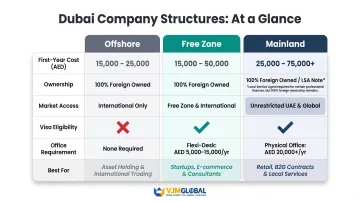
For Indian entrepreneurs in early growth stages, free zones offer the strongest combination of low cost, 100% ownership, tax efficiency, and visa eligibility. This holds especially true for technology, consulting, and export-oriented services. Mainland registration suits businesses that need direct UAE market access: retail, F&B, construction, and government contracts.
Many Indian entrepreneurs assume the cheapest setup is always optimal — that assumption is costly. Choosing the wrong jurisdiction can create problems that compound over time:
- Restricted banking access: some banks scrutinise certain free zones more heavily
- Restructuring costs: switching jurisdictions later adds legal and licensing fees
- Lost business opportunities: market access limitations may not surface until year two
Always evaluate 3-year total cost, not year-one setup fees alone.
What Indian Entrepreneurs Often Miss When Budgeting for Dubai
Recurring Annual Renewal Costs
Trade license renewal, establishment card renewal, visa renewals, and registered office fees collectively equal 60–80% of first-year setup costs. For a RAKEZ setup at AED 14,000 initially, expect annual renewals around AED 10,000–12,000.
India-Side Professional and Compliance Fees
Indian residents must engage a Chartered Accountant or legal advisor to:
- Structure the investment correctly under FEMA
- File Form FC (Financial Commitment) within 30 days of remittance
- Obtain a Unique Identification Number (UIN) from RBI
- Submit Annual Performance Reports (APR) by December 31
- Leverage the India-UAE DTAA for tax efficiency
These services cost ₹30,000–₹1,50,000 and are rarely covered in standard Dubai setup checklists. NRIs and OCIs face fewer restrictions but should still consult cross-border tax advisors to correctly apply DTAA provisions and avoid double taxation on UAE income.
Hidden Banking and Operational Costs
Corporate bank account setup in Dubai can be declined for Indian passport holders if business plans or transaction history are insufficient. Banks typically require:
- Personal visit to UAE branch
- Detailed business plan and financial projections
- Minimum balance deposits (AED 25,000–50,000)
- Proof of business activity and source of funds
Beyond banking, VAT compliance adds another layer of cost. UAE levies 5% VAT on most services, and registration becomes mandatory once taxable supplies exceed AED 375,000 annually. Late registration carries penalties starting at AED 10,000; late filing penalties run AED 1,000–2,000 per offense. Factor in ongoing accounting and VAT filing fees — typically AED 3,000–8,000 annually — when projecting your true operational costs.
Conclusion
Dubai company registration costs range from approximately AED 12,000 for offshore setups to AED 80,000+ for full mainland operations. Indian entrepreneurs face an additional compliance layer that demands advance planning:
- FEMA reporting obligations tied to outbound investment
- RBI filings under the Overseas Direct Investment framework
- Banking preparation to satisfy UAE account opening requirements
Choosing purely on price — without weighing jurisdiction restrictions, banking viability, or India-UAE DTAA implications — often leads to expensive restructuring within 18–24 months. The setup that costs least upfront rarely stays cheapest once banking rejections, licensing gaps, or missed ODI filings enter the picture.
VJM Global brings 30+ years of cross-border advisory experience to Indian entrepreneurs expanding into Dubai. From jurisdiction selection and ODI filing to DTAA planning and India-side FEMA compliance, the firm helps structure Dubai setups that hold up operationally — not just on paper.
Frequently Asked Questions
Frequently Asked Questions
How much will it cost to register a company in Dubai?
Costs vary by jurisdiction: Offshore (AED 12,000–25,000), Free Zone (AED 15,000–50,000), and Mainland (AED 30,000–80,000+). Final cost depends on license type, office choice, and number of visas. Indian residents must add ₹30,000–₹1,50,000 for India-side FEMA compliance advisory.
What types of business can we start with 50,000 AED in Dubai?
AED 50,000 is sufficient for a professional or commercial company in most free zones (RAKEZ, IFZA, Meydan) with a flexi-desk and one investor visa included. Typical setups cover IT consulting, e-commerce, digital marketing, general trading, and management advisory.
Is it cheaper to register a company in a Dubai Free Zone or Mainland?
Free zones are generally cheaper (AED 15,000–35,000 vs. AED 30,000–80,000 for mainland) and allow 100% foreign ownership without local sponsors. Mainland costs more but grants unrestricted access to the UAE domestic market and government contracts.
Can an Indian citizen own 100% of a company in Dubai?
Yes. 100% foreign ownership is permitted in all UAE free zones and most mainland activities under the 2021 Commercial Companies Law reforms. Regulated sectors such as banking, telecom, and defense still require a Local Service Agent, though that role carries 0% equity.
What are the annual renewal costs for a Dubai company?
Annual renewal costs — covering trade license, establishment card, office/flexi-desk, and visa renewals — typically range from AED 10,000–30,000 depending on jurisdiction and setup type. This represents 60–80% of first-year costs.
Do Indian entrepreneurs need to comply with FEMA or RBI rules when setting up a company in Dubai?
Indian residents must comply with FEMA's Overseas Direct Investment regulations and file Form FC within 30 days of remittance through an Authorized Dealer bank, subject to the USD 250,000/year LRS limit. NRIs and OCIs face fewer restrictions but should consult a cross-border tax advisor to maximize India-UAE DTAA benefits.