Many Indian entrepreneurs focus exclusively on the UAE incorporation process, overlooking the critical India-side obligations that can trigger serious penalties. The regulatory burden varies dramatically based on residency status—what's straightforward for an NRI can become complex and compliance-heavy for an Indian resident. India was Dubai's top FDI source in 2024 at $3 billion (21.5% share), reflecting the strong bilateral corridor, yet many entrepreneurs still stumble on basic FEMA reporting requirements.
This guide addresses the complete picture: how to register a Dubai offshore company, what it legally can and cannot do, and—crucially—how to stay compliant with India's Foreign Exchange Management Act (FEMA), RBI reporting obligations, and income tax disclosure requirements.
Key Takeaways
- Dubai offshore companies are registered in JAFZA or RAK ICC and can only conduct international business—no UAE operations or visa sponsorship allowed
- Indian residents must comply with FEMA's Overseas Direct Investment rules: file Form ODI through an authorized dealer bank and disclose the entity in Schedule FA and Schedule FSI of their ITR
- RAK ICC costs approximately 65% less than JAFZA (AED 3,250 vs. AED 10,000), but JAFZA allows Dubai real estate ownership
- NRIs and OCIs face a significantly lower regulatory burden than Indian residents under FEMA
- Non-disclosure of foreign assets triggers flat INR 10 lakh penalties under the Black Money Act, plus potential imprisonment
What Is a Dubai Offshore Company?
A Dubai offshore company—formally called an International Business Company (IBC)—is a legal entity registered in a UAE free zone jurisdiction whose operations are conducted entirely outside the UAE. It possesses a separate legal personality and limits shareholder liability.
An offshore company receives only a Certificate of Incorporation, not a business license. It cannot conduct commercial activities within the UAE—onshore or within any free zone—and does not grant the right to apply for UAE residency visas. Its legal address is the registered agent's office, not a physical UAE office.
Two jurisdictions handle the vast majority of offshore incorporations for Indian entrepreneurs. Here's how they differ in practice.
Primary Offshore Jurisdictions
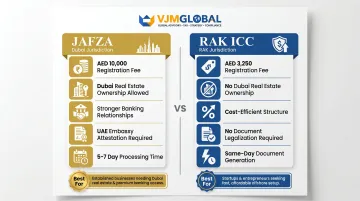
Jebel Ali Free Zone Authority (JAFZA):
- Registered under Dubai jurisdiction
- Permits ownership of freehold property in designated Dubai areas (with NOC from JAFZA)
- Preferred by banks for international account opening due to Dubai's global financial standing
- Registration fee: AED 10,000
- Indian corporate documents must be attested via UAE Embassy before submission
- Processing: 5–7 working days
RAK International Corporate Centre (RAK ICC):
- Registered under Ras Al Khaimah jurisdiction
- Does not permit Dubai real estate ownership
- More cost-effective (incorporation fee: AED 3,250)
- No foreign document legalization required
- Faster processing (documents generated on registration)
Offshore vs. Free Zone Company
The key differences come down to what you can actually do with each structure:
| Feature | Offshore Company | Free Zone Company |
|---|---|---|
| UAE business activity | Prohibited | Permitted (within free zone) |
| UAE residence visas | Cannot issue | Can issue |
| Physical office | Not permitted | Required |
| Document issued | Certificate of Incorporation | Trade License |
| Best for | International holding, trading, IP | UAE operations, staffing |
Why this matters: If you need to hire employees in Dubai, conduct business in the UAE market, or sponsor residence visas, you need a free zone company (FZE or FZCO), not an offshore structure.
Why Indian Entrepreneurs Are Choosing Dubai for Offshore Business Setup
Zero Corporate Tax on Qualifying Income
The UAE introduced a 9% federal corporate tax effective June 1, 2023, but offshore companies may qualify for a 0% rate on Qualifying Income under Qualifying Free Zone Person (QFZP) status. Meeting that status requires satisfying all of the following:
- Adequate economic substance in the UAE
- Income classified as "qualifying income"
- Arm's length pricing on related-party transactions
- Transfer pricing documentation
- Audited financial statements
- Revenue threshold (de minimis) requirements
Important: QFZP status is conditional, not automatic. Whether a JAFZA or RAK ICC offshore company qualifies requires fact-specific analysis. The UAE also imposes 0% personal income tax on individuals.
India-UAE DTAA Benefits
The Double Taxation Avoidance Agreement between India and UAE provides:
- Dividend withholding capped at 10% (Article 10)
- Business profits taxed only in resident state unless a Permanent Establishment exists (Article 7)
- Credit method for eliminating double taxation (Article 25)
In practice, this means an Indian entrepreneur operating through a UAE offshore entity can receive dividends at a maximum 10% withholding rate — rather than the standard 20% under domestic Indian law — provided the structure has genuine commercial substance.
100% Foreign Ownership & No Local Sponsor
Unlike many other jurisdictions where Indian entrepreneurs face ownership restrictions, Dubai offshore companies permit:
- 100% foreign ownership
- No UAE national sponsor required
- Minimum one shareholder (up to 50 for RAK ICC)
- Full control of the entity
This is particularly valuable for Indian business families and HNIs structuring asset protection or intellectual property holdings.
Strategic Global Trade Positioning
Dubai's geographic position covers time zones from India to Europe within a single business day — a practical advantage for entrepreneurs managing clients across multiple regions. Banking infrastructure supports multi-currency accounts, and established trade corridors reach MENA, Africa, and Southeast Asia with minimal friction.
For Indian exporters, consultants, and service providers targeting international markets, a Dubai offshore entity lets them invoice globally, collect in multiple currencies, and reinvest profits without an immediate local tax drag.
Growing Indian Investment Flows
India became Dubai's top FDI source in 2024, accounting for 21.5% of total FDI capital with over $3 billion invested. Bilateral trade reached USD 100.06 billion in FY 2024-25, making UAE India's 3rd-largest trading partner.
NRI Advantage: NRIs holding non-resident status under FEMA face a substantially lower regulatory burden than Indian residents when setting up Dubai offshore companies. For this segment, the compliance path is more straightforward and the structuring options broader.
Step-by-Step: How to Register a Dubai Offshore Company as an Indian Entrepreneur
The end-to-end process takes 5–15 working days and can be completed entirely remotely. You do not need to travel to Dubai at any point.
Step 1: Choose Your Offshore Jurisdiction
Decision framework:
Choose JAFZA if:
- You plan to own Dubai freehold property
- You need stronger banking relationships and prestige
- Budget accommodates higher costs (AED 10,000 registration)
Choose RAK ICC if:
- Cost efficiency is priority (AED 3,250 registration—65% lower)
- Your business is purely international trading, holding, consulting, or IP management
- You want faster processing without document legalization
Both jurisdictions offer 100% foreign ownership and the same operational restrictions (no conducting business within the UAE, no employee visas).
Step 2: Define Business Activity and Reserve Company Name
Declare a permitted business activity:
- International trading
- Consulting and advisory
- Holding company (investments, subsidiaries)
- Intellectual property management
- Investment management
Naming rules (JAFZA):
- Must end with "Limited" (Ltd)
- Cannot include "Bank," "Insurance," "Royal," "Trustee," "Fund," or government-related terms without regulatory approval
- Must not be identical or deceptively similar to existing registered names
RAK ICC allows more naming flexibility — your registered agent will confirm availability and any restrictions at the reservation stage.
Step 3: Appoint a Registered Agent
Both JAFZA and RAK ICC require a licensed registered agent to act as intermediary for all communications with the authority. The agent handles:
- Document submission and KYC processing
- Compliance filings
- Annual renewals
- Authority correspondence
For Indian applicants: Verify the agent's credentials and experience with Indian clients specifically, as KYC scrutiny can be higher for Indian applicants. This due diligence at Step 3 will save time when you reach document submission.
Step 4: Prepare and Submit Documents
For individual Indian applicants:
- Valid passport copy (certified)
- Proof of address dated within 3 months (bank statement or utility bill, certified)
- Offshore application form
- Memorandum and Articles of Association (MOA)
- Letter of Appointment of Registered Agent
- Curriculum Vitae (CV)
- Specimen signature
For corporate applicants:
- Certificate of Incorporation/Registration (notarized and UAE Embassy attested for JAFZA)
- Certificate of Good Standing
- Incumbency Certificate listing ultimate beneficial owners
- MOA/AOA (notarized and attested for JAFZA)
- Board Resolution authorizing establishment (notarized and attested for JAFZA)
- Power of Attorney (notarized and attested for JAFZA)
- Passport and specimen signature of POA holder
RAK ICC simplification: No foreign document legalization required—documents signed outside UAE need only notarization; if signed in UAE, the registered agent provides an Undertaking Letter.
Indian applicants should prepare for additional KYC scrutiny and have certified/attested documents ready in advance.
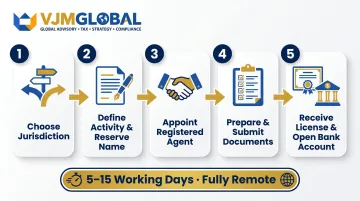
Step 5: Receive Offshore License and Open Corporate Bank Account
Once approved, the authority issues your offshore license — renewal is required annually (RAK ICC renewal: AED 3,950 per year).
Opening a UAE corporate bank account is often the most challenging step in the entire process. Offshore companies face thorough KYC requirements, and many UAE banks apply strict criteria for new offshore entities. Plan for this stage to take longer than the incorporation itself.
If UAE banking proves difficult, common alternatives include:
- Multi-currency accounts in Singapore or Hong Kong
- European fintech business accounts (Wise, Airwallex)
- Private banking relationships in jurisdictions with established India-UAE trade corridors
FEMA, RBI Compliance & Tax Implications for Indian Entrepreneurs
This is where most Indian entrepreneurs go wrong. UAE registration alone does not make your structure legally compliant if you're an Indian resident.
Two distinct compliance layers apply: FEMA's Overseas Direct Investment (ODI) rules govern how and how much you can invest abroad, while India's tax laws determine what you owe at home — regardless of where profits are earned.
FEMA Overseas Direct Investment (ODI) Framework
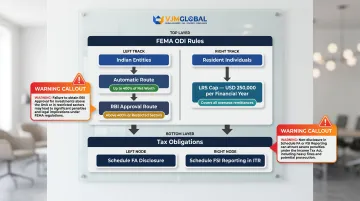
Indian residents (not NRIs) setting up or investing in a foreign company must comply with RBI's ODI regulations under FEMA 1999:
For Indian entities (companies, LLPs, partnerships):
- Automatic route: ODI permitted up to 400% of net worth (based on the last audited balance sheet)
- RBI approval route: Mandatory if the investment exceeds 400% of net worth, if the entity is under regulatory investigation, or if the target sector is restricted
For resident individuals:
- ODI is counted within the Liberalized Remittance Scheme (LRS) limit of USD 250,000 per financial year — this cap covers all overseas remittances combined, not just equity investments