On paper, incorporating one looks simple: pick a name, file some forms, get a certificate. In practice, timelines swing from two weeks to two months depending on entity choice, document readiness, and the FDI route selected. A missed apostille deadline or an incomplete director KYC file can stall the entire process.
This guide walks through the exact incorporation steps, eligibility requirements, FDI routes, common pitfalls, and alternative structures, so you can choose the right path and execute it without surprises.
Key Takeaways
- A private limited subsidiary needs only 2 directors (1 India-resident) and 2 shareholders—with no minimum capital.
- Most sectors qualify for 100% FDI under the Automatic Route, skipping government pre-approval entirely.
- SPICe+ and AGILE-PRO bundle incorporation, PAN, TAN, GST, and labor registrations into one filing.
- Post-incorporation RBI reporting (Form FC-GPR) and US document apostille are the two most underestimated steps.
- Lock in compliance support early to avoid FC-GPR delays, apostille bottlenecks, and ROC penalties.
Step-by-Step Process to Set Up a Foreign Subsidiary in India
The process runs through the Ministry of Corporate Affairs' (MCA) SPICe+ portal, and it's standardized. What varies is how prepared you are before you start filing. Sequencing errors, not regulatory complexity, are what stretch a two-week process into a two-month one.
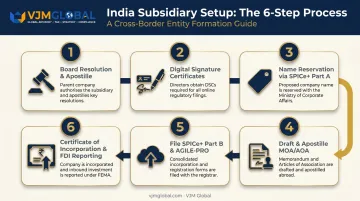
Step 1: Parent Company Board Resolution & Structure Finalization
The US parent's board must pass a resolution authorizing the Indian subsidiary, naming an authorized signatory, and approving the shareholding split between the parent and any co-shareholder.
This resolution isn't just an internal formality. It has to be apostilled through the US Secretary of State (or the relevant Hague Convention process) before Indian authorities will accept it. Skip this early, and it becomes your critical-path bottleneck later.
Step 2: Obtain Digital Signature Certificates (DSC) for Directors
Every proposed director, including US-based ones, needs a digital signature certificate to sign incorporation forms electronically. MCA guidance requires Class 2 or above credentials for e-filing; most filers use a Class 3 DSC to be safe.
First-time subscribers must also register as MCA business users before their DSC can be linked to SPICe+ Part B and the e-MOA/e-AOA.
Step 3: Reserve the Company Name via SPICe+ Part A
You can request your US company's name with "India" appended, subject to:
- Trademark clearance — no conflict with existing registered marks
- Rule 8 naming checks — MCA's rules against undesirable or misleading names
A reserved name stays valid for 20 days once approved, giving you a defined window to complete the next steps.
Step 4: Draft, Notarize and Apostille Charter Documents (MOA/AOA)
If your subscribers and directors sign the Memorandum and Articles of Association outside India, those signatures, along with proof of identity, must be notarized in the US and then apostilled. This is mandated under India's Companies Incorporation Rules for foreign subscribers based in Hague Convention countries.
Alternatively, signing in India is possible, but it requires a valid business visa and a passport stamp as proof of physical presence at signing. Most US companies find remote apostille simpler than arranging travel.
Step 5: File SPICe+ Part B and AGILE-PRO with the MCA
This single filing bundles:
- Incorporation and Certificate issuance
- PAN and TAN allotment
- GST registration (optional at this stage)
- EPFO and ESIC registration (mandatory)
- Professional tax registration in applicable states
- Bank account application
Every director and subscriber must sign this filing with their registered DSC. Incomplete KYC or mismatched signatory details are the most common reasons for resubmission at this stage.
Step 6: Receive Certificate of Incorporation and Complete FDI Reporting
Once the Registrar of Companies (ROC) issues the Certificate of Incorporation with your CIN, PAN, and TAN, three things happen in sequence:
- Open the subsidiary's bank account
- Receive share subscription funds from the US parent
- File Form FC-GPR with the RBI within 30 days of share allotment
That third step is where a lot of otherwise smooth incorporations run into trouble, and we'll come back to it in the common mistakes section below.
Eligibility Criteria and Documents Your US Company Will Need
Before you file anything, confirm you can meet India's structural and documentary requirements. None of these are negotiable.
Director and Shareholder Requirements
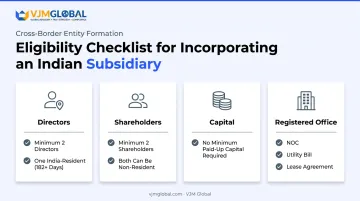
A private limited company needs a minimum of 2 directors, and at least one must qualify as an India-resident director. That means they stay in India for 182 days or more during the financial year (calculated proportionately in the company's first year).
US businesses without local staff typically engage a professional resident director service so they meet the rule without relocating an executive.
On the shareholder side:
- Minimum 2 shareholders required
- Both can be non-resident — the US parent plus another foreign entity or individual
- No requirement for any Indian shareholder or director to hold equity
Capital and Registered Office Requirements
India removed its statutory minimum paid-up capital requirement back in 2015. You can incorporate with virtually any capital amount your business plan calls for.
What you can't skip is a registered office. ROC filings require:
- A physical or virtual registered address in India
- A No Objection Certificate (NOC) from the property owner
- A recent utility bill
- A lease or rent agreement
Documents Required From the US Parent Company
Your core document set includes:
- Certificate of Incorporation
- MOA/AOA or equivalent charter documents (bylaws)
- Board Resolution authorizing the subsidiary
- KYC/ID proof of authorized signatories and directors
- Apostille or notarization on all of the above, as applicable
Foreign directors or subscribers who don't already hold a Director Identification Number (DIN) must also submit an apostilled passport, driver's license, and a recent bank statement or utility bill as address proof.
VJM Global's incorporation team compiles and checks this document set for US clients before filing so incomplete or non-apostilled papers don't stall the application.
Choosing the Right FDI Route and Entity Structure
Your entity choice and FDI route decision happen together, and getting this wrong before incorporation is expensive to fix afterward.
Automatic Route vs Government Approval Route
Most sectors relevant to US businesses, including IT/ITeS, manufacturing, and most professional services, allow 100% FDI via the Automatic Route. That means no prior RBI or government approval before you incorporate.
Restricted sectors work differently. Per DPIIT's Consolidated FDI Policy:
| Sector | FDI Limit | Route |
|---|---|---|
| Defence (up to 74%) | 74% | Automatic |
| Defence (above 74%) | Up to 100% | Government approval |
| Multi-brand retail | 51% | Government approval |
| Single-brand retail, manufacturing | 100% | Automatic |
If your business falls into a restricted category, you'll need DPIIT approval before incorporation, not after. Build this into your timeline from day one rather than discovering it mid-filing.
Subsidiary vs Other Entry Structures
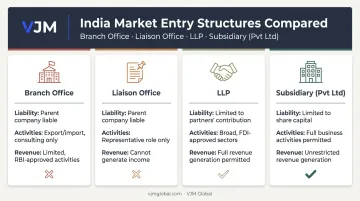
Once the FDI route is clear, you still need the right legal vehicle for Indian operations. A wholly owned subsidiary isn't the only way in, but it's usually the strongest option:
- Branch Office: Unlimited liability back to the parent; activities limited to the parent's existing business
- Liaison Office: Market research and coordination only; cannot generate revenue in India
- LLP: Limited liability and flexible structure for professional services or JVs, but less familiar to Indian banks and vendors
- Subsidiary (Pvt Ltd): Full operational control, limited liability, and unrestricted business activity
VJM Global's cross-border team helps US businesses match structure and route to their sector, then handles formation, resident director support, and FEMA/RBI compliance through setup.
Common Mistakes and Compliance Challenges for US Businesses
Most incorporation delays and penalties trace back to a handful of recurring gaps. Watch for these:
- Underestimating apostille turnaround. US Secretary of State processing frequently pushes SPICe+ filing back by a week or more when documents aren't submitted early.
- Missing the FC-GPR deadline. Issue equity within 60 days of receiving subscription funds; file Form FC-GPR within 30 days of issuance. Late fees run ₹7,500 plus 0.025% of the amount per year of delay (RBI's Master Direction on FEMA reporting).
- Skipping transfer pricing documentation in year one. Related-party deals with the US parent need arm's-length support and a Local File from day one. Waiting until year two invites disputes over prior-year transactions.
- Missing the FLA Return deadline. Entities with outstanding foreign investment must file the annual FLA Return by July 15 on RBI's FLAIR portal, even if accounts aren't fully audited yet.
Conclusion
A wholly owned subsidiary remains the strongest structure for US businesses that want full control, limited liability, and tax efficiency in the Indian market. The Companies Act framework and SPICe+ portal make the mechanics of incorporation standardized.
Where things go wrong isn't usually the incorporation itself. It's the document preparation on the US side, the apostille lead time, and the post-incorporation RBI/FEMA filings that come due in the weeks and months after your Certificate of Incorporation arrives.
VJM Global has guided US companies, including firms like Incubit GBS, through this process—from board resolution through FC-GPR filing and ongoing FEMA compliance. As one US client put it: "VJM Global made our India entry seamless, transparent, and fully compliant."
Treat incorporation as the midpoint, not the finish. Plan US-side documents, apostille timing, and post-incorporation RBI/FEMA filings up front so the subsidiary stays compliant after the Certificate of Incorporation arrives.
Frequently Asked Questions
Can a foreign company have a subsidiary in India?
Yes. A foreign company can hold up to 100% ownership in an Indian subsidiary in most sectors under the Automatic FDI Route, subject to appointing at least one India-resident director.
Can a US citizen own a company in India?
Yes. A US citizen can own shares in an Indian company as a shareholder or director. Incorporation still requires one India-resident director plus standard KYC and apostille documentation.
What is an example of a foreign subsidiary company in India?
A common example is a US technology or services company incorporating an Indian private limited subsidiary to run delivery or back-office operations. The US parent typically retains 100% ownership throughout.
How long does it take a US company to set up a subsidiary in India?
Incorporation itself typically takes 10-15 working days once your documents are ready. Add bank account opening, FC-GPR filing, and GST registration, and the full process usually runs 4-6 weeks.
Does a US company need to visit India to incorporate a subsidiary?
No. Documents can be signed in the US and apostilled remotely. Signing in India is possible but requires a valid business visa and passport as proof of presence.
What is the difference between a subsidiary and a branch office in India?
A subsidiary is a separate Indian legal entity with full business rights and limited liability. A branch office is simply an extension of the foreign parent, with restricted permitted activities and no separate liability shield.