The MCA has digitized nearly every step of incorporation, yet the process still trips people up at the document level. A mismatched DSC, an outdated utility bill, or an unclear board resolution from a parent company can stall an application for weeks. This article walks through the complete incorporation process, the documents you'll need, the mistakes that cause the most rejections, and what happens once your Certificate of Incorporation lands in your inbox.
Key Takeaways
- SPICe+ (INC-32) combines name reservation, DIN, PAN, and TAN into one application
- Accurate filings typically incorporate within one to two weeks of name approval
- Foreign directors need notarized or apostilled documents that Indian residents don't
- Name similarity, incomplete forms, and DSC errors cause most registration rejections
- Professional guidance from experienced firms reduces filing errors and delays
What Is Company Incorporation Under the MCA Portal and Why It Matters
Company incorporation is the legal act of registering a business entity with the Registrar of Companies (RoC) through MCA's SPICe+ system. Once the Registrar verifies your application under Section 7 of the Companies Act, 2013, it issues a Certificate of Incorporation (COI) and allots a Corporate Identity Number (CIN).
This single event creates a separate legal entity with limited liability. Your company gets its own CIN, PAN, and TAN, which means it can open bank accounts, sign contracts, raise capital, and operate as a distinct legal person, separate from its founders.
Incorporation is not the same as business registration. MSME/Udyam registration and GST registration are compliance steps that happen after incorporation, not substitutes for it. A company must first exist legally before it can register for these secondary requirements.
For foreign investors, this MCA-driven process is the only legitimate route to establish an Indian subsidiary, private limited company, or LLP. The scale is substantial:
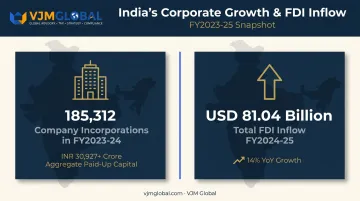
- India recorded 185,312 company incorporations in FY2023-24, with aggregate paid-up capital exceeding INR 30,927 crore, according to Business Standard's coverage of MCA data
- Total FDI inflow into India reached USD 81.04 billion in FY2024-25, a 14% jump, per a Press Information Bureau release on FY 2024-25 FDI figures
- Every rupee of that capital passed through this same SPICe+ gateway before reaching Indian operations
Step-by-Step Guide to Company Incorporation on the MCA Portal
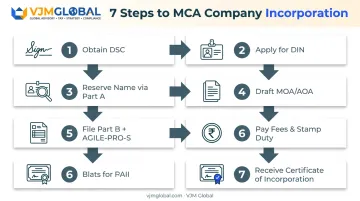
The entire process runs through the SPICe+ integrated web form, which requires digital signatures, identity documents, and mandatory certification by a Chartered Accountant, Company Secretary, or Cost Accountant before submission. One error anywhere in this chain, whether it's a DSC mismatch, a wrong DIN, or an incomplete MOA/AOA, triggers a resubmission request or outright rejection from the Central Registration Centre (CRC).
Step 1: Obtain Digital Signature Certificates (DSC)
Every proposed director and subscriber needs a valid Class 3 DSC before anything else can happen. Standard documents include:
- PAN card (self-attested)
- Aadhaar or passport
- Address proof
- Passport-size photograph
Foreign nationals face an extra hurdle: their identity and address documents typically require notarization and, depending on the country, apostille authentication before the DSC issuing authority will accept them.
Step 2: Apply for Director Identification Number (DIN)
New directors can apply for DIN directly within SPICe+, without a separate filing. SPICe+ can allot DINs to a maximum of three proposed directors in a single application. Foreign directors need their identity and address proofs notarized and apostilled first, since the RoC won't accept uncertified copies from overseas applicants.
Step 3: Reserve the Company Name via SPICe+ Part A
You can propose up to two names if filing Part A standalone, or just one if you're combining Part A and Part B into a single submission. The CRC checks each name against existing companies, LLPs, and trademarks under Rule 8 of the Companies (Incorporation) Rules. If a name is rejected, the applicant gets a chance to resubmit via registered email, usually within 15 days.
Step 4: Draft the MOA and AOA
The Memorandum of Association (MOA) defines what your company is legally allowed to do, its objects and scope. The Articles of Association (AOA) set the internal rules for how the company governs itself, from board meetings to share transfers.
Both documents are filed electronically as e-MOA (INC-33) and e-AOA (INC-34) within SPICe+ Part B. Exceptions apply for companies with more than seven subscribers or a subscriber signing from outside India.
Step 5: Fill and Submit SPICe+ Part B with AGILE-PRO-S
Part B captures your company structure, registered office address, and subscriber/director particulars. AGILE-PRO-S is filed alongside it and applies simultaneously for a few things:
- GSTIN (optional, based on your choice)
- EPFO registration (mandatory linked output)
- ESIC registration (mandatory linked output)
- Bank account application
Filing these forms doesn't create immediate tax or contribution liability; it just sets up the registrations for when you actually need them.
Step 6: Pay Government Fees and Stamp Duty
Fees depend on your authorized capital and the state where you're registering. Companies with nominal capital up to ₹15 lakh currently qualify for a no-filing-fee concession on SPICe+ and linked e-MOA/e-AOA forms, though stamp duty still applies and varies by state and instrument.
Payment happens directly on the portal via net banking, UPI, or card. Rather than relying on a fixed national quote, run your numbers through MCA's ROC Fees Calculator since state-level stamp duty differs significantly.
Step 7: Receive the Certificate of Incorporation (COI)
Once the RoC verifies everything, it issues the COI digitally on Form INC-11, complete with your CIN, PAN, and TAN. This is the moment your company legally exists.
A practitioner benchmark from Khaitan & Co.'s Doing Business in India guide estimates one to two weeks after successful filing, though resubmissions or foreign-document authentication delays can push this out further. Foreign founders often work with firms like VJM Global to coordinate DSC, DIN, and RoC filings from abroad, which helps avoid many of these delays.
Documents Required and Key Factors That Affect the Incorporation Process
For Indian directors and subscribers, the core document set is straightforward:
- PAN card
- Aadhaar card
- Address proof (bank statement, utility bill not older than two months)
- Passport-size photograph
- Registered office proof (utility bill, plus rent agreement or NOC from the owner)
For foreign nationals, NRIs, and OCIs, the list gets more involved. You'll typically need notarized and apostilled passport copies, notarized address proof, and, if you're incorporating a subsidiary, a board resolution from the parent company authorizing the setup. This last requirement is the one cross-border founders overlook most often, and it's a common cause of avoidable delay.
| Applicant Type | Additional Requirement |
|---|---|
| NRI/OCI | Notarized passport, address proof under 2-3 months old |
| Foreign national | Apostille per Rule 13, based on country of execution |
| Foreign body corporate subscriber | Authenticated incorporation certificate, board authorization |
The entity type you choose also reshapes your paperwork. A private limited company, One Person Company (OPC), Section 8 company, or a subsidiary of a foreign parent each triggers different SPICe+ fields and attachments. Also, once you cross seven subscribers, MOA/AOA must be filed as physical attachments rather than through the web-integrated e-MOA/e-AOA forms.
Professional certification by a CA, CS, or CMA is mandatory before submission, no exceptions.
Firms like VJM Global bring 30+ years of experience and a dedicated team of chartered accountants and business-setup professionals to this process. They help foreign companies and NRIs get the documentation right the first time, avoiding the delays that trip up many first-time founders.
Common Mistakes and Misconceptions During MCA Incorporation
Incorporation doesn't mean you're ready to trade. Many founders assume that once the COI arrives, they can start invoicing clients immediately.
In reality, if your company has share capital, you must file Form INC-20A (Commencement of Business) within 180 days, confirming that subscribers have paid for their shares. Skip this, and you can't legally borrow or start operations.
Other recurring errors include:
- Choosing a name too close to an existing company or registered trademark
- Uploading blurry, mismatched, or expired documents (address proofs older than two months are routinely rejected)
- Using an incorrectly registered or expired DSC during signing
There's also confusion between the electronically issued COI (Form INC-11, delivered at incorporation) and a certified copy obtained separately through MCA's Get Certified Copies service.
Banks and investors sometimes ask for the certified version specifically for due diligence. Treating the two as interchangeable can cause unnecessary back-and-forth during fundraising or account opening.
Post-Incorporation Compliance and Getting Professional Support
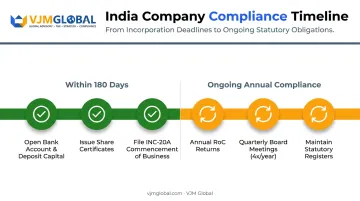
Getting the COI is just the starting line. Within the first 180 days, you need to:
- Open a company bank account and deposit subscribed capital
- Issue share certificates to subscribers
- File Form INC-20A to declare commencement of business
Beyond that initial window, ongoing MCA obligations continue indefinitely. These include:
- Filing annual returns with the RoC every year
- Holding at least four board meetings annually, no more than 120 days apart
- Maintaining statutory registers under Sections 88 and 170 of the Companies Act
Miss these consistently, and the RoC can strike the company off the register.
Foreign businesses and NRIs often find this ongoing layer (GST filings, tax returns, accounting, RoC submissions) harder to manage than the incorporation itself. It demands continuous attention rather than a one-time push.
VJM Global has supported 500+ US, 250+ UK, and 250+ Australian businesses with end-to-end setup and compliance in India. Our team handles everything from bookkeeping and payroll to secretarial compliance and transfer pricing advisory once the company is operational.
Frequently Asked Questions
What is MCA corporate?
MCA (Ministry of Corporate Affairs) is the Indian government body regulating corporate affairs, company registration, and compliance under the Companies Act, 2013. "MCA corporate" generally refers to companies registered and regulated through this ministry.
What is the SPICe+ form used for?
SPICe+ is the integrated web form on the MCA portal combining name reservation, incorporation, DIN, PAN, TAN, and optional GST/EPFO/ESIC registration into a single application.
How long does company incorporation take through the MCA portal?
With accurate documents and no CRC objections, practitioners generally estimate one to two weeks from name approval to Certificate of Incorporation. Foreign document authentication or resubmissions can extend this timeline.
Can a foreign national or NRI incorporate a company in India through the MCA portal?
Yes. Foreign nationals and NRIs need additional apostilled or notarized identity and address proofs, since authentication requirements vary by country. Professionals experienced in cross-border filings, such as VJM Global, can help navigate these country-specific rules.
What is the approximate cost of incorporating a company via the MCA portal?
Costs depend on authorized capital, state stamp duty, and DSC/professional fees, so there's no fixed national number. Companies with nominal capital under ₹15 lakh currently qualify for a filing-fee concession, though stamp duty still applies.
Is a Digital Signature Certificate (DSC) mandatory for all directors during incorporation?
DSCs are mandatory for all subscribers and the witness signing electronic MOA/AOA forms, plus the designated director and professional signing SPICe+ itself. Not every named director automatically requires one.