But Canadian founders quickly run into unfamiliar territory: entity types with no Canadian equivalent, a sweeping October 2025 visa overhaul, and paperwork that assumes fluent Japanese. These hurdles can stall market entry for months if you don't plan around them.
This guide walks through ownership rules, entity choice, visa pathways, registration steps, and ongoing compliance — specifically for Canadians entering Japan.
Key Takeaways
- Canadians can own 100% of a Japanese company; no nationality restrictions apply under the Companies Act
- Two practical entity types exist: KK (joint stock company) and GK (limited liability company)
- The Business Manager Visa requires ¥30 million capital after October 2025 reforms, a sixfold increase
- Incorporation can happen remotely, but living in Japan to run the business requires a residence visa
- Professional support cuts setup time and banking rejection risk
Can a Canadian Legally Start and Own a Business in Japan?
Yes. Japan's Companies Act doesn't require a Japanese co-owner. According to JETRO (Japan External Trade Organization), a KK (Kabushiki Kaisha) or GK (Godo Kaisha) can have one or more investors, Canadian or otherwise, with capital starting at just ¥1.
In 2015, Japan removed the requirement that a KK have a Japan-resident representative director. Before that reform, incorporating without physically relocating was nearly impossible. Now, a Canadian founder can incorporate remotely and appoint officers who live outside Japan.
One filing you can't skip, though: the Foreign Exchange and Foreign Trade Act (FEFTA) notification. As a non-resident investor, you may need to report your stock acquisition to the Bank of Japan, and certain sectors require prior notification before you even close the deal. This isn't citizenship-specific — it applies to the activity, not the nationality.
Two Paths for Canadian Entrants
Broadly, Canadian founders choose between two structures:
- Relocate personally — you move to Japan and manage the company yourself, which triggers Business Manager Visa requirements (capital, staffing, office, language)
- Open a subsidiary run locally — a Canadian company incorporates in Japan and hires a Japan-based representative to manage day-to-day operations, sidestepping the founder's own visa need entirely
This choice changes everything downstream: capital thresholds, documentation, and timeline. Decide this before you touch any paperwork.
Choosing a Business Structure: KK vs GK for Canadian Founders
Japan offers two realistic options for foreign-owned businesses: the Kabushiki Kaisha (KK) and the Godo Kaisha (GK).
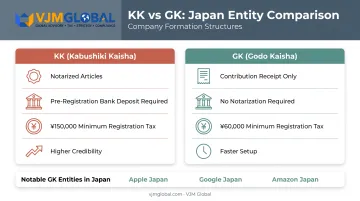
KK is Japan's traditional joint-stock structure. It carries more credibility with enterprise clients and investors, but comes with extra steps:
- Articles of Incorporation must be notarized (¥30,000–50,000)
- A pre-registration bank deposit of capital is required
- Registration tax starts at a minimum of ¥150,000
GK is closer to an LLC. It's cheaper and faster to set up:
- No notarization step for Articles
- No pre-registration bank deposit — a simple contribution receipt suffices
- Registration tax minimum is just ¥60,000
That last point matters most for non-resident founders. A pre-registration deposit typically means someone needs a usable Japanese bank account before the company legally exists — a chicken-and-egg problem for a Canada-based founder. GK avoids it.
Don't assume GK signals a "small" business, though. Apple Japan, Google Japan, and Amazon Japan all operate as GKs. The structure carries genuine commercial weight.
| Feature | KK | GK |
|---|---|---|
| Minimum capital | ¥1 | ¥1 |
| Registration tax minimum | ¥150,000 | ¥60,000 |
| Notarization required | Yes | No |
| Pre-registration deposit | Yes | No (receipt only) |
| Governance | Shareholders' meeting | Flexible, per Articles |
| Public share offering | Possible | Not possible |
Our recommendation: GK suits Canadian solo founders and SMEs without fundraising plans. KK makes sense if you're planning external investment or an eventual IPO.
Visa Requirements for Canadians Managing a Business in Japan
Here's a distinction Canadian founders often miss: incorporating a Japanese company does not, by itself, require a visa. You only need one if you plan to personally live in Japan and manage the business.
Business Manager Visa (Post-October 2025)
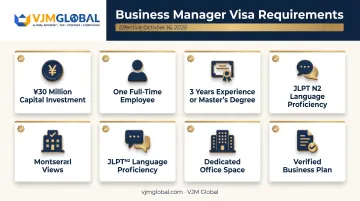
As of October 16, 2025, the Business Manager category carries higher capital and operating thresholds. Applicants need:
- ¥30 million in capital or contribution — up from roughly ¥5 million previously
- At least one full-time employee
- Either three years of management/business experience or a relevant master's degree
- JLPT N2 Japanese proficiency (applicant or a full-time employee can satisfy this)
- A dedicated physical office — a home address generally won't qualify
- A business plan confirmed by someone with relevant professional management expertise
That capital jump is a sixfold increase, so many founders will need a clearer funding and staffing plan before they relocate to manage the company in person.
Startup Visa
If you're not there yet, the Startup Visa buys time. It grants up to two years to build toward Business Manager thresholds without meeting the full capital or staffing requirements upfront. Useful detail: this preparation period counts toward the three-year management-experience requirement later.
Highly Skilled Professional Visa
The Highly Skilled Professional route is points-based. Strong scores on education, experience, and salary can open a faster path to permanent residency for qualified founders.
Renewals for Pre-October 2025 Holders
If you already hold Business Manager status obtained before October 16, 2025, renewal rules are more forgiving for a limited window. Full compliance with the amended criteria becomes mandatory three years after implementation.
Step-by-Step: Registering Your Company from Canada
Here's the practical sequence for a Canada-based founder:
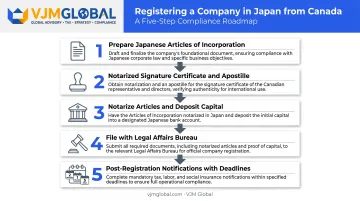
- Prepare Articles of Incorporation in Japanese. Commission a company seal set (still standard practice for Japanese registration, even for foreign-owned entities).
- Handle Canada-specific documentation. Overseas founders use a notarized signature certificate in place of a Japanese seal certificate. Some filings also need an apostille authenticating your identity from Canada.
- Notarize Articles (KK only) and deposit capital. KK requires capital in a usable bank account before registration. GK only needs a contribution receipt, which is simpler if you do not yet have a Japanese account.
- File with the Legal Affairs Bureau and pay the registration tax.
- Complete post-registration notifications within statutory deadlines:
- Corporation establishment notice: within 2 months
- Salary-paying office notice: within 1 month
- Blue-form tax return application: by the earlier of 3 months post-incorporation or fiscal year-end
- Social insurance notices: within 5 days from the day after incorporation or hiring, where applicable
Miss these deadlines and you can lose access to preferential tax treatment or face penalties, so build a calendar the day you register.
Costs, Banking and Ongoing Compliance for Canadian-Owned Entities
Formation Costs
- KK: roughly ¥250,000+ in fees and notarization, excluding capital
- GK: roughly ¥100,000+, excluding capital and professional fees
The Banking Bottleneck
This is where many Canadian founders get stuck. Japanese banks apply strict due diligence to foreign-owned entities, and having a Japan-resident representative director improves approval odds. If a traditional bank stalls, challenger banks like Rakuten Bank and PayPay Bank are worth exploring. Neither guarantees approval for a non-resident-controlled company.

Ongoing Obligations
- Monthly accounting, prepared to Japanese standards: roughly ¥50,000–200,000/month depending on transaction volume and scope
- Corporate tax filings, with effective combined rates from about 22% for smaller SMEs to over 34% for larger companies, due within two months of fiscal year-end
- Industry-specific licenses, where applicable
Coordinating incorporation paperwork, bilingual accounting, and tax compliance across Canada and Japan is where many founders lose time. VJM Global brings 30+ years of cross-border entity formation and compliance experience across 100+ countries and can coordinate that documentation end to end.
Frequently Asked Questions
How much money do I need to start a business in Japan?
Registration alone costs roughly ¥100,000–750,000 depending on whether you choose KK or GK. If you plan to apply for a Business Manager Visa, budget ¥30 million in capital. Banks and immigration officials both view sub-¥1 million capital as high-risk.
What are the requirements for a foreigner to start a business in Japan?
Foreigners can own 100% of the company. You also need a chosen entity type, notarized Articles of Incorporation, a capital deposit, and Legal Affairs Bureau registration. If you plan to reside in Japan to manage the business, you'll also need a Business Manager or Startup Visa.
Can a Canadian start a business in Japan without living there?
Yes. Remote incorporation has been legal since the 2015 reform removing the resident-director requirement. GK is generally more practical for non-residents since it skips the pre-registration bank deposit KK requires.
Do I need a visa to open a company in Japan as a Canadian?
No. Incorporation itself doesn't require a visa. You only need one if you personally reside in Japan to manage the business, typically through a Business Manager or Startup Visa.
Which is better for a Canadian founder, KK or GK?
GK suits cost-conscious, non-resident founders who don't need to raise outside capital. KK suits founders planning investment rounds or targeting large enterprise clients who expect a conventional corporate structure.
Do I need to speak Japanese to run a business in Japan?
Business Manager Visa applicants need JLPT N2 proficiency, either personally or through a full-time employee. Day-to-day operations are manageable with limited Japanese if you're using bilingual professional support for accounting and compliance.