Most Canadians assume they need to relocate, hold a special visa, or handle the paperwork solo before owning a Singapore company. None of that is true. You can incorporate, own 100% of the business, and run it from Toronto, Calgary, or Halifax without ever boarding a flight.
This guide walks through eligibility, structure options, the registration process, and what comes after incorporation, written specifically for Canadian founders, SMEs expanding into APAC, and remote consultants looking for a regional base.
Key Takeaways
- Canadians can own 100% of a Singapore Pte Ltd with a local director and filing agent
- Relocation isn't required: a nominee director satisfies residency rules while you keep full control
- Pte Ltd registration typically completes in 1-3 business days once documents are ready
- Actively running the business in Singapore requires a work pass, like EntrePass or Employment Pass
- Post-incorporation, expect a bank account, a company secretary within 6 months, and annual ACRA/IRAS filings
What Canadians Need to Know Before Starting a Business in Singapore
There's no Canada-specific restriction on owning a Singapore company. The same baseline rules apply to every foreign national: you must be 18 or older, not an undischarged bankrupt, and free of disqualifying convictions tied to fraud or repeated filing failures.
You don't need to set foot in Singapore to incorporate. As a non-resident, you must work through an ACRA-registered Corporate Service Provider (CSP), which files your application through the BizFile+ portal on your behalf. Self-registration simply isn't an option for foreigners.
The Local Director Requirement
Every Singapore company needs at least one director who is ordinarily resident in Singapore, meaning a citizen, permanent resident, or eligible pass holder. Most Canadian founders who aren't relocating solve this by appointing a nominee director — someone who satisfies the residency rule on paper while you retain full ownership, decision-making authority, and control of the corporate bank account.
Work Passes If You Plan to Relocate
If you want to personally run the business from Singapore, you'll need a work pass. Here's how the two most common options compare:
| Pass | Who it's for | Key requirement |
|---|---|---|
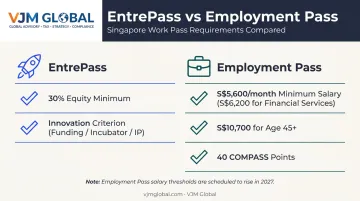
| EntrePass | Founders launching an innovative or venture-backed startup | Hold at least 30% equity in an ACRA-registered Pte Ltd, plus meet one MOM innovation criterion (for example, S$100,000 in funding, incubator backing, or qualifying IP) |
| Employment Pass | Founders taking an operational role in an established company | Minimum salary of S$5,600/month (S$6,200 in financial services), rising to S$10,700 at age 45+, plus at least 40 COMPASS points |
The Employment Pass salary floors are set to rise to S$6,000 and S$6,600 for new applications from January 2027, per the Ministry of Manpower's eligibility criteria. Tech.Pass and ONE Pass exist too, but both target established tech leaders or high earners rather than first-time founders, so most Canadians will land on EntrePass or Employment Pass.
The Canada-Singapore Tax Treaty
Canada and Singapore maintain a bilateral tax convention that prevents double taxation on business income. Under the Canada-Singapore tax treaty, business profits are generally taxed only in your country of residence unless you operate through a permanent establishment in the other country.
The treaty also caps source-country withholding on dividends, interest, and royalties at 15% of the gross amount. This is a genuinely useful framework, but treaty application gets technical fast, so loop in a cross-border tax advisor before assuming a specific outcome.
Business Structures Available to Foreign Entrepreneurs
Your choice of structure shapes liability exposure, your tax position, and how credible you look to banks and investors. Get this wrong early and you'll be restructuring later, which costs more than doing it right the first time.
Private Limited Company (Pte Ltd)
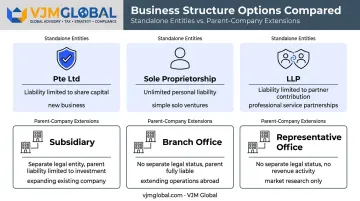
This is the default choice for a reason. A Pte Ltd is a separate legal entity from its owners, supports 1 to 50 shareholders (individual or corporate), and caps liability at what shareholders have invested. It's also the structure banks and investors trust most, and it carries Singapore's 17% flat corporate tax rate. Registering with Singapore's Accounting and Corporate Regulatory Authority (ACRA) typically takes 1 to 3 business days, and the law requires at least one locally resident director, a role Canadians often fill by engaging a corporate services firm such as VJM Global.
Sole Proprietorship and LLP: Simpler Structures With Trade-Offs
Sole Proprietorship: Not a separate legal entity (you and the business are legally the same thing), meaning unlimited personal liability. This suits a local Singaporean freelancer, not a Canadian building a formal overseas presence, since it offers none of the protection or credibility a Pte Ltd provides.
Limited Liability Partnership (LLP): Suited to Canadian professionals such as consultants, accountants, and designers who want to pool skills under one banner. Liability attaches to each partner's own actions rather than the partnership collectively, giving more protection than a sole proprietorship without the full corporate structure of a Pte Ltd.
Expanding an Existing Canadian Company
If you're not starting fresh but extending an operating Canadian business into Singapore, you have three options:
- Subsidiary – A separate legal entity; your Canadian company can be the sole shareholder, and liability stays limited to the subsidiary's own assets
- Branch Office – Not legally separate from the parent; the Canadian company carries full liability for the branch's obligations
- Representative Office – Restricted to market research and feasibility work only, with no profit-making activity allowed; requires the parent company to show over 3 years of operating history and sales turnover above US$250,000
How to Register a Company in Singapore From Canada – Step by Step
Once you've picked a structure, execution is straightforward. The two biggest sources of delay for remote founders are skipping the filing agent step and delaying document certification.
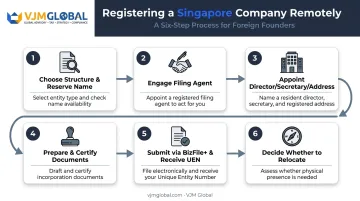
Step 1: Choose Your Structure and Reserve a Name
Decide on Pte Ltd, LLP, or another structure, then have your filing agent submit a name application to ACRA. The fee is S$15, and an approved name stays reserved for 120 days. Names containing restricted words (banking, finance, education) get referred to other agencies and take considerably longer.
Step 2: Engage a Registered Filing Agent
As a non-resident, you legally cannot self-file. You need a licensed Corporate Service Provider to submit your BizFile+ application. Firms like VJM Global support Canadian founders with entity formation across Singapore and other jurisdictions simultaneously. This matters if you're also managing a Canadian entity: one point of contact instead of juggling separate local providers on each side.
Step 3: Appoint a Local Director, Secretary, and Registered Address
You'll need:
- A locally resident director (nominee, if you're not relocating)
- A company secretary, appointed within 6 months of incorporation
- A registered office address: a physical Singapore address, never a P.O. Box
Filing agents typically bundle the registered address as a virtual office service alongside incorporation.
Step 4: Prepare and Certify Your Documents
Documents required include a certified passport copy, proof of your Canadian residential address dated within the last 3 months, and full shareholder and director details. Some of these documents require notarisation before submission. Your filing agent can usually coordinate this remotely, rather than requiring you to visit anyone in person.
Step 5: Submit via BizFile+ and Receive Your UEN
Once documents are complete, your agent files the application. Most straightforward Pte Ltd registrations clear within 1-3 business days. Applications referred to other regulators (finance, education, F&B) can take 14 to 60 days. On approval, you receive a Unique Entity Number (UEN) and a digital notice of incorporation.
Step 6: Decide Whether to Relocate
This step is entirely optional. Run the company from Canada indefinitely, or apply for an EntrePass or Employment Pass later if you decide to move and take an active role. Changing your mind after incorporating remotely is possible — it just means a fresh work pass application, not a company restructure.
What Happens After Incorporation: Post-Registration Compliance
Incorporation is the easy part. Staying compliant is where founders slip up, especially when managing obligations across two countries.
Opening a Corporate Bank Account
Banks typically ask for your certificate of incorporation, company constitution, and director/shareholder identification. Canadian applicants sometimes face extra verification steps, such as video calls, compared to local resident applicants, since banks apply heightened due diligence to non-resident beneficial owners.
GST Registration
GST registration becomes mandatory once taxable turnover exceeds S$1 million in a calendar year, or is expected to in the next 12 months. Below that, you can register voluntarily. The current GST rate is 9%, effective since January 2024.
Ongoing Compliance Checklist
- Appoint an auditor within 3 months of incorporation, unless you qualify for small-company exemption
- Hold an AGM within 6 months of your financial year end
- File Annual Returns with ACRA within 7 months of financial year end (late filing penalty: S$300, rising to S$600)
- File Estimated Chargeable Income with IRAS within 3 months of financial year end
Managing this alongside your existing Canadian tax obligations (T2 filings, GST/HST, payroll) adds another layer of complexity. This is exactly where cross-border firms such as VJM Global support founders, combining accounting, tax, and secretarial services across both markets instead of forcing you to coordinate two disconnected providers.
Costs, Timelines, and Common Pitfalls for Canadian Founders
Budgeting the Fees
Government fees are fixed: S$15 for the name application plus S$300 for incorporation, totalling S$315. Filing agent fees sit on top of that and vary by scope; VJM Global, for example, provides a fixed quote before you commit.
Realistic Timelines
- 1-3 business days for a standard Pte Ltd application
- Up to 15 working days for more complex reviews
- 14-60 days if referred to another regulator (financial services, education, F&B licensing)
Where Remote Founders Get Tripped Up
- Assuming self-registration is allowed (it isn't, for non-residents)
- Underestimating how long it takes to source a suitable nominee director
- Forgetting the 6-month deadline to appoint a company secretary
- Overlooking currency conversion costs when funding a Singapore account from a Canadian dollar balance
Frequently Asked Questions
What business can I start in Singapore as a foreigner?
Foreigners can start virtually any legal business activity through a Pte Ltd, LLP, or sole proprietorship. Regulated sectors like finance, education, and F&B require additional licensing on top of standard registration.
Can a Canadian own 100% of a Singapore company?
Yes. Canadians can retain full foreign ownership, with no local shareholder requirement. You do need to appoint at least one locally resident director to satisfy the Accounting and Corporate Regulatory Authority's (ACRA) rules.
Do I need to move to Singapore to start a business there?
No. Relocation is only necessary if you want to personally serve as the local director without hiring a nominee. Otherwise, you can own and direct the company entirely from Canada.
How long does it take for a Canadian to register a company in Singapore?
Standard applications typically clear in 1-3 business days once your filing agent submits complete documentation. Applications referred to other regulators can take 14-60 days.
Could a Canadian serve as the local director of their own Singapore company?
Only if you hold an eligible pass, such as an EntrePass, and relocate to Singapore. Otherwise, you'll need to appoint a nominee director to meet the residency requirement.
Is there a tax treaty between Canada and Singapore that benefits business owners?
Yes, a bilateral tax treaty prevents double taxation on business income and caps withholding tax on dividends and royalties. Consult a cross-border tax advisor for how it applies to your specific structure.