
Starting a business here involves choosing the right legal structure, navigating updated visa requirements, completing a multi-step registration process, and maintaining ongoing compliance from day one. Skip a step or sequence them incorrectly, and you will lose weeks to rework.
This guide covers every stage — from selecting between a KK and GK to post-registration obligations — so you can plan your Japan entry with clear expectations rather than costly surprises.
Key Takeaways
- Foreigners can own 100% of a Japanese company with no nationality restrictions
- Two practical structures exist for foreign founders: KK (joint stock company) and GK (limited liability company)
- The Business Manager Visa now requires ¥30 million in capital following October 2025 reforms, a sixfold increase from the prior threshold
- Registration follows a fixed sequence: Articles of Incorporation, capital deposit, Legal Affairs Bureau filing, then tax notifications
- Post-registration compliance — tax filings, social insurance, banking — begins immediately and cannot be deferred
Understanding Japan's Business Landscape Before You Start
Two Distinct Entry Paths
Foreign businesses typically enter Japan one of two ways:
- Founder-led entry — a foreign national relocates to Japan, manages operations directly, and needs a Business Manager Visa
- Remote subsidiary model — the foreign parent company incorporates a Japanese entity managed by a locally hired representative who already holds work authorization; no founder visa required
These two paths have very different capital requirements, timelines, and documentation needs. Knowing which applies to you before starting any paperwork saves significant time.
That choice also shapes your timeline — and most founders are surprised by how long the full process actually takes.
Realistic Timeline and Cost Expectations
The Legal Affairs Bureau can process registration in as little as three business days under a fast-track system, but total setup time is another matter:
- Gathering notarized documents from outside Japan: 2–4 weeks
- Legal Affairs Bureau registration: 3 business days to 2 weeks
- Corporate bank account approval: 2–6 weeks (often longer for foreign-owned entities)
- Business Manager Visa processing: several months
Budget for costs well beyond registration fees. Office leases, professional services, capital deposits, and banking setup can collectively run into the tens of thousands of dollars before a single yen of revenue arrives.
Business Structures in Japan: KK vs. GK
Japan's Companies Act defines four entity types, but foreign founders almost universally choose between two. The other two — Gomei Kaisha (general partnership) and Goshi Kaisha (limited partnership) — carry unlimited liability for some partners, ruling them out for most foreign investors.
Kabushiki Kaisha (KK) — Joint Stock Company
The KK is Japan's traditional corporate structure, equivalent to a corporation or joint stock company. It carries the most institutional credibility with Japanese banks, enterprise clients, and government counterparties.
When a KK makes sense:
- You plan to raise outside equity or issue shares
- You're targeting enterprise-level Japanese clients or regulated industries
- A future public listing is part of the roadmap
- Your business model requires formal governance signals
Practical considerations:
- Articles of Incorporation must be notarized by a Japanese notary, costing ¥30,000–¥50,000 depending on capital level
- Capital must be deposited into a Japanese bank account before registration — challenging for non-resident founders who don't yet have a local account
- Annual shareholder meetings and public financial disclosure are mandatory
Godo Kaisha (GK) — Limited Liability Company
The GK is Japan's LLC equivalent — simpler, cheaper, and faster to set up. Apple Japan, Google Japan, and Amazon Japan all operate as GKs, confirming it carries real credibility for tech and service businesses.
Why foreign founders often prefer the GK:
- No Articles of Incorporation notarization required
- No pre-registration bank deposit needed — a representative member can issue a receipt for invested funds, making remote incorporation far more practical
- No annual meeting requirement and no mandatory public financial disclosure
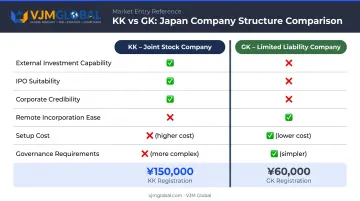
- Lower registration tax (¥60,000 minimum vs. ¥150,000 for KK)
- For US parent companies, the GK can offer pass-through tax treatment
Which Structure Should You Choose?
Both structures receive identical tax treatment under Japanese law and both qualify for a Business Manager Visa. The decision comes down to your funding plans and how you'll be operating on the ground.
| Factor | Choose KK | Choose GK |
|---|---|---|
| External investment/equity issuance | ✅ | ❌ |
| IPO or public listing plans | ✅ | ❌ |
| Corporate credibility with large Japanese clients | ✅ | Often sufficient |
| Remote incorporation (non-resident founder) | More complex | ✅ Easier |
| Cost and speed priority | Slower, costlier | ✅ Faster, cheaper |
| No external fundraising planned | Secondary choice | ✅ |
Visa and Regulatory Requirements for Foreign Business Owners
Incorporation itself does not require physical presence in Japan. However, if a foreign national wants to personally reside in Japan and manage the business, appropriate residency status is mandatory.
Business Manager Visa
The Business Manager Visa is the primary route for foreign nationals managing a Japanese company from within Japan. Requirements were significantly revised on October 16, 2025, and now include:
- ¥30 million minimum paid-in capital (increased sixfold from the previous ¥5 million threshold, per KPMG's October 2025 alert)
- At least one full-time employee with unrestricted work rights in Japan
- Three years of business management experience — or a relevant master's, doctoral, or professional degree
- Japanese language proficiency at JLPT N2 level (or equivalent CEFR B2), either by the applicant or a qualifying full-time employee
- A dedicated physical office — home offices are no longer accepted
- A professionally certified business plan reviewed by a qualified SME consultant, CPA, or tax accountant
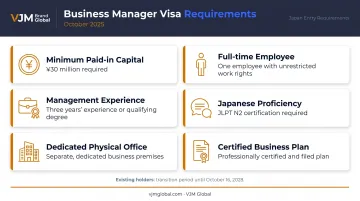
Existing visa holders have a transition period until October 16, 2028.
Startup Visa
For founders not yet ready to meet the full Business Manager Visa requirements, the Startup Visa provides up to two years of residence in Japan while building the business through an approved municipal or private organization. Time spent under this visa now counts toward the three-year management experience requirement, making it a viable path to the full Business Manager Visa.
Key practical advantages:
- No ¥30 million capital requirement upfront
- Residence time counts toward management experience
- Accessible before securing significant funding
Highly Skilled Professional (HSP) Visa
Founders who qualify under Japan's points-based immigration system should consider the HSP Visa. At 70+ points, it provides accelerated access to permanent residency alongside business activity — a practical option for founders with strong academic or professional credentials who plan to permanently relocate to Japan.
How to Start a Business in Japan: Step by Step
Step 1 — Choose Your Business Name and Prepare Core Documents
Before anything else:
- Verify your chosen business name is unique within the same Legal Affairs Bureau jurisdiction using the Ministry of Justice registry
- Draft Articles of Incorporation (teikan) in Japanese, including: company name, registered address, business purpose, capital amount, fiscal year, and founders' details
- Commission a company seal set (inkan) — required for virtually all banking, contracts, and official filings in Japan
For non-resident founders: Standard Japanese personal seal certificates must be replaced with notarized signature attestations from a notary in your home country, apostilled for use in Japan, with certified Japanese translations. This document phase alone can take several weeks.
Step 2 — Notarize Articles of Incorporation (KK Only)
KK formations require Articles of Incorporation to be certified by a Japanese notary public, at a cost of ¥30,000–¥50,000 depending on capital amount. GK formations skip this step entirely — one of the clearest reasons GKs have a shorter, lower-cost setup timeline.
Electronic filing of Articles eliminates the ¥40,000 stamp duty that applies to paper submission.
Step 3 — Deposit Capital and Confirm Funding
For a KK, capital must be deposited into a bank account before registration. Since a corporate account cannot exist before the company is legally formed, this typically means using a founding director's personal Japanese bank account.
Non-resident founders without access to a Japanese account often arrange this through resident representative services offered by local service providers.
A GK does not require a pre-registration bank deposit — the representative member issues a receipt for contributed funds.
Step 4 — Register with the Legal Affairs Bureau
Submit all incorporation documents to the Legal Affairs Bureau (homukyoku) with jurisdiction over your registered address. Required documents include:
- Articles of Incorporation
- Capital deposit evidence (KK) or contribution receipt (GK)
- Director or member information
- Company seal registration
Registration tax:
- KK: ¥150,000 minimum (or 0.7% of capital, whichever is higher)
- GK: ¥60,000 minimum (or 0.7% of capital, whichever is higher)
Processing takes approximately three business days when all documents are in order.
Step 5 — Post-Registration Tax and Government Notifications
Two sets of deadlines apply immediately after registration:
Within two months of establishment:
- Submit the Corporate Establishment Notification to the local tax office
- File the Payroll Office Opening Notification if the company will pay salaries
- Your company automatically receives a 13-digit Corporate Number (houjin bango) upon registration — this serves as your tax identification number for official filings
Within five days of beginning operations:
- Register with the local pension and health insurance office
All Japanese corporations — including single-person companies where the founder draws a salary — must enroll in social insurance. Missing this deadline creates compliance problems that can affect visa renewals and banking relationships.
Step 6 — Open a Corporate Bank Account
With registration and compliance filings complete, the next task is opening a corporate bank account — and this step trips up more new companies than any other. Major Japanese banks apply strict anti-money laundering due diligence on newly incorporated or foreign-owned entities, and rejection reasons are rarely disclosed.
Practical guidance:
- Having a Japan-resident representative director significantly improves approval odds at major banks
- If major banks decline, consider challenger and regional options: Rakuten Bank, PayPay Bank, Resona Bank, or SBI Shinsei Bank — all publish corporate account services and are generally more accessible to new entities
- Apply to only one major bank at a time and prepare complete documentation before submission
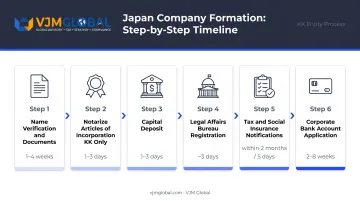
Japan Company Formation: Step-by-Step Timeline
| Step | Action | Est. Time |
|---|---|---|
| 1 | Name verification, documents, and seal preparation | 1–4 weeks (longer for non-residents) |
| 2 | Notarize Articles of Incorporation (KK only) | 1–3 business days |
| 3 | Capital deposit | 1–3 business days |
| 4 | Legal Affairs Bureau registration | ~3 business days |
| 5 | Tax office and social insurance notifications | Within 2 months / 5 days |
| 6 | Corporate bank account application | 2–8 weeks |
Post-Registration Obligations and Ongoing Compliance
Registration creates the legal entity. The recurring work starts immediately after.
Core Ongoing Requirements
Japanese corporations face layered compliance obligations from the moment they begin operating:
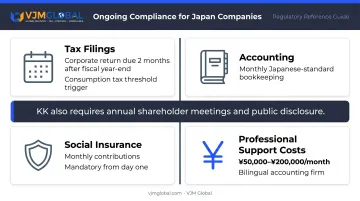
- Corporate tax returns — due within two months of fiscal year-end
- Monthly accounting — maintained under Japanese accounting standards
- Social insurance contributions — paid monthly for all enrolled employees
- Consumption tax filing — once the company exceeds revenue thresholds
- Annual shareholder meetings (KK only) — minutes and related filings required
Industry-Specific Licenses
Certain sectors require separate government licenses that are not covered by incorporation:
- Food service and restaurants
- Real estate transactions
- Financial services and investment activities
- Healthcare and pharmaceuticals
- Worker dispatching and staffing agencies
Confirm whether your business activity triggers a licensing requirement before beginning operations.
Professional Support Costs
Licensing and compliance together create a strong case for professional support. Bilingual accounting is the most significant recurring cost for foreign-owned companies in Japan.
Monthly fees for a qualified accounting firm typically range from ¥50,000 to ¥200,000, depending on transaction volume, payroll headcount, and reporting complexity. The firm should maintain Japanese-compliant books while delivering reports in your working language.
Structured professional support reduces the risk of missed deadlines, labor compliance errors, and incomplete filings — all of which carry penalties or operational delays that are far more costly than the advisory fees themselves.
Conclusion
Starting a business in Japan is entirely feasible for foreign founders. The legal framework is clear, 100% foreign ownership is permitted, and both major entity structures offer genuine flexibility. Where founders most often run into trouble is sequencing: documentation requirements are tightly interdependent, and a misstep in one area stalls progress in the next.
Choose your entity structure based on fundraising needs, not just setup costs. Build your visa strategy in parallel with incorporation — not as an afterthought. Registration marks the start of your compliance obligations, not the finish line.
Companies that move through Japan's setup process successfully share one consistent habit: they engage qualified local professionals at the outset, before complications arise.
Frequently Asked Questions
Can a foreigner own a business in Japan?
Foreigners can own 100% of a Japanese company with no nationality restrictions under Japan's Companies Act. Both individuals and foreign corporations can serve as founders or shareholders. Since March 2015, no director is required to be a Japan resident.
How much does it cost to start a business in Japan?
A KK costs approximately ¥250,000 or more in government fees and notarization; a GK costs approximately ¥100,000 or more. These figures cover registration only. Professional support fees, capital requirements (¥30 million for Business Manager Visa applicants), office leases, and banking setup substantially increase the real total.
What is the difference between a KK and a GK in Japan?
A KK is a joint stock company with higher setup costs, formal governance requirements, and share-issuance capability — suited for businesses seeking investment or enterprise clients. A GK is a simpler LLC structure with lower costs and fewer formalities, suited for small and medium operations not planning equity fundraising.
What visa do I need to start a business in Japan as a foreigner?
Foreign nationals residing in Japan and managing the business need a Business Manager Visa, which requires ¥30 million in capital as of October 2025. Those not yet meeting that threshold can use the Startup Visa (up to two years) as an interim path. If a locally authorized representative manages the entity, no visa is required from the foreign parent company.
Can I set up a Japanese company without living in Japan?
Since 2015, no director needs to be Japan-based, so remote setup is fully legal. A GK is more practical for non-residents since it does not require a Japanese bank account before incorporation. Non-residents must provide apostilled notarized documents from their home country in place of standard Japanese seal certificates.
What taxes does a foreign-owned company pay in Japan?
Most foreign-owned companies face an effective combined rate of approximately 30–33%, comprising national corporate tax (23.2%, or 15% on the first ¥8 million for smaller companies), local corporate tax, and prefectural and municipal enterprise taxes. Consumption tax is 10% on goods and services, with a reduced 8% rate on certain items.