
Bilateral trade between India and Japan hit US$22.85 billion in FY2023-24, and the India-Japan CEPA covers tariff elimination on over 94% of traded items. JETRO actively supports foreign entrants through its Invest Japan Business Support Centers.
But Japan's registration process is not simple. Strict documentation standards, a language barrier, and unfamiliar filing procedures at the Legal Affairs Bureau trip up first-time founders constantly.
This guide walks through business opportunities, entity types, the step-by-step KK registration process, costs, taxes, and ongoing compliance for Indian founders.
Key Takeaways
- Register a Kabushiki Kaisha (KK) in Japan with 100% foreign ownership in most sectors
- Appoint a local representative and secure a registered Japanese address before filing
- Legal minimum capital is ¥1, but ¥1 million+ is recommended for banking and visa credibility
- The India-Japan DTAA prevents double taxation on repatriated profits
- Plan 4–8 weeks for registration once documents, capital, and the local representative are ready
Business Opportunities in Japan for Indian Businesses
Japan's ageing population and shrinking workforce are creating real demand for outside talent and services. Reuters projects a shortage of almost 1 million foreign workers by 2040, based on think-tank estimates.
For Indian businesses, that gap translates into concrete openings:
- IT and Global Capability Centre (GCC) services: Japan needs software engineering and back-office tech support at scale
- Manufacturing components: supply chains for EVs, robotics, and precision engineering
- F&B and consumer goods: a small but rising appetite for Indian cuisine and products
- Consulting and advisory: bridging Japanese firms with Indian markets and vice versa
JETRO's support infrastructure, including dedicated India-facing offices, backs this trend at the government level.
Diaspora & Ecosystem
Japan's foreign resident population reached 4,125,395 at end-2025, up 9.5% year-on-year. The Indian community remains modest but is concentrated in IT and engineering roles, forming an informal support network for new arrivals.
That network helps with referrals, local insight, and vendor recommendations when you're setting up shop.
Choosing the Right Business Structure in Japan
Before registering anything, decide what kind of entity actually fits your plans. Japan offers four practical routes.
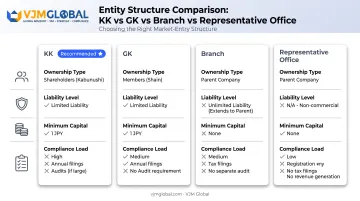
Kabushiki Kaisha (KK) is the closest match to a Private Limited Company. It's a separate legal entity with limited liability, legal minimum capital of ¥1, and requires at least one representative director. It must hold annual shareholder meetings.
Godo Kaisha (GK) works like an LLC: cheaper to run, lighter on compliance, and a solid fit for smaller Indian startups testing the market before committing further.
Branch offices and representative offices are non-subsidiary alternatives. A branch can trade but carries unlimited liability for the parent. A representative office cannot generate revenue or open its own bank account. It exists purely for market research and liaison.
| Structure | Ownership | Liability | Minimum Capital | Compliance Load |
|---|---|---|---|---|
| KK | 100% foreign allowed | Limited | ¥1 | Higher (annual filings, board formalities) |
| GK | 100% foreign allowed | Limited | ¥1 | Lower |
| Branch | Extension of parent | Unlimited | None | Moderate |
| Representative Office | N/A | N/A | None | Minimal (no revenue allowed) |
For Indian founders seeking bank credibility, future funding, and long-term operations, KK remains the standard recommendation. It signals seriousness to Japanese partners, landlords, and banks in a way GK sometimes doesn't.
Step-by-Step Process to Register a Private Limited Company (KK) in Japan
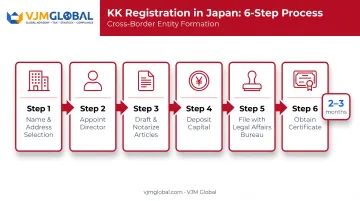
Here's the practical sequence, based on JETRO's official procedure for establishing a KK.
- Decide company name, purpose, and registered address. A virtual office works initially. Check for name duplication at the Legal Affairs Bureau (Homukyoku) before proceeding.
- Appoint at least one representative director. Japan dropped the resident-director requirement for KKs on 16 March 2015. Banks often still want a local contact, so many Indian founders use a nominee or representative service to open a corporate account.
- Draft and notarise the Articles of Incorporation (Teikan). Indian founders signing documents at home must get them notarised and apostilled or embassy-legalised before Japan will accept them.
- Deposit paid-in capital. Legally ¥1 is enough, but ¥1 million+ is strongly recommended for banking and visa purposes. Get formal proof of payment.
- File with the Legal Affairs Bureau. Submit Articles of Incorporation, director's affidavit, and register your company seal.
- Obtain the Certificate of Registered Matters. Then complete tax office, pension, and labour bureau notifications. Realistic timeline: JETRO estimates roughly 2-3 months from finalising the company profile to full establishment. Registered-information and seal certificates are typically ready within about two weeks of filing.
Documents, Costs, and Practical Requirements for Indian Founders
Indian founders should prepare these from home before starting:
- Notarized and apostilled passport copies
- Proof of address (directors / investors)
- Board resolution (if a parent company is the investor)
- Japanese translations of key documents where required
Cost components typically include:
- Registration tax: 0.7% of stated capital, per Japan's Ministry of Justice
- Notary fees for authenticating the Articles of Incorporation (varies with capital amount, per the Japan National Notaries Association)
- Company seal registration: engraving and registering the corporate seal used on official filings
- Professional or agent fees: local filing, translations, and coordination across India and Japan
The Visa Angle
Registering the KK does not automatically let you run it day-to-day in Japan. Indian founders generally need a residence path as well:
- Business Manager Visa: JETRO notes a current threshold of at least ¥30 million in investment and one full-time employee
- Startup Visa: Offered through participating municipalities in designated zones; can grant up to one year of residence status to develop the business plan
Many founders finish incorporation, then stall on apostille coordination, translations, or the parent-company document trail. VJM Global supports Indian companies with cross-border entity formation and the documentation coordination those steps require when expanding into markets such as Japan.

Taxes, DTAA Benefits, and Ongoing Compliance
Japan's corporate tax is layered across several levies:
- National corporate tax on taxable income
- Local inhabitant tax at prefectural and municipal level
- Enterprise tax, plus the special corporate enterprise tax
For qualifying SMEs with capital of ¥100 million or less, effective rates step up by income band. JETRO's current effective rate table shows roughly 21.37% on income up to ¥4 million, rising to 33.58% above ¥8 million.
Those figures cover business years through 31 March 2026 and assume a Tokyo base; actual local rates vary by prefecture.
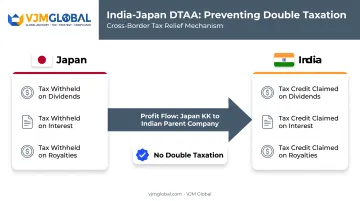
The India-Japan DTAA cuts withholding tax on dividends, interest, and royalties paid to the Indian parent. It also lets you claim credit in India for tax already paid in Japan, so the same income is not taxed twice.
Annual compliance obligations include:
- Financial statement filing and corporate tax returns (due within 2 months of year-end)
- Social insurance and pension registrations once you hire employees
- Indian-side ODI reporting to RBI via your authorised dealer bank under the Overseas Direct Investment framework, including the annual Form APR
Common Mistakes Indian Businesses Should Avoid
These missteps delay registration or create compliance exposure after the entity is live:
- Skipping professional translation — Japanese filing offices do not work in English; weak translations can stall registration for weeks.
- Using a rep office when you plan revenue — representative offices cannot legally trade, so this structure triggers compliance violations.
- Ignoring ODI/FEMA reporting in India — RBI reporting is mandatory when capital moves from India into the Japanese entity.
- Delaying visa planning — without the right visa, you cannot lawfully draw a salary or run day-to-day operations in Japan.
Frequently Asked Questions
What are the business opportunities in Japan for Indians?
IT and GCC services, manufacturing/engineering supply chains (especially EV and robotics), and consulting stand out. Japan's talent gap and strengthening trade ties with India both support this demand.
Can an Indian citizen own 100% of a company in Japan?
Yes, 100% foreign ownership is permitted in most sectors for a KK or GK. The practical hurdle is usually banking and visa logistics, not ownership restrictions.
Do I need to visit Japan to register a company?
Much of the process can start remotely using notarised and apostilled documents. However, opening a bank account and completing visa formalities typically require physical presence.
How much capital is needed to start a KK in Japan?
The legal minimum is ¥1, but ¥1 million or more is recommended. Banks and visa authorities view very low capital amounts as a red flag.
Will my company be taxed twice, in India and Japan?
No. The India-Japan DTAA prevents double taxation on the same income and allows credit for tax already paid in one country against liability in the other.
Do I need to report my Japan investment to Indian authorities?
Yes. Indian residents investing overseas must report through the ODI framework to their authorised dealer bank, which forwards details to the RBI.