The practical hurdles are real, though. Sanctions have reshaped cross-border banking. Visa and residency rules limit which structures are actually usable. And picking the wrong legal entity can stall a project for months.
This guide walks through the structures available, what to expect, and the exact registration steps for a German founder operating from Germany.
Key Takeaways
- OOO (LLC): realistic route for German founders who stay in Germany—no residence permit required
- NPD self-employment: not available to German citizens; limited to EAEU nationals
- Registration: 3 working days; banking and document legalisation add weeks
- Main obstacle: sanctions-related banking limits, not the paperwork, for German founders
What Business Structures Can a German Citizen Use in Russia?
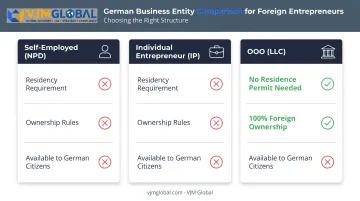
Three structures exist in Russian company law, but not all are open to a German national.
Self-Employed (NPD) is off the table. The Russian tax service has confirmed this status is available only to EAEU citizens under Article 5 of Law 422-FZ. Germany isn't an EAEU member state, so this route doesn't apply, regardless of tax residency.
Individual Entrepreneur (IP) requires the founder to hold Russian residence status: either a temporary residence permit (RVP) or a permanent one. Registration is tied to a Russian residential address. For a German national still based in Germany, this is a non-starter unless residency is already secured for other reasons.
Limited Liability Company (OOO) is the practical default.
- Foreign individuals can own 100% of an OOO, with no Russian partner required
- The founder does not need an RVP or residence permit just to hold shares
- The business can be managed from Germany via power of attorney
- Only the director role triggers residency and work-authorization questions, not the shareholder role
Branches and representative offices exist as an alternative, but only for German companies (not individuals) expanding an existing legal entity into Russia. This is a separate structure with its own registration path and isn't covered here.
What to Know Before a German National Starts a Business in Russia
A German national can form a Russian company. Banking access, who can act as director, document legalization, and where management actually sits are what slow the process down.
Banking Is the Real Bottleneck
In July 2025, the EU converted its existing SWIFT-related restriction for covered Russian banks into a full transaction ban — direct and indirect. Since June 2024, EU-based entities have also been barred from connecting to Russia's SPFS payment messaging system as a workaround. Any founder planning to move money between German and Russian accounts needs to check current restrictions before assuming a transfer will clear.
A Local Director May Be Necessary
If the founder lacks a Russian residence or work permit, someone with the right status needs to hold the director role, or the company needs a properly structured power of attorney arrangement.
Documents Need Legalization
Founding documents drafted in Germany require notarization, apostille, and certified Russian translation before Russian authorities will accept them.
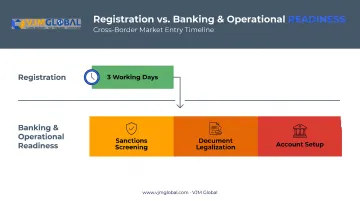
Registration Speed vs. Operational Readiness
These are two different timelines:
- Registration: 3 working days once documents are filed
- Banking and full operational readiness: Considerably longer, and dependent on sanctions screening
Remote Management or Relocation?
Where you run the company day to day matters as much as where it is incorporated. If key management decisions stay in Germany, tax residence and permanent-establishment risk can follow—even with a valid Russian entity on paper.
Why Consider Starting a Business in Russia from Germany
This only makes sense under specific conditions, not as a general recommendation.
Trade history still has residual value. Germany was historically one of Russia's largest trading partners. Even after the collapse in bilateral trade, demand persists for German engineering, industrial equipment, and consumer goods expertise.
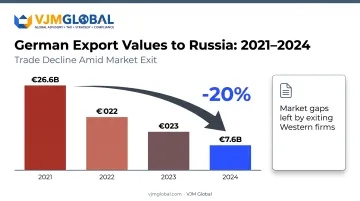
The market has contracted, but so has the competition. German exports to Russia dropped from €26.6 billion in 2021 to €7.6 billion in 2024, according to Germany's Federal Statistical Office. But many Western firms exited entirely, leaving gaps in certain sectors for those still willing to operate compliantly.
Cost advantages remain, particularly for services and light manufacturing:
- Lower labour costs than Germany for IT, consulting, or production work
- Simplified taxation available for small businesses under the USN regime
- Full foreign ownership permitted — no forced local partner
None of this offsets the banking friction. It just explains why some founders still find the trade-off worthwhile.
Early Decisions That Matter for German Founders
Most problems trace back to underestimating three things: banking, sanctions exposure, and compliance complexity. The registration paperwork itself is rarely the real obstacle.
Areas founders commonly overlook:
- True cost of an OOO, once notary fees, legal address rental, and translation/apostille costs stack on top of the state duty
- How money actually moves between German and Russian accounts, given current EU restrictions
- Whether a nominee director is needed, and how to structure accountability so the founder retains real control
- Business activity restrictions: some sectors are off-limits for foreign or sanctioned-adjacent entities
- Remote management vs. relocation, which has tax and compliance consequences beyond convenience
Getting these decisions wrong early is far more costly than getting the P11001 form wrong.
How a German Citizen Can Start a Business in Russia — Step by Step
Registration itself is straightforward. The work is in the Germany-side preparation, banking, and compliance steps most founders underestimate.
Step 1 – Choose Your Legal Structure and Business Activity
Confirm OOO is the right fit (it usually is for remote German founders) and define the specific business activity.
Common mistake: Choosing IP without realising it requires Russian residency, which is a dead end for most Germany-based founders.
Step 2 – Prepare and Legalise Documentation from Germany
- Gather passport copies and founding documents
- Apply for notarisation and apostille in Germany
- Draft the Articles of Association and incorporation minutes
- Arrange certified Russian translations of everything
Common mistake: Submitting documents without a proper apostille, which leads to rejection.
Step 3 – Appoint a Director and Register a Legal Address
Two decisions sit here:
- Director: Use a local Russian-resident director, or manage remotely under a power of attorney
- Legal address: Secure a genuine rented address or service-provider arrangement, not a mailbox
Common mistake: Underestimating the vetting and cost involved in a nominee director arrangement.
Step 4 – File with the Russian Registration Body (FTS)
Submit form P11001, the charter, incorporation minutes, address confirmation, and duty receipt. Filing can go through a notary or electronic channel using a power of attorney, so travel to Russia isn't required.
The Federal Tax Service states registration takes 3 working days, not the 3–5 days sometimes quoted elsewhere.
Common mistake: Assuming every foreign founder skips government review. If the structure acquires or restructures an existing OOO interest, check Decree No. 618 first. Transactions involving parties from "unfriendly" states may need Government Commission approval before filing.
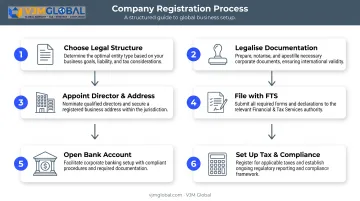
Step 5 – Open a Russian Bank Account and Set Up Banking Flows
Once registered, complete post-registration steps: company seal, address confirmation, and corporate bank account opening.
Plan for sanctions-related limitations before assuming standard transfers will work. Get written confirmation from both the German sending bank and the Russian receiving bank before relying on any corridor.
Common mistake: Assuming SWIFT transfers will go through without checking current restrictions first.
Step 6 – Set Up Accounting, Tax Regime, and Compliance
Choose between the simplified system (USN) and the general regime based on projected turnover. For 2026, USN carries a revenue ceiling of ₽490.5 million, with base rates of 6% (income) or 15% (income minus expenses). The general corporate profit-tax rate is 25%.
Arrange local accounting support: bookkeeping from Germany isn't practical given Russian reporting requirements.
Common mistake: Missing the 30-day window to submit the USN election after registration.
Conclusion
Starting a Russia-facing business as a German national is legally possible, primarily through an OOO structure, and without relocating. The registration process itself is fast and well-defined.
Success depends on solving banking, sanctions screening, and local management questions before the business needs to operate, not after registration is done.
Cross-border entity formation always brings jurisdiction-specific documentation, translation, and compliance requirements that are easy to underestimate from abroad. VJM Global's setup advisory supports founders through that complexity, from entity-type decisions through registrar filings and post-incorporation registrations.
Frequently Asked Questions
Can a foreigner start a business in Russia?
Yes. Foreigners, including German citizens, can register as OOO founders without holding a Russian residence permit. Individual Entrepreneur (IP) status is the exception: it requires residency.
Is it difficult to start a business in Russia?
Registration itself is straightforward and takes about 3 working days. The real difficulty for German founders is banking access and sanctions compliance, not the paperwork.
How much does it cost to start a business in Russia?
Budget for the state duty (waived for electronic/notary filing, otherwise ₽4,000), German notarisation and apostille fees (roughly €19 per document in Berlin), certified translations, and legal address costs. Overall cost depends on your provider and document volume.
Can a German citizen own 100% of a Russian LLC?
Yes. Full foreign ownership is permitted for OOO structures. No Russian partner or local shareholder is required.
Do I need to travel to Russia to register a company?
No. Registration can be completed remotely from Germany through a power of attorney and a local representative or notary, provided documents are properly apostilled and translated in advance.
How long does it take to register a business in Russia?
The Federal Tax Service registers an OOO within 3 working days of filing. Document legalisation and banking setup typically take considerably longer.