Introduction
More Malaysian founders are looking south to Australia, and for clear commercial reasons. A stable economy, overlapping business hours, and deep trade ties make it a natural next step for SMEs outgrowing the domestic market.
Two-way trade between Malaysia and Australia hit A$35 billion in 2025, with Malaysia ranking as Australia's second-largest goods trading partner in Southeast Asia and ninth globally. But the path isn't always clear. Founders often confuse company registration with visa rights, get stuck on terms like ABN, ASIC, and Pty Ltd, and hit friction with remote banking verification.
This guide breaks down eligibility, business structures, registration, visa options, and ongoing compliance—and where cross-border specialists fit for entity setup, tax, and statutory filings.
Key Takeaways
- Malaysians may fully own an Australian company; a separate visa is required only to run it on the ground
- Pty Ltd entities need one Australian-resident director—most founders use a nominee
- GST registration is required once turnover reaches A$75,000
- Employer of Record (EOR) lets you hire Australian staff without incorporating
Can a Malaysian Start a Business in Australia?
Yes. Malaysians can register and own an Australian business under the same rules that apply to any other foreign national. There's no citizenship requirement to hold shares or be listed as a company owner.
The catch lies elsewhere. Australia's official small business guidance confirms that a non-citizen or non-permanent resident needs an appropriate visa to actually run the business day-to-day. Registering an entity and operating it hands-on from within Australia are two very different things.
This distinction runs through every stage of this guide:
- Registering a company — open to anyone, anywhere, no visa needed
- Actively working in or managing the business from inside Australia — requires the right visa subclass
Ownership and visa rules are only half the picture for Malaysian founders. The Malaysia-Australia Free Trade Agreement (MAFTA), in force since 2013, has removed tariffs on most goods traded between the two countries and opened services-sector access.
Add Australia's role as a gateway into the broader Asia-Pacific economy, and it becomes a practical entry point for Malaysian SMEs looking to diversify beyond ASEAN markets.
Business Structures Available to Malaysian Entrepreneurs in Australia
Foreign founders face no restriction on which structure they choose. The four common options are sole trader, partnership, company (Pty Ltd), and trust, each with different tax treatment and liability exposure.
Why Pty Ltd Is the Default Choice
A Proprietary Limited (Pty Ltd) company is the structure most Malaysian entrepreneurs choose. It's a separate legal entity, offers limited liability protection, and allows up to 50 non-employee shareholders.
ASIC requires at least one director who ordinarily resides in Australia. That director must also hold a valid Director Identification Number before appointment.
Most Malaysian founders don't have a resident director on hand. Incorporation usually means engaging a local resident director or nominee service first.
Alternative Entry Options
Malaysian companies wanting to test the market without forming a new entity can consider:
- Branch office — Malaysian parent registers with ASIC to trade directly in Australia and receives an ARBN
- Representative office — lighter presence for market research or liaison, not active trading
Sole trader and partnership structures are a different story—and generally impractical for non-residents. Both tie to residency-linked tax file number rules and expose the individual to unlimited personal liability, a poor fit for someone operating remotely from Malaysia.
| Structure | Foreign Ownership | Liability | Resident Director/Agent Required? |
|---|---|---|---|
| Sole Trader | Allowed, impractical for non-residents | Unlimited | No, but TFN/residency issues apply |
| Partnership | Allowed, impractical for non-residents | Unlimited (joint) | No, but TFN/residency issues apply |
| Pty Ltd Company | Fully open | Limited to shareholding | Yes — one resident director |
| Trust | Fully open | Depends on trustee structure | Often yes, via corporate trustee |
Step-by-Step Process to Register a Business in Australia from Malaysia
Registration follows a clear sequence. Complete the steps in order to avoid rework later.
Choose your business structure. Base this on liability tolerance, growth plans, and investment needs. Pty Ltd remains the typical choice for most Malaysian entrants.
Reserve and register a business name. Check it against existing trademarks and registered business names before locking it in, since a name clash later can be costly to fix.
Apply for an Australian Business Number (ABN). This 11-digit number is your key to invoicing, dealing with the ATO, and interacting with other government agencies. You often receive the ABN instantly after a successful application.
Register with ASIC and secure a Director Identification Number. This step formalises your company and issues an Australian Company Number (ACN). The director ID exists specifically to prevent fraudulent or fictitious director appointments.
Register for GST and apply for a Tax File Number. GST registration is compulsory once your current or projected turnover crosses A$75,000. You must register within 21 days of crossing that threshold. Apply for your entity TFN at the same stage.
Secure licences and a business bank account. Use the Australian Business Licence and Information Service (ABLIS) to identify any state, territory, or industry-specific permits you need, then open a business bank account.
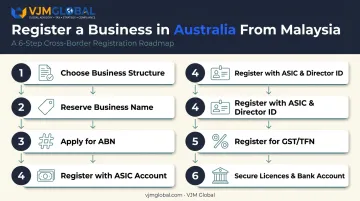
Skipping steps or sequencing them wrong is the most common reason Malaysian founders face delays, so treat this order as more than a suggestion.
Visa and Work Requirements for Malaysians in Australia
Here's the part that catches people off guard: incorporating an Australian company does not grant you the right to live, work, or relocate there. Company registration and visa status are entirely separate processes.
The National Innovation Visa (Subclass 858)
This permanent, invitation-only visa is now the main route for entrepreneurial migrants. It replaced the innovation pathway after the Business Innovation and Investment Program closed to new applications in July 2024. Key points:
- You must first submit an Expression of Interest demonstrating exceptional achievement in an eligible field
- Home Affairs must invite you before you can lodge a full application
- The government charge starts from A$6,235, with limited fee concessions available
Other Pathways Worth Considering
Not every founder qualifies for an invitation-only route. Skilled and employer-sponsored visas remain viable alternatives:
- Skilled Independent (subclass 189) — for invited applicants with in-demand skills
- Skilled Nominated (subclass 190) — requires state or territory nomination plus a points test
- Employer Nomination Scheme (subclass 186) — sponsored by an Australian employer
A registered migration agent can help match your background to the right subclass, since eligibility criteria shift often.
The Practical Workaround
Rather than relocating immediately, many Malaysian owners appoint a local resident director or company secretary service to satisfy ASIC's residency rule. This keeps the company compliant while the founder continues running things from Kuala Lumpur or Penang.
If you only need to hire Australian staff, an Employer of Record (EOR) lets you employ people legally without incorporating locally or arranging a visa for every hire.
VJM Global's EOR coverage spans 100+ countries including Australia, so Malaysian companies can test the market before full incorporation.
Business Banking, Tax and Ongoing Compliance in Australia
Companies, partnerships, and trusts must open a dedicated Australian business bank account. Sole traders have more flexibility and can initially operate through a personal account.
What Banks Typically Ask For
Australian banks generally request:
- Proof of identity (passport, driving licence)
- Business registration documents and ABN confirmation
- Proof of address
- Tax File Number
Some banks require in-person identity verification for foreign-linked applicants, though rules vary by institution. If travel isn't feasible, a multi-currency fintech account can bridge the gap while you finalise formal banking.
Recurring Tax Obligations
Once your business is running, expect these ongoing requirements:
- Annual income tax returns for your entity
- GST reporting once you've crossed the A$75,000 threshold
- PAYG withholding if you hire employees or contractors
Staying on ASIC's Good Side
ASIC compliance doesn't end at registration. You will need to:
- Paying the annual review fee and confirming company details
- Passing a solvency resolution within two months of the review date
- Lodging financial statements (mandatory for larger or foreign-controlled proprietary companies)
- Maintaining a registered office and local agent in Australia
Common Challenges and How VJM Global Simplifies Cross-Border Setup
Malaysian founders repeatedly hit the same friction points when setting up in Australia:
- Time zone gaps that slow down communication with ASIC, the ATO, or banks
- The resident director requirement, which stalls incorporation without a local arrangement
- Document notarisation and certification demands
- Banking limitations that make remote verification a genuine headache
VJM Global is a chartered accountancy and cross-border business services firm that has supported 250+ Australian businesses, with delivery capability across 100+ countries.
The firm handles entity formation, ABN and ASIC registration, tax compliance, payroll, and accounting, applying Australia's own regulators and statutory frameworks for each engagement.
For Malaysian founders, that shows up in practice as:
- Chartered Accountants and multi-jurisdiction professionals who understand both Malaysian and Australian business contexts
- Employer of Record as a lighter-touch entry path when full incorporation is not the right move yet
- One point of accountability for incorporation, payroll, and tax compliance, so you are not juggling separate vendors

If you are weighing full incorporation against a hiring-first approach, speak with VJM Global before you start registration. Getting the structure right from day one avoids compliance missteps that cost far more to fix later.
Frequently Asked Questions
Can I open a business in Australia as a foreigner?
Yes. Malaysians and other foreigners can legally register a business in Australia. You will face extra documentation checks and need at least one Australia-resident director, which citizens often do not.
How can a Malaysian work in Australia?
Company registration does not give you work rights. You still need a separate valid visa—usually an employer-sponsored or skilled migration pathway—before you can work in Australia.
Do I need to travel to Australia to register my company?
Most registration steps, including ABN and ASIC filing, can be completed remotely. Some steps like bank account verification may still require in-person presence or a local representative.
How long does it take to register a company in Australia from Malaysia?
ABN applications are often near-instant when accepted. ASIC company registration usually confirms within one to two business days once all details are complete. A local agent can shorten document handling time.
Can I open an Australian business bank account without visiting Australia?
Some banks accept remote applications with electronic ID checks; others still require an in-person visit. A multi-currency account can handle AUD payments while your local bank setup is pending.
Is there a free trade agreement that benefits Malaysian businesses expanding to Australia?
Yes, the Malaysia-Australia Free Trade Agreement has been in force since 2013. It removes tariffs on most traded goods and opens up services-sector access between the two countries.