Introduction
US entrepreneurs keep looking at Dubai for the same reasons: 0% personal income tax, direct flights to nearly every major market, and a government that actively courts foreign capital. But almost every founder hits the same fork in the road early on: do you set up in a Free Zone, or register a Mainland LLC?
Your choice goes beyond paperwork. It shapes how the UAE taxes your company, whether you can sell directly to UAE customers, and how you open a bank account. For US founders, it also determines how the IRS treats the entity under GILTI, Form 5471, and FBAR rules.
This guide breaks down both structures through the lens of a US-based founder, then helps you match the right one to your business goals.
Key Takeaways
- Free Zones offer 100% foreign ownership and fast, low-cost setup, but restrict direct mainland trading
- Mainland LLCs now allow up to 100% foreign ownership for most activities and unlock full UAE market access
- Qualifying Free Zone companies can access 0% tax on qualifying income; Mainland companies pay 9% above AED 375,000
- US tax obligations (GILTI, Subpart F, Form 5471) apply regardless of which UAE structure you pick
- The right choice depends on your customer base and growth plans, not setup cost alone
Free Zone vs LLC: Quick Comparison
Before digging into definitions, here's how the two structures stack up on the factors that matter most to US founders.
| Factor | Free Zone Company | Mainland LLC |
|---|---|---|
| Foreign Ownership | 100% across all licensed activities | Up to 100% for most activities post-2020 reform; strategic sectors still restricted |
| Market Access | Zone-based and international trade; mainland sales typically require a permit or local partner | Full UAE market access, including government tenders |
| Corporate Tax | 0% on qualifying income for a Qualifying Free Zone Person; 9% on non-qualifying income | 0% up to AED 375,000; 9% on profit above that threshold |
| Setup Cost & Office | Lower entry cost; flexi-desk and virtual office options widely available | Higher cost; a leased physical office is mandatory |
| Visa Allocation | Scales with the office package chosen (desk, serviced office, or physical unit) | Scales with leased office footprint under GDRFA and MOHRE rules |
A quick note on the tax row, since it trips up a lot of founders: Free Zone tax relief isn't automatic.
According to the UAE Federal Tax Authority's guidance on Qualifying Free Zone Persons, a company must meet all of these conditions:
- Maintain adequate substance in the zone
- Earn genuinely qualifying income
- Keep transfer-pricing documentation
- Hold non-qualifying revenue under the lower of AED 5 million or 5% of total revenue
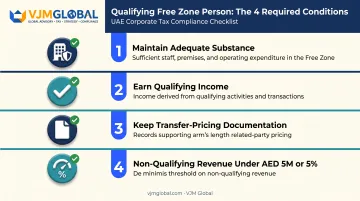
Miss any of those, and the 9% rate applies anyway.
What is a Free Zone Company?
A UAE Free Zone company is a legal entity licensed by a specific Free Zone authority (such as DMCC, JAFZA, or DIFC) rather than by an Emirate's general government. It operates under that zone's own rules, with its own registrar, and typically its own regulatory framework separate from the mainland.
For US founders running remote, export-focused, or holding-company structures, one point matters most: you don't need a UAE-based customer to justify setting one up.
Core benefits for US owners include:
- Full control without a mandatory local partner or sponsor
- Fast incorporation, often completed in days rather than weeks
- Simplified repatriation of capital and profits to the US with no outbound fund restrictions
FZE vs FZCO: Picking Your Structure
Most zones offer two entity types:
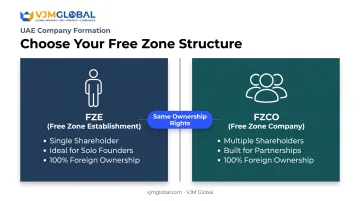
- FZE (Free Zone Establishment) — single shareholder, ideal for solo founders
- FZCO (Free Zone Company) — multiple shareholders, built for partnerships or co-founded ventures
Both give 100% foreign ownership. The choice comes down to how many people are on the cap table, not tax treatment.
Use Cases of Free Zone Companies
Free Zones fit naturally into a US company's expansion strategy. Common goals include holding IP, running a SaaS or e-commerce operation, or using Dubai as a logistics and trading hub rather than a direct-to-consumer storefront.
Certain zones have built reputations around specific industries:
- DMCC dominates commodities and general trading
- DIFC anchors financial services and asset management
- Tech and media zones serve digital, content, and software businesses
The UAE operates dozens of these specialized zones. A large share of foreign-owned businesses entering the country route through one of them rather than the mainland, especially when they do not need direct access to local customers.
What is an LLC (Mainland Company)?
A Mainland LLC is licensed by the Department of Economic Development (DED) in whichever Emirate you register, giving it a broader scope than a Free Zone entity. This matters for US businesses that need to sell directly to UAE-based customers, work with local distributors, or bid on government contracts.
Core benefits for US owners:
- Unrestricted UAE-wide trading: no zone boundaries to work around
- Eligibility for government and semi-government contracts, a market segment closed to most Free Zone entities without additional permits
- Flexibility in office location across Emirates, not locked into a single zone's premises
The biggest shift for US investors came in 2020. Federal Decree-Law No. 26 of 2020 (later consolidated into Federal Decree-Law No. 32 of 2021) removed the 51% Emirati partner requirement across most commercial activities. US businesses can now hold full foreign ownership on the mainland for the first time.
Abu Dhabi alone opened 1,105 commercial and industrial activities to full foreign ownership, plus a professional license covering 604 activities. Those counts show, license by license, what a 100%-owned US business can do on the mainland.
Use Cases of LLC (Mainland) Companies
Mainland licensing fits businesses built around in-person service delivery: retail, consulting, F&B, construction, and anything requiring regular face-to-face contact with UAE residents.
Industries where Mainland structures dominate include:
- Professional services: legal, consulting, and accounting firms serving local clients
- Real estate: brokerage and development requiring direct market presence
- Public-sector contracting: construction, IT services, and supply agreements with government entities
Free Zone vs LLC: Which Is Better for US Businesses?
There's no single right answer here: it depends on four factors:
- Target customer base: UAE-based buyers versus international/US clients
- Licensed activity: some activities are simply better supported in one structure
- Need for government contracts: largely a Mainland advantage, though this is shifting
- Long-term scaling plans: how much UAE-specific growth you're actually planning
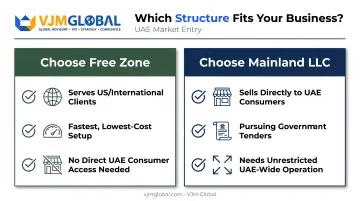
Choose a Free Zone if:
- Your business primarily serves US or international clients
- You want the fastest, lowest-cost setup available
- You don't need direct access to UAE consumers
Choose a Mainland LLC if:
- You need to sell directly to UAE-based consumers
- You're pursuing government tenders or public contracts
- You want to operate without geographic restriction inside the UAE
Dubai has also loosened the line between the two. As of late 2025, the Dubai Department of Economy and Tourism launched a Free Zone Mainland Operating Permit, letting eligible Free Zone companies conduct specified non-regulated mainland activities and pursue certain government work for a renewable fee, without converting to a full Mainland license.
It's not universal access, but it's a real middle path worth asking your formation advisor about.
The US Tax Layer Nobody Talks About Enough
Your UAE entity choice doesn't change your US tax obligations. If you're a US citizen or resident, IRS Publication 54 confirms you remain taxed on worldwide income regardless of where you incorporate.
A wholly US-owned Free Zone or Mainland entity will almost always qualify as a Controlled Foreign Corporation (CFC). US shareholders owning more than 50% of vote or value trigger this automatically. That means GILTI inclusions, potential Subpart F income, and Form 5471 filing obligations apply regardless of whether you picked Free Zone or Mainland.
Consider a typical scenario: a US-based e-commerce founder selling internationally with occasional UAE fulfillment needs. If the business has no UAE customers and only needs a lean international base, a Free Zone setup avoids unnecessary mainland office overhead.
If that same founder later wants to sell directly into the UAE market or bid on a distribution contract, the calculus flips toward Mainland. Restructuring after the fact costs more than getting it right the first time.
That dual UAE-plus-US layer is where coordinated advice matters. VJM Global has guided over 500 American business owners through entity formation and tax compliance across more than 100 countries. The firm supports UAE setup through Mainland LLC and major Free Zones such as DMCC, JAFZA, DIFC, and ADGM, and coordinates the US-side reporting that comes with owning a foreign entity.
Conclusion
The better structure depends on where you plan to sell and how much flexibility you need later.
Choose a Free Zone if you need:
- International reach with 100% ownership
- A leaner setup and lower ongoing overhead
- Operations focused outside the mainland market
Choose a Mainland LLC if you need:
- Direct access to the UAE domestic market
- Eligibility for government contracts
- Unrestricted geographic operation across the Emirates
What matters most is linking the UAE choice to US outcomes: tax efficiency, compliance simplicity, and avoiding a costly restructure if your model shifts in two years. If you're deciding now, speak with a cross-border specialist at VJM Global before you file. The structure you pick shapes your US tax position from day one.
Frequently Asked Questions
Can free zone companies do business in Dubai?
Free Zone companies can operate freely within their zone and internationally. Selling directly into the UAE mainland typically requires a local distributor, agent, or a specific mainland operating permit.
Do free zone companies need to register for corporate tax in the UAE?
Yes. Every Free Zone company must register for UAE corporate tax, even if it ultimately qualifies for the 0% rate on qualifying income as a Qualifying Free Zone Person.
Can I form a company in the Jebel Ali Free Zone?
Yes. JAFZA is open to foreign investors and offers 100% ownership with a range of office and warehousing options, making it a strong fit for trading and logistics businesses.
Can a US citizen own 100% of a company in Dubai?
Yes. US citizens can own 100% of a Free Zone company outright, and in most sectors, 100% of a Mainland LLC following the UAE's 2020 ownership reform.
Which is cheaper to set up: Free Zone or LLC in Dubai?
Free Zones are generally cheaper due to flexi-desk options and fewer approvals. Mainland LLCs cost more because of mandatory office space and additional government fees.
Do US business owners still need to pay US taxes on UAE income?
Yes. US citizens and residents are taxed on worldwide income regardless of UAE entity type, which makes coordinated cross-border tax planning essential from the start.