On paper, ACRA's incorporation process looks straightforward: reserve a name, file a constitution, get registered. In practice, a standalone VCC set up from the UAE carries extra layers a Singapore-resident promoter never has to think about.
You'll need a MAS-regulated fund manager lined up before you can incorporate. You'll need a Singapore-resident director, which almost no UAE-based founder can supply personally. And every UAE-issued personal document needs notarization, attestation and legalization through a multi-step chain before Singapore will accept it.
This guide walks through the exact steps, requirements, costs, timelines, common pitfalls, and alternative structures a UAE-based applicant should weigh before incorporating.
TL;DR
- Standalone VCCs suit UAE applicants running one strategy with no near-term plans for sub-funds.
- Every VCC needs a MAS-licensed fund manager and a Singapore-resident director (often via nominee).
- ACRA filing takes days to weeks; manager licensing and UAE document legalization extend setup to several months.
- Licensing costs vary widely by pathway, so confirm current fee ranges before budgeting.
- Banking and AML due diligence, not the ACRA filing, cause most delays for UAE promoters.
Step-by-Step: How to Incorporate a Standalone VCC in Singapore from the UAE
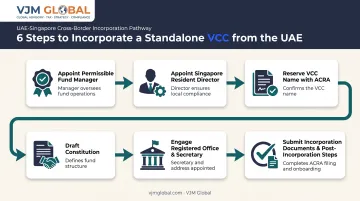
Step 1: Appoint a Permissible Fund Manager
Every VCC must be run by a "permissible fund manager" - a licensed fund management company (LFMC) holding a Capital Markets Services (CMS) licence, or an exempt financial institution such as a bank or MAS-regulated affiliate. This has to be locked in before ACRA will register the entity.
One outdated assumption trips up a lot of UAE applicants: the Registered Fund Management Company (RFMC) route is gone. MAS repealed the RFMC regime effective 1 August 2024, and existing RFMCs were required to transition into Accredited/Institutional LFMCs. If you don't already hold a Singapore licence or exemption, a fresh application is unavoidable.
For UAE promoters without an existing licence, MAS's benchmark for reviewing a complete fund management application is up to six months for applicants meeting all admission criteria. Start this process alongside your structuring decisions, not after them.
The manager also runs AML/CFT checks and appoints an independent custodian. Source-of-funds and beneficial-ownership documents get scrutinised heavily at this stage, so pick a manager with real experience handling Middle East-sourced capital.
Step 2: Appoint a Singapore Resident Director
At least one director must be ordinarily resident in Singapore: a citizen, permanent resident, or an EntrePass/Employment Pass holder (EP holders also need a Letter of Consent). Almost no UAE-based founder meets this without relocating, which is why a professional resident-director service becomes essential here.
Contrary to what many applicants expect, there's no automatic second-director requirement. One director must be either a Qualified Representative under the VCC Act or a director of the fund manager, and the same person can satisfy both the resident and manager-linked criteria at once.
A third, independent director only becomes mandatory if the VCC operates an Authorised Scheme, which requires a minimum of three directors.
Step 3: Reserve the VCC Name with ACRA
Name reservation costs S$15 and typically clears within three working days for straightforward applications. If the name triggers referral to another regulator, approval can stretch to 14-60 days.
Once approved, the name stays reserved for 120 days. Incorporation must be completed within that window, or the reservation lapses and you start again.
Step 4: Confirm the Standalone Structure and Draft the Constitution
A standalone VCC fits a single investment strategy with a uniform investor base and no near-term plan for additional sub-funds. That choice shapes what the constitution needs to cover.
Core constitution contents under the VCC Act include:
- The VCC's name and confirmation of incorporation under the Act
- The appointed manager's name
- Each subscriber's full name, address, occupation, and share commitment
- Economic participation, voting, redemption/repurchase, and restructuring rights (or a statement that a right doesn't apply)
Have the constitution cross-checked against the fund offering documents your UAE-side tax and legal advisors are preparing, so investor rights and economics stay consistent across both jurisdictions.
Step 5: Engage a Registered Office and Company Secretary
A VCC needs a physical Singapore registered office open during normal business hours - a PO Box won't satisfy ACRA. Non-resident promoters almost always engage a corporate secretarial provider to supply this address alongside filing support.
Two deadlines follow incorporation:
- A resident company secretary (an ordinarily resident natural person who isn't also the sole director) within 6 months
- A Singapore-based auditor within 3 months - VCCs get no audit exemption, unlike some small private companies
Step 6: Submit Incorporation Documents and Complete Post-Incorporation Steps
ACRA's filing covers subscriber details, director and officer consents, and the signed constitution. All key officers and subscribers must give online consent within 60 days of ACRA's notification email - a separate clock from the 120-day name reservation.
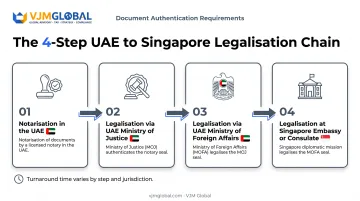
UAE-issued personal documents (passports, proof of address) generally need notarisation, then legalisation through the UAE Ministry of Justice and Ministry of Foreign Affairs, before final legalisation at the Singapore Embassy in Abu Dhabi or Consulate-General in Dubai.
Neither post publishes a fixed processing time. In practice this step adds one to three weeks, depending on document volume and appointment availability—something Singapore-resident promoters never face.
Once ACRA registers the VCC, post-incorporation work begins:
- Open a bank or e-money institution (EMI) account
- Register for GST if turnover thresholds apply
- Finalize fund management and custody agreements
What You Need Before Incorporating: Requirements for UAE Applicants
Preparation determines approval speed more than anything else, especially for cross-border applicants unfamiliar with Singapore's corporate secretarial conventions.
Fund Manager and Licensing Requirements
Two main routes exist for a permissible manager:
- CMS license (Licensed Fund Management Company): required for most third-party managed funds; the application fee is S$1,000, non-refundable
- Exempt financial institution status: banks and MAS-regulated affiliates can act as manager without a fresh license application
The RFMC route MAS previously offered smaller managers (capped qualified investors and AUM) was repealed from 1 August 2024. Existing RFMCs transitioned into Accredited/Institutional LFMCs, some with an initial S$250 million AUM condition that can be lifted on request.
New UAE applicants should plan around the CMS/LFMC pathway or a valid exemption, not a fresh RFMC registration.
Director, Secretary and Subscriber Requirements
A standalone VCC needs at least one director who is ordinarily resident in Singapore. That person can be a professional nominee or someone from your fund manager’s team, provided they meet fit-and-proper standards.
At least one subscriber, individual or corporate, must commit to shares at incorporation. If that subscriber is a UAE corporate entity, expect the fund manager, bank, or EMI to request certified constitutional documents and beneficial-ownership disclosure during their own risk-based onboarding, even where ACRA’s filing checklist does not universally demand it.
The resident company secretary must meet one of several qualifications under the VCC Regulations 2020:
- At least 3 years' experience as a company or VCC secretary in the preceding 5 years
- A qualified person under the Legal Profession Act
- A public accountant
- A member of ISCA, the Chartered Secretaries Institute of Singapore, the Association of International Accountants Singapore Branch, or the Institute of Company Accountants Singapore
Document Legalisation from the UAE
UAE-sourced paperwork follows a defined chain:
- Notarisation in the UAE (with translation where needed)
- Legalisation through the UAE Ministry of Justice
- Legalisation through the UAE Ministry of Foreign Affairs
- Legalisation at the Singapore mission
The mission confirms an appointment and fee only after reviewing the documents, so build in buffer time rather than assuming a fixed turnaround.
Engaging one provider that operates on both ends of this chain removes a common failure point. VJM Global, for example, runs teams locally in both the UAE and Singapore, coordinating UAE-side attestation and the ACRA filing directly instead of handing the file between disconnected advisors.
Costs and Timelines for a UAE-Based Standalone VCC
Because UAE applicants incorporate remotely, total cost and time depend as much on fund manager licensing and document legalization as on the ACRA filing itself.
Cost Breakdown
| Item | Amount |
|---|---|
| VCC name reservation | S$15 |
| VCC registration | S$8,000 |
| Standard ACRA formation total | S$8,015 |
| Annual return (ongoing) | S$1,600 |
| CMS application (non-refundable) | S$1,000 |
| Fund manager annual license | S$4,000 fixed, plus S$5 per representative from the 101st |
Per ACRA's published fee schedule, that S$8,015 covers statutory fees only. Budget extra for constitution drafting and legal advisory work.
Fund manager setup is usually the largest single cost component, particularly if you need a fresh CMS license rather than an existing license or exemption. Budget separately for legal and compliance consulting to build the manager's AML/CFT framework.
UAE-side costs add notarization, Ministry of Justice and MOFA legalization, mission fees, and courier logistics - modest individually, but they add up across a full document set. Pricing is confirmed only after the mission reviews your paperwork.
Ongoing annual maintenance typically includes:
- S$1,600 annual return (plus S$200 for any AGM or return extension)
- Mandatory audit fees
- Resident secretary retention
- Fund manager compliance overhead
Timeline Breakdown
- Name reservation - up to 3 working days (14-60 days if referred to another regulator)
- Incorporation filing - 2-4 weeks once the manager and directors are confirmed
- Fund manager licensing - 2-6 months, typically the longest step in the process
- UAE document legalization - run in parallel; plan for several weeks depending on appointment availability
- Banking/EMI onboarding - 4-12 weeks for non-resident promoters, driven largely by AML due diligence
Run steps 3 and 4 at the same time rather than one after the other. That's the single biggest lever UAE applicants have over total setup time.
Common Mistakes UAE Applicants Make When Incorporating a Standalone VCC
- Assuming a UAE passport covers the resident-director requirement. It doesn't. You need a Singapore citizen, PR, or Employment Pass/EntrePass holder in the seat. Most UAE founders engage a nominee director service.
- Starting document attestation too late. The UAE-to-Singapore legalisation chain runs on its own schedule, separate from ACRA's. Waiting until other incorporation documents are ready often adds weeks of avoidable delay.
- Choosing standalone when an umbrella fits better. If you already expect a second strategy or investor segment within a year or two, restructuring into an umbrella later costs more than getting the structure right from day one.
- Under-preparing the AML/KYC file for Middle East-linked capital. Thin source-of-funds documentation or an incomplete beneficial-ownership chain often triggers extended bank and EMI due diligence, sometimes adding months to account opening.
Is a Standalone VCC Right for You? Key Alternatives to Consider
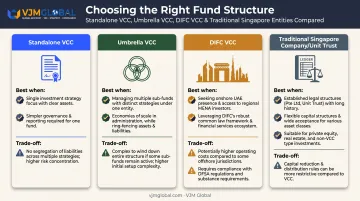
A standalone VCC isn't automatically the right fit. If your strategy or investor base might diversify, or you'd rather keep the structure onshore in the UAE, these alternatives are worth weighing first.
Umbrella VCC
Better when you have multiple planned strategies or investor segments that need segregating into sub-funds under one legal entity, sharing directors and service providers.
Trade-off: each sub-fund still files its own annual return and keeps separate accounts, assets and liabilities, plus an S$400 ACRA fee per sub-fund registered - more governance overhead than a standalone entity carries.
DIFC VCC (UAE-Based Alternative)
Better when you'd rather keep the asset-holding structure onshore in the UAE, particularly for family office, property, or IP-holding purposes, and don't need the vehicle to run a MAS-regulated collective investment scheme.
Trade-off: a DIFC VCC can hold proprietary assets without DFSA authorisation only as long as it stays outside regulated financial-services activity. If you cross into fund management, DFSA licensing requirements apply. A Singapore VCC, by contrast, is built to house a MAS-regulated fund from the outset.
Traditional Singapore Investment Company or Unit Trust
Better when your mandate is smaller and simpler, and you don't need NAV-based share issuance, redemption, or capital dividends.
Trade-off: an ordinary Singapore company sits under Companies Act capital maintenance rules, so capital reductions are restricted and dividends can only come from profits. A unit trust avoids that constraint but runs on a trust deed instead of a company structure, so investor entry and exit work differently than under a company or VCC structure.
Frequently Asked Questions
How much does it cost to set up a VCC in Singapore?
ACRA name reservation and registration together run roughly S$8,015. Budget also for constitution drafting, fund manager licensing (often the largest cost), and UAE-side notarization, attestation, and legalization.
How does a VCC work in Singapore?
A VCC’s share capital varies with net asset value, so investors can subscribe and redeem without ordinary company capital-maintenance rules. It must be managed by a MAS-permissible fund manager and remain registered with ACRA.
Is a VCC regulated in Singapore?
Yes, in two layers. ACRA administers the VCC Act and corporate filings, while MAS sets AML/CFT obligations under Notice VCC-N01 and licenses or exempts the fund manager running the vehicle.
Can a UAE resident be the sole director of a Singapore VCC?
No. At least one director must be ordinarily resident in Singapore (citizen, PR, or Employment Pass/EntrePass holder). A UAE resident alone cannot meet that rule, so most applicants appoint a local nominee director.
Do I need to travel to Singapore to incorporate a VCC?
No. Local representation can handle filings, the registered office, and director appointments so incorporation is done remotely. VJM Global coordinates the UAE and Singapore sides for clients who do not need to visit in person.
What's the difference between a standalone VCC and an umbrella VCC?
A standalone VCC is one legal entity running a single fund. An umbrella VCC houses multiple sub-funds under one entity, each with segregated assets and liabilities but shared directors and service providers.