Introduction
UAE-Singapore goods trade hit S$24 billion in 2024, while UAE investment into Singapore jumped 83% year-on-year to S$10.7 billion in 2023, according to Singapore's Ministry of Trade and Industry.
Those figures are why more UAE-based entrepreneurs are looking at Singapore as a stable base for Asia-Pacific expansion.
The setup looks deceptively simple online: fill in a form, pay a fee, get a company. UAE founders usually struggle with the parts that never show up on that form—the structure you pick, whether the shareholder is an individual or a UAE free zone entity, residency status, and Singapore’s banking scrutiny.
This guide walks through whether the route fits your business, the exact incorporation steps, the requirements that trip up UAE founders, and the alternative structures worth weighing before you commit.
Key Takeaways
- Singapore allows 100% UAE ownership with no relocation; a resident director, secretary, and local address stay mandatory
- UAE founders cannot self-register—a licensed filing agent must handle ACRA filings and nominee arrangements
- Most digital filings clear soon after payment; complex or referred cases can take 15–60 working days
- UAE–Singapore CRS data exchange makes this a transparent structure, not a secrecy vehicle
- Best as a regional holding or contracting vehicle—not a substitute for genuine UAE trading operations
How to Incorporate a Singapore Offshore Company from the UAE: Step-by-Step Process
Step 1: Choose Your Company Structure and Confirm Eligibility
Most foreign promoters register a private limited company (Pte Ltd). It caps shareholder liability at their share capital and opens access to Singapore's tax incentive schemes, including partial exemptions on early profits.
There's no nationality restriction on ownership. UAE nationals, UAE residents, and UAE-incorporated companies can all hold shares. ACRA confirms that a foreign company may even be the sole shareholder of a Singapore subsidiary.
If a UAE free zone or mainland company will act as the shareholder, expect one extra layer of preparation:
- Parent company charter documents (certificate of registration, bylaws, Memorandum of Association)
- A board resolution authorising the Singapore investment
- Notarisation and apostille of these documents before submission
This adds paperwork, but it doesn't change eligibility. It simply extends your timeline.
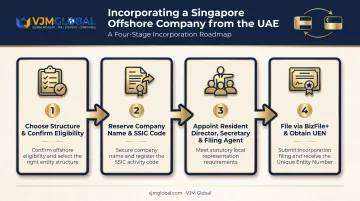
Step 2: Reserve Your Company Name and Define Business Activity
Name reservation happens through BizFile+, ACRA's online filing portal. Once approved, the name is held for 120 days, which is plenty of time to complete the rest of incorporation.
Alongside the name, you'll select an SSIC code (Singapore Standard Industrial Classification) describing your business activity. This code isn't cosmetic. It determines:
- Which licences you may need before trading
- Whether GST registration thresholds apply differently to your sector
- Whether your application gets referred to another regulator
Names containing regulated terms (for example, "bank," "finance," "school," "military," or even "ASEAN") trigger a referral to the relevant authority. That referral alone can add 14 to 60 working days, so it's worth avoiding ambiguous wording if your actual activity doesn't require it.
Step 3: Appoint Statutory Officers and a Registered Filing Agent
Every Singapore company needs at least one ordinarily resident director — a citizen, permanent resident, or someone meeting local residency criteria. Since most UAE founders don't meet this test, a nominee director service typically fills the gap.
You'll also need a resident company secretary, appointed within six months of incorporation. One rule catches people out: the secretary cannot be the same person as a sole director.
Here's the part many UAE applicants overlook: you cannot file directly with ACRA yourself. Foreign-based founders must go through a registered filing agent (a Corporate Service Provider).
A cross-border firm such as VJM Global, already operating across both the UAE and Singapore, can handle nominee director arrangements, secretarial appointments, and ACRA filings in one coordinated process.
You'll also need a genuine local registered address. PO boxes don't qualify — it must be a physical Singapore address where statutory records can be inspected.
Step 4: File Incorporation, Obtain a UEN, and Complete Post-Incorporation Steps
Your filing agent submits the incorporation package through BizFile+, including:
- Passport copies of all directors and shareholders
- UAE residential address proof (Emirates ID or equivalent)
- The company's constitution
- Director consents and declarations
ACRA states that most registrations clear soon after payment, though complex applications can take up to 15 working days, and cases referred to another authority may take 14 to 60 working days. Build in buffer time rather than assuming instant approval.
Once approved, you receive a Unique Entity Number (UEN) : your company's official identifier for all government dealings. From there:
Bank account opening comes next. UAE-based directors and foreign corporate shareholders often face enhanced due diligence. Some banks, like OCBC, offer remote onboarding for qualifying foreign-owned companies; others may ask for source-of-wealth documents first.
You may also need:
- GST registration once taxable turnover exceeds S$1 million in a calendar year, or is reasonably expected to in the next 12 months
- Sector licensing tied to your SSIC code, separate from ACRA approval
When Should a UAE Business Set Up a Singapore Offshore Company?
This structure isn't a default upgrade for every UAE business. It fits some models well and adds unnecessary complexity to others.
It makes sense when you're:
- Building a credible Asia-Pacific holding, invoicing, or contracting hub for trade with China, India, or Southeast Asia
- An IP owner, consultant, or e-commerce brand needing a reputable entity for international clients and investors—without relocating
- Looking to diversify jurisdictional risk while keeping day-to-day operations in the UAE
It becomes inefficient when:
- Your trading activity stays entirely within the UAE or wider GCC
- A UAE mainland or free zone entity already covers your operational needs
- Extra compliance (annual returns, XBRL filings, a resident secretary) brings no matching business benefit
Match the structure to where your revenue and clients actually are, not where it sounds impressive to be registered.
Key Requirements and Factors That Affect Your Singapore Offshore Setup
Cost, timeline, and tax outcome all hinge on a handful of variables you can actually control before you file.
Director, Nominee, and Shareholding Setup
The mandatory resident-director rule means most UAE founders engage a nominee director service. According to The Business Times, annual fees range from roughly S$2,000 to over S$15,000, depending on the provider's risk exposure and scope of duties.
Vet providers carefully:
- Confirm they're a licensed Corporate Service Provider, not an informal arrangement
- Ask what happens if the nominee resigns mid-year
- Clarify exactly what decisions the nominee will and won't make
Shareholding path changes the paperwork load. An individual UAE-resident shareholder needs standard identity documents. A UAE free zone or mainland company acting as shareholder needs notarised and apostilled parent company documents plus a board resolution.
Legalisation adds real processing time, so build it into your timeline rather than assuming both paths move at the same speed.
Tax Residency, Treaty Benefits, and CRS
Tax residency depends on where strategic control and management actually occur, not on incorporation location or a nominee director on paper. IRAS looks at:
- Where board meetings happen and who attends
- Whether the local director makes real strategic decisions
- Where key employees are based
Get this wrong, and you risk an IRAS review that unwinds assumed tax benefits. Singapore's exemption on foreign-sourced income (dividends, branch profits, and qualifying service income) only applies when specific conditions are met, including that the income was taxed abroad and the foreign jurisdiction's headline corporate rate was at least 15% at the time.
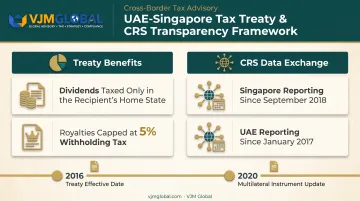
How profits move back to the UAE also turns on the treaty. The amended UAE-Singapore double tax agreement has applied since 16 March 2016, with Multilateral Instrument changes from 2020. Under the treaty:
- Dividends are taxable only in the recipient's home state
- Qualifying royalties face a capped 5% withholding tax at source, provided the recipient is the beneficial owner
Both jurisdictions also exchange account data under the Common Reporting Standard (CRS) (Singapore since September 2018; the UAE since January 2017). Tax authorities receive that information automatically, so build the structure for full transparency from day one.
Banking Readiness
Singapore banks apply enhanced due diligence to non-resident directors and foreign corporate shareholders. Incomplete documentation or a vague business model is the single biggest cause of account-opening delays for UAE-based founders. Prepare source-of-wealth evidence and a clear operational narrative before you approach a bank.
Common Mistakes UAE Entrepreneurs Make When Incorporating in Singapore
UAE founders hit the same avoidable snags when incorporating in Singapore. Fix these four before you file.
- Assuming GST registration never applies — Crossing the S$1 million turnover threshold, or expecting to, triggers mandatory registration regardless of where your directors sit.
- Skipping tax advice on management-and-control rules — Foreign income isn't automatically tax-exempt just because it originated outside Singapore; the substance test has to be met first.
- Underestimating ongoing compliance costs — Nominee director fees, secretarial retainers, and annual filing costs add up fast when budgeted against a UAE cost baseline.
- Choosing an inexperienced filing agent — Not every corporate service provider understands UAE document legalisation and apostille requirements, and that gap shows up as delays later.
Singapore Offshore Company vs Alternative Structures for UAE Businesses
Singapore isn't the only option for a UAE business seeking an Asia-facing or international holding structure. Here's how it stacks up.
| Structure | When It's Better | Trade-offs |
|---|---|---|
| UAE Offshore Company (RAK ICC / JAFZA) | Proximity, Arabic-language support, no genuine Asia-Pacific presence needed | Lacks Singapore's standing with Asian banks and investors, and its treaty network |
| Hong Kong Company | Trade focus is primarily Greater China | Different regulatory environment; less established as a Middle East-Asia bridge |
| Direct Singapore Operating Company (Employment Pass) | Founder intends to relocate and manage operations in person | Requires ongoing physical presence; forfeits tax-neutral offshore positioning |
| Singapore Offshore Pte Ltd | Regional holding, IP licensing, or Asia-Pacific contracting without relocating | Requires resident director, secretary, and banking readiness from day one |
For UAE businesses already running entities in both jurisdictions, coordinating compliance across two regulator sets creates unnecessary overhead: UAE corporate tax, VAT, and WPS payroll on one side; ACRA annual returns, IRAS filings, and CPF on the other.
Consolidating both under one cross-border partner like VJM Global reduces that coordination burden and keeps deadlines from slipping between jurisdictions.
Frequently Asked Questions
Can a non-resident set up a company in Singapore?
Yes. ACRA allows 100% foreign ownership regardless of residency. You must appoint a resident director, resident secretary, and local registered address, typically arranged through a licensed filing agent.
Can a foreigner be self-employed in Singapore?
Sole proprietorship requires a valid pass or residency status. Owning and directing a Singapore Pte Ltd is different. You can do that remotely without relocating.
Do I need to visit Singapore to incorporate a company from the UAE?
No. The process is fully digital through BizFile+, managed by your appointed filing agent from start to finish.
Can a UAE free zone company act as a shareholder in a Singapore company?
Yes, this is permitted. You'll need notarised and apostilled parent company documents plus a board resolution authorising the investment.
Is there a double tax treaty between the UAE and Singapore?
Yes, the amended treaty has been in force since 2016. Dividends are taxed only in the recipient's home state, and qualifying royalties face a capped 5% withholding tax at source.
How long does it take to incorporate a Singapore offshore company from the UAE?
Most straightforward filings clear within a few days of payment, but complex or referred applications can take 15 to 60 working days. Document legalisation for UAE corporate shareholders can add further time.