
Introduction
Ask a lawyer in New York and a compliance officer in Mumbai what "investment company" means, and you'll get two very different answers.
There's no single global rulebook — just a patchwork of tests, thresholds, and regulators that shift depending on where you're incorporated, what you invest in, and who your investors are.
That's the trap. Holding companies, family offices, SPVs, and even joint ventures routinely get swept into regulated "investment company" status without anyone intending it.
A structure built for tax efficiency or group consolidation can suddenly trigger SEC or RBI registration obligations nobody budgeted for.
This guide breaks down what actually qualifies as an investment company, who must register, the step-by-step process in the US and India, and the classification traps that catch founders off guard.
Key Takeaways
- The US applies a 40% asset test; India uses 50-50 and 90-60 tests to classify investment companies.
- US entities register under the Investment Company Act of 1940; Indian entities face MCA, SEBI, or RBI oversight.
- Hedge funds, PE funds, and family offices often qualify for exemptions based on investor count or investor type.
- Multi-level holding structures can accidentally trigger NBFC or CIC classification in India.
- Cross-border compliance guidance helps avoid penalties and unintended regulatory status.
What Is an Investment Company?
Under Section 3(a)(1) of the Investment Company Act of 1940, an issuer qualifies as an investment company if it holds itself out as primarily engaged in investing, reinvesting, or trading securities. There's also a quieter, more dangerous route: owning investment securities worth more than 40% of total assets, excluding cash and government securities, on an unconsolidated basis.
That 40% test has no separate income requirement. A company doesn't need to call itself an investment fund to get caught by it. It just needs the wrong balance sheet.
Types of Registered Investment Companies
The Act splits registered vehicles into a few core categories:
- Management companies: the broadest category, split into open-end funds (mutual funds, which issue redeemable shares) and closed-end funds (which don't).
- Unit investment trusts (UITs): passive, fixed-portfolio vehicles with no board and no investment adviser.
- ETFs: not a separate statutory class; most register as open-end companies or UITs.
- BDCs (business development companies): closed-end companies that elect specialized treatment under Section 54.
Private and Exempt Investment Companies
Not every fund registers. Two exclusions do most of the heavy lifting:
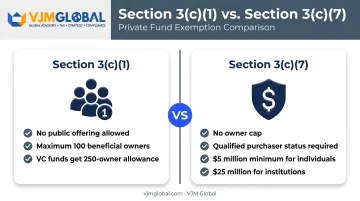
- Section 3(c)(1): no public offering, and no more than 100 beneficial owners (venture capital funds get a 250-owner allowance).
- Section 3(c)(7): no owner cap, but every investor must be a "qualified purchaser," meaning at least $5 million in investments for individuals or $25 million for institutions.
Hedge funds, PE funds, and VC funds lean on these exclusions constantly. They still answer to other securities laws — they just skip full Investment Company Act registration.
For firms structuring cross-border investments, that distinction matters: India has no direct equivalent statute. Instead, similar vehicles typically fall under NBFC or Core Investment Company (CIC) classification through the RBI, a distinctly different regulatory framework that shapes how Indian entities can hold, or be held by, foreign investment structures.
Who Is Required to Register as an Investment Company?
In the United States, registration analysis starts with two tests: the "holding out" test (does the company present itself as primarily in the investment business?) and the 40% asset test. Intent doesn't matter here: if you meet the statutory definition, you register, regardless of what you call yourself.
Key US exemptions include:
- Government entities and municipal bodies
- Broker-dealers and bank/insurance company activities
- Charitable organizations
- Qualifying employee pension and profit-sharing plans
In India, the RBI applies two separate tests:
| Test | Threshold | Triggers |
|---|---|---|
| 50-50 Principal Business Test | Financial assets >50% of total assets AND financial income >50% of gross income | NBFC registration |
| 90-60 Criteria | 90% of net assets in group company securities/loans, with 60%+ in group equity | Core Investment Company (CIC) registration |
A CIC below ₹100 crore in size, or one that doesn't access public funds, can remain an "Unregistered CIC" and skip formal registration. Other exemptions cover insurance companies, SEBI-registered stock brokers, and registered stock exchanges.
One overlooked wrinkle: a company investing only its own net worth, with no public funds and no external leverage, can still get pulled into registration requirements depending on how its income and assets get classified. This catches a lot of family offices off guard.
Shifting back to US rules, foreign investment companies face an extra gate: Section 7(d) requires an SEC order before making a public offering domestically. Most foreign issuers find this route impractical, which is why so few pursue it.
How to Register an Investment Company: Step-by-Step Process
The mechanics differ sharply between the US and India, but both share one theme: the paperwork comes after you've already settled your classification.
Registering an Investment Company in the United States
- Form the entity and finalize governance, investment policy, and service providers before filing anything.
- Obtain EDGAR access through Form ID.
- File Form N-8A under Section 8(a), the notification of registration.
- File the full registration statement within three months of the N-8A: Form N-1A for mutual funds, N-2 for closed-end funds and BDCs, or N-3/N-4/N-6 for separate accounts.
- Register the public offering under the Securities Act. The FY2026 Section 6(b) fee runs $138.10 per $1 million of maximum aggregate offering price.
- Meet minimum capital requirements: $100,000 net worth before the first public offering, under Section 14.
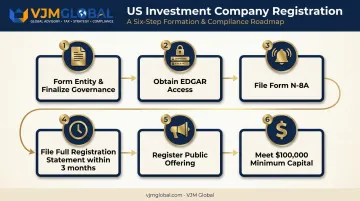
The three-month window between N-8A and the full registration statement is tight. Most of the real work, fund design and disclosure drafting, needs to happen before that clock starts.
Registering an Investment Company in India
India runs a three-regulator relay instead of one filing sequence:
- MCA incorporation via SPICe+: name reservation, DIN allotment, PAN/TAN issuance, and MOA/AOA filing.
- RBI classification check: apply the 50-50 and 90-60 tests; if triggered, file for a Certificate of Registration through RBI's PRAVAAH portal (new NBFCs need ₹10 crore net owned funds).
- SEBI registration if the entity provides advisory or portfolio management services: Investment Adviser or Portfolio Manager registration, as applicable.
- FEMA/RBI reporting for foreign capital, including FC-GPR filings after issuing equity to non-residents.
For foreign-linked entities, expect additional documentation:
- Digital Signature Certificates (DSC) for all directors
- Notarized, apostilled passport and address proof for foreign directors
- At least one India-resident director (a Companies Act requirement)
- Post-incorporation filings: INC-20A within 180 days, INC-22 within 30 days
The parallel-track principle matters here: if your business activity needs SEBI or RBI approval, flag it at incorporation instead of waiting until after the company exists to discover you can't legally operate yet. VJM Global's cross-border teams typically map this SEBI/RBI dependency during incorporation planning, before the SPICe+ filing goes in. Published timelines for MCA and SEBI approval windows vary case by case, so treat any fixed "X days" figure as a rough estimate rather than a guarantee.
Key Compliance Requirements After Registration
Registration triggers years of continuing compliance obligations. Both jurisdictions require ongoing reporting.
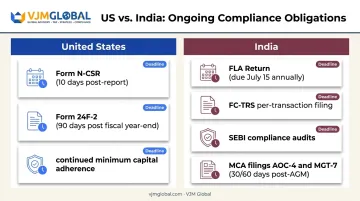
US ongoing obligations:
- Form N-CSR: filed no later than 10 days after transmitting the shareholder report
- Form 24F-2: annual notice within 90 calendar days of fiscal year-end for open-end funds and UITs
- Minimum capital rules: continued adherence required after registration
India ongoing obligations:
- FLA return: due annually by July 15 for entities with foreign liabilities/assets
- FC-TRS filing: per-transaction, tied to equity transfers between residents and non-residents
- SEBI compliance audits: for registered intermediaries
- MCA filings: AOC-4 (financial statements) and MGT-7 (annual return), generally due 30 and 60 days after the AGM respectively
State-level regulation tends to be light-touch in most jurisdictions, but don't assume it's zero: local filing or notice requirements can still apply, so check them directly.
Common Challenges and Regulatory Pitfalls in Investment Company Registration
Most registration failures come from structural drift, not fraud or bad intent.
Multi-level holding and SPV structures, common in infrastructure and group investments, can cross the 50-50 NBFC threshold or the CIC 90-60 criteria without anyone noticing.
A parent company holding stakes in operational SPVs might look purely commercial on paper. But if the balance sheet skews toward financial assets, RBI sees an investment company, not an infrastructure group.
Another wrinkle: RBI's 2019 harmonisation merged the old Asset Finance Company, Loan Company, and Investment Company categories into a single Investment and Credit Company (ICC) classification.
That means purely investment-focused entities can get pulled into lending-oriented compliance checks, such as fit-and-proper director tests and retail lending experience queries, that don't fit their actual business model.
Cross-border capital adds another layer. Under India's 2020 Consolidated FDI Policy, regulated financial services enjoy the automatic FDI route. But unregulated or ambiguously-regulated activities, including an unregistered CIC, get routed to government approval instead, adding real delay.
That approval doesn't excuse a company that was already required to hold an RBI Certificate of Registration in the first place.
The practical fix: re-test your classification whenever one of these events happens, not just once at incorporation:
- Adding a new SPV to the group structure
- Closing a financing round that shifts the balance sheet mix
- Issuing an intercompany loan
How VJM Global Simplifies Cross-Border Investment Company Registration
Classification questions like these rarely have obvious answers on day one. VJM Global has spent over 30 years in tax, audit, and advisory work. Its team of 100-plus professionals — Chartered Accountants, CPAs, company secretaries, and FEMA consultants — works through exactly this kind of structural analysis before a client files anything.
For foreign companies entering India, that typically means:
- Handles MCA incorporation alongside FEMA and FDI structuring advice
- Flags NBFC or CIC exposure early, before it becomes a post-incorporation surprise
- Coordinates RBI reporting (FC-GPR, FC-TRS, FLA) and ongoing ROC compliance under one advisory relationship
VJM Global's reach extends across 100+ countries, and its membership in EAI International connects clients to qualified accounting and tax professionals in other markets when a structure spans more than one jurisdiction. For a business setting up in India, the US, UK, or UAE simultaneously, that means one point of contact instead of three separate regulatory conversations happening in isolation.

Frequently Asked Questions
How do I register an investment company?
Registration requirements vary by jurisdiction. In the US, file SEC Form N-8A, then the appropriate registration statement (N-1A, N-2, etc.). In India, complete MCA incorporation, followed by SEBI and/or RBI registration based on your activity.
Who is required to register as an investment company?
Any entity meeting the statutory asset or income test (the 40% test in the US, or the 50-50/90-60 tests in India) must register unless it qualifies for a private-fund or other specific exemption.
What is the difference between an investment company and an investment adviser?
An investment company holds or pools securities on behalf of investors. An investment adviser is a separately registered entity or person paid to manage that portfolio. One status doesn't replace the other.
Are hedge funds required to register as investment companies?
Most rely on Section 3(c)(1) or 3(c)(7) exemptions, based on investor count or qualified purchaser status, to avoid full Investment Company Act registration while still complying with other securities laws.
How long does it take to register an investment company in India?
Incorporation through MCA typically takes a matter of days, while SEBI registration can take considerably longer depending on the license type. FDI reporting deadlines run in parallel, so build buffer time into your launch plan.
What happens if a company fails to register when required?
Penalties vary by jurisdiction and can include regulatory fines, forced compliance orders, and restrictions on capital movement or public offerings. For example, FEMA contraventions in India can reach up to three times the amount involved.