Common mistakes include treating Japan like a fast-moving Western market, skipping localisation, and rushing entity formation. The result? Costly false starts and stalled launches.
This guide covers realistic entry strategies, trade agreement benefits, compliance obligations, cultural expectations, and how to build a Japan market entry plan that actually works.
Key Takeaways
- Budget 12+ months for Japan entry — sub-six-month timelines usually raise cost and failure risk
- Use the UK-Japan CEPA for tariff cuts, digital trade protections and public procurement access
- Pick distributor, branch or subsidiary deliberately — each locks different control, cost and speed trade-offs
- Treat Japanese tax, labour law and entity registration as non-negotiable from day one
Why Japan Is a Strategic Market for UK Businesses
Japan's economy generated USD 4.21 trillion in nominal GDP in 2023, according to Reuters, making it the fourth-largest economy globally. That scale, combined with high consumer spending power and a strong appetite for imported quality goods, makes it a genuine strategic target for UK exporters.
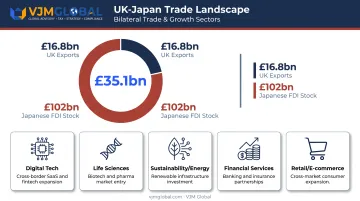
UK-Japan trade is already substantial:
- Total bilateral trade reached £35.1 billion in the four quarters to Q1 2026, up 3.2% year-on-year
- UK exports to Japan stood at £16.8 billion
- Japanese FDI stock in the UK reached £102.0 billion, dwarfing UK investment stock in Japan at £3.2 billion
Growth sectors worth watching:
- Digital technology and IT services: Japan's ageing infrastructure and labour shortage are fuelling demand for software and automation
- Life sciences and healthcare: regulatory reform is opening doors for foreign biotech and medical device firms
- Sustainability and energy: Japan's decarbonisation push creates opportunities for UK cleantech
- Financial services: the UK-Japan Comprehensive Economic Partnership Agreement (CEPA) widened market access in this sector
- Retail and e-commerce: Japanese consumers pay a premium for perceived quality and provenance
Japan isn't an easy market. But for UK firms with patience and the right structure, it's one of the most lucrative in Asia.
UK-Japan Trade Agreements and What They Mean for Market Entry
The UK-Japan Comprehensive Economic Partnership Agreement (CEPA) came into force on 1 January 2021, largely carrying forward the EU-Japan Economic Partnership Agreement that applied before Brexit. It continues that framework, with a set of UK-specific upgrades.
What CEPA Actually Delivers
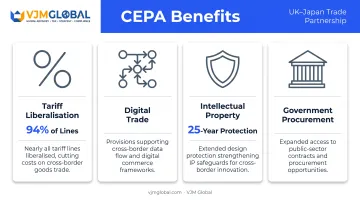
In the long term, Japan is committed to liberalising 94% of tariff lines and 99% of trade value on UK exports. This is not immediate across-the-board zero tariffs: liberalisation is phased, and preferential rates depend on meeting rules-of-origin requirements.
Beyond tariffs, CEPA strengthens:
- Digital trade — protections for cross-border data flows, limits on forced data localisation, and rules supporting e-signatures and source code protection
- Intellectual property — extended industrial design protection from 20 to 25 years, plus coverage for trade secrets, geographical indications and domain names
- Government procurement — UK suppliers gain non-discriminatory access to a range of Japanese public bodies
What CEPA Doesn't Do
CEPA smooths the path, but it doesn't replace the groundwork. You'll still need to:
- Register a legal entity if you plan to trade directly
- Meet Japan's tax registration requirements
- Comply with local labour law if hiring staff
CEPA reduces friction at the border. You still need a full market entry plan for entity setup, tax and local compliance.
Japan Market Entry Strategies: Choosing the Right Model
There's no single "correct" way into Japan. The right model depends on your product, sector, and appetite for risk.
Distributor and Agent Arrangements
Working through a distributor is often the fastest, lowest-cost way to test the market. You hand over local sales and logistics to a partner who already understands the terrain.
Typical advantages:
- Lower upfront investment
- Faster market validation
The trade-off is lower margin and less direct control over customer relationships.
Agent arrangements suit licensing deals or technical B2B products where a direct sales relationship matters less than getting the right introductions.
Joint Ventures
A joint venture pools resources and local knowledge with a Japanese partner. It's a strong option when regulatory expertise or distribution networks are hard to build alone.
The trade-off: joint ventures take longer to negotiate and carry more structural complexity than a simple distribution deal.
Representative Office, Branch, or Subsidiary
This is where legal form really matters:
| Structure | Can it sell? | Liability | Notes |
|---|---|---|---|
| Representative office | No | N/A | Research and preparatory work only; can't sign contracts or bank in its own name |
| Branch | Yes | Stays with UK parent | Needs at least one Japan-resident representative |
| KK (subsidiary) | Yes | Limited to entity | Can issue public stock; representative director doesn't need to reside in Japan |
| GK (subsidiary) | Yes | Limited to entity | More flexible governance; no public offering |
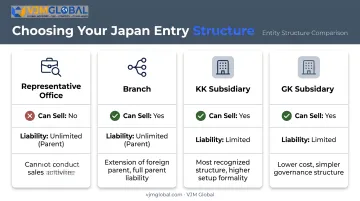
According to JETRO, a representative office genuinely cannot conduct sales. It exists purely for research and relationship-building. If revenue generation is the goal, you need a branch or subsidiary.
Matching the Model to Your Business
- E-commerce/consumer goods: distributor first, subsidiary once volume justifies it
- B2B/SaaS: direct branch or KK subsidiary, since relationship control matters
- Regulated products (pharma, medical devices): subsidiary is usually mandatory for regulatory liaison
Entity formation runs through Japan's Legal Affairs Bureau, and application materials are generally only accepted in Japanese. Specialist cross-border support helps here: VJM Global assists with entity formation across multiple jurisdictions, which can cut setup time and reduce the risk of rejected filings.
Realistic Timeline and Compliance Considerations
Here's where many UK companies get tripped up: they plan for a Western timeline and hit a Japanese reality.
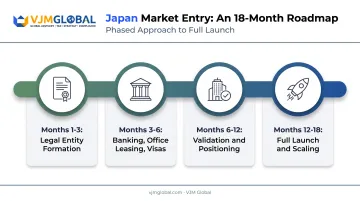
JETRO estimates formation itself takes around 2 months for a branch and 2–3 months for a subsidiary, once you've settled on structure and documentation. That covers legal registration only.
Add banking setup, office leasing, visa processing and relationship-building, and full market entry more realistically spans 6–18 months across validation, positioning and launch.
Tax Obligations
Build these headline rates into your entry budget from day one:
- Corporate tax: JETRO’s aggregate effective rate for larger enterprises is roughly 30.64%; SMEs pay banded rates of 21.94%, 23.73% or 34.43% by income
- Consumption tax: general rate of 10%, with 8% on certain food and newspaper items
- Withholding tax: typically 20.42% for non-residents without a permanent establishment; the UK–Japan tax treaty may reduce this on qualifying payments
Check double taxation relief under the UK–Japan convention before assuming full withholding exposure.
Labour Law
Once you hire locally, Japan's Labor Standards Act applies:
- Standard hours: 8/day, 40/week, with mandated breaks
- Overtime pay of at least 25%, rising to 35% for statutory rest-day work
- Employers with 10+ staff must file and publish formal Work Rules
If you are not ready to incorporate solely to hire, an Employer of Record arrangement lets you engage Japan-based staff compliantly without a local entity. That route is especially useful in the validation phase, before you commit to full incorporation.
Trademark Filing
Japan operates a first-to-file trademark system. Whoever files first gets the registration, regardless of prior use elsewhere. File early—ideally before any public market exposure—so a third party cannot register the mark ahead of you.
Business Culture, Relationships and Localisation
Japan runs on trust before transactions. This is a high-context business culture, where relationship depth often matters more than the deal terms on the table.
Long-term relationships sit at the centre of how business gets done. Build that trust with your customer base first; everything else follows from it.
Etiquette Basics
- Business cards (meishi): exchange with both hands, read carefully before putting away
- Punctuality: non-negotiable; arriving even a few minutes late signals disrespect
- Seating protocol: the most senior visitor typically sits furthest from the door
- Preparation: come with detailed materials; improvisation reads as unpreparedness
Localisation Isn't Optional
Translating your website into Japanese is only the first step. True localisation means:
- Adapting pricing models and payment methods to local expectations
- Rewriting marketing copy for Japanese tone and formality conventions
- Adjusting product features to match local use cases
One UK fintech that entered Japan saw a sharp rise in transaction volumes after tailoring features to Japanese user expectations, rather than shipping its Western product unchanged.
Building Your Japan Market Entry Strategic Advantage
Getting into Japan successfully comes down to three things: the right partner, a staged approach, and specialist support where you lack local expertise.
Choosing a Local Partner
Look for partners who bring:
- Deep market knowledge of your specific sector
- An existing distribution network you'd otherwise take years to build
- Regulatory expertise relevant to your product category
- Genuine willingness to invest in a long-term relationship, not a quick transaction
Pilot Before You Scale
Small-scale pilots (a limited product range, a single region, or a soft launch) let you test positioning before committing to full-scale investment. This matters more in Japan than in most markets, because a mismatched full launch is expensive to unwind.
Where Specialist Support Helps
Entity formation, tax registration, payroll setup and ongoing compliance need Japan-specific expertise most UK SMEs do not hold in-house.
VJM Global supports market entry with entity formation, accounting, tax and compliance across multiple jurisdictions. Through Employer of Record, UK businesses can also hire in Japan before committing to full incorporation.
That support helps you avoid early-stage mistakes that derail first attempts:
- Missed tax registrations
- Incorrect entity choice
- Delayed trademark filing
Frequently Asked Questions
How can UK businesses enter the Japanese market?
Main routes include distributor arrangements, agents, joint ventures, and direct entity formation via branch or subsidiary. The right choice depends on your product, sector, and how much control you need over customer relationships.
What trade agreements does Japan have with the UK?
The UK-Japan CEPA, in force since January 2021, provides tariff reductions on most trade lines, digital trade protections, and expanded government procurement access for UK exporters.
How long does it take to set up a company in Japan?
Legal registration typically takes 2-3 months, but full operational setup, including banking, office leasing and visas, can take several additional months.
Do UK businesses need a local partner to succeed in Japan?
Most UK SMEs benefit significantly from a local partner's market knowledge and network. Direct entry without one is possible in some technical B2B sectors, but it's the exception, not the rule.
What are the biggest mistakes UK companies make entering Japan?
The most common are skipping proper localisation, underestimating how long relationship-building takes, and delaying trademark filing under Japan's first-to-file system. Any one of these can derail an otherwise solid entry plan.
Is Japan a good market for UK small businesses?
Yes, but only with adequate investment and patience. Japan rewards long-term commitment and punishes rushed, underfunded entries.