Introduction
UK businesses expanding into Asia increasingly treat Singapore as their first stop — and the compliance obligations they encounter there are often nothing like what they expected. UK exports to Singapore reached £17.6 billion in the four quarters to Q3 2025, with 58% of British firms planning to expand investments. The city-state offers low corporate tax rates, a stable legal system aligned with Commonwealth principles, and strong trade ties with the UK — but expanding there comes with unfamiliar compliance obligations, including statutory audit requirements.
Many UK business owners assume Singapore's audit rules mirror those at home. After all, both jurisdictions use a "2 of 3" threshold test for small company exemption, both cap employee counts at 50, and both align their accounting standards with IFRS.
That surface-level similarity masks real differences. Singapore operates its own framework with distinct monetary thresholds, a mandatory two-year qualification rule, and a group-level test that can pull subsidiaries into audit scope even when the Singapore entity itself is small — simply because its UK parent exceeds consolidation limits.
This guide explains who in Singapore must be audited, how the small company exemption works, how the rules compare to UK requirements, and what compliance obligations remain even for exempt companies.
Key Takeaways
- Singapore's Companies Act requires most private companies to have annual statutory audits by an ACRA-registered public accountant
- Qualify as a "small company" to skip the audit: revenue ≤S$10M, assets ≤S$10M, or ≤50 employees (meet 2 of 3 criteria)
- These criteria must be met for two consecutive financial years — not just the current one
- Group structures add complexity: your UK parent's consolidated financials determine your Singapore subsidiary's exempt status
- Audit-exempt companies still must file unaudited financials, submit annual returns within 7 months, and keep records for 5 years
What Is a Statutory Audit in Singapore?
A statutory audit in Singapore is an annual independent examination of a company's financial statements carried out by a public accountant registered with the Accounting and Corporate Regulatory Authority (ACRA), as mandated under the Singapore Companies Act. Unlike internal audits or tax filings, it is a legal requirement designed to give stakeholders objective assurance over reported financials.
The audit confirms whether financial statements give a "true and fair view" of the company's financial position, protecting investors, creditors, and other stakeholders. For UK businesses entering Singapore, it fulfils a similar governance function to the statutory audit under the UK Companies Act 2006. The regulatory framework and eligibility thresholds, however, differ in several important ways:
- Auditing standards: Singapore follows the Singapore Standards on Auditing (SSAs), issued by the Accounting Standards Council and aligned with International Standards on Auditing (ISAs)
- Methodology: The approach is familiar to UK-trained finance professionals, given the ISA alignment
- Auditor registration: Only public accountants registered with ACRA can sign off on Singapore audits — your London-based auditor cannot extend their engagement to a Singapore subsidiary
- Exemption thresholds: Singapore's small company audit exemption uses different size criteria than the UK's Companies Act 2006 thresholds
Singapore's Audit Thresholds: Who Must Be Audited?
Standalone Private Companies
All Singapore-incorporated private companies must appoint at least one auditor within three months of incorporation. Auditors must be public accountants or accounting firms registered with ACRA — UK-based audit firms cannot conduct Singapore statutory audits unless their auditors hold ACRA registration.
A standalone private company requires a mandatory audit if it exceeds at least 2 of these 3 thresholds:
- Annual revenue above S$10 million
- Total assets above S$10 million
- More than 50 full-time employees at financial year-end
All public companies in Singapore must be audited regardless of size, with no exemption threshold for listed entities.
Group Companies and UK Subsidiaries
Group structures introduce a critical additional layer. Even if a Singapore subsidiary independently qualifies as a small company, it only retains audit exemption if the entire group (holding company and all subsidiaries, including foreign entities) also qualifies as a small group on a consolidated basis.
A UK parent with turnover or assets well above S$10 million will likely disqualify its Singapore subsidiary from the small company audit exemption — even if that subsidiary is operationally small.
UK businesses should assess group-level thresholds before incorporation. Most mid-market and larger UK enterprises will fail the consolidated group test, making mandatory audit unavoidable regardless of subsidiary size.
Audit Exemptions: The Small Company Concept Explained
Small Company Criteria
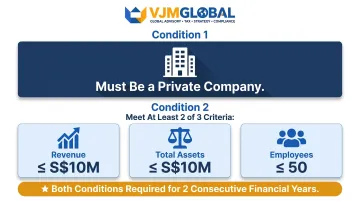
To qualify for audit exemption, a company must pass a two-part test:
- Be a private company during the financial year in question
- Meet at least 2 of 3 quantitative criteria for the immediate past two consecutive financial years:
- Total annual revenue ≤S$10 million
- Total assets ≤S$10 million
- ≤50 full-time employees at financial year-end
- Revenue is based on financial statements prepared per accounting standards
- Employee count uses full-time employees at year-end only — excludes part-time staff and peak headcount
- Both revenue and assets use Singapore dollar thresholds, creating exchange rate exposure for UK businesses
Small Group Criteria
For companies belonging to a group, both conditions must be met simultaneously:
- The Singapore entity qualifies as a small company
- The consolidated group meets at least 2 of the same 3 thresholds on a group-wide basis
Group-level assessment uses the holding company's consolidated financial statements, not individual subsidiary accounts. For UK businesses, this has direct implications:
- UK parent company revenue, assets, and headcount are all included in the group calculation
- A Singapore subsidiary that qualifies individually may still fail the group test
- Exchange rate fluctuations can push consolidated figures across S$ thresholds unexpectedly
UK businesses structuring Singapore operations under a holding company should model group-level eligibility before assuming the exemption applies.
Dormant Companies
A company qualifies as dormant if it has had no accounting transactions since incorporation or since the end of the prior financial year, and its total assets do not exceed S$500,000. This exemption applies to UK businesses that incorporate a Singapore entity before commencing active operations.
The 2-Year Rule in Practice
The 2-year rule operates differently for new versus established companies:
Newly incorporated companies:
- Year 1: Assess eligibility based on that year alone
- Year 2: Assess both year 1 and year 2
- Year 3 onward: Criteria must be met for the immediate two consecutive preceding financial years
Disqualification triggers:
- Company ceases to be a private company at any time during a financial year
- Company fails to meet at least 2 of 3 criteria for two consecutive years
If disqualification occurs, the company must resume statutory audit from the next applicable financial year and appoint an ACRA-registered auditor within 3 months.
How Singapore Audit Requirements Compare to UK Rules
Threshold Structures
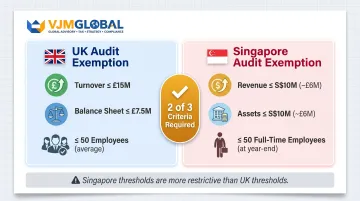
The UK's small company audit exemption (for financial years beginning on or after 6 April 2025) requires meeting 2 of 3 criteria:
- Turnover ≤£15 million
- Balance sheet ≤£7.5 million
- ≤50 employees (average)
Singapore uses similar 2-of-3 logic but with different parameters:
- Revenue ≤S$10 million (approximately £6 million at current exchange rates)
- Assets ≤S$10 million (approximately £6 million)
- ≤50 full-time employees at year-end
The structural parallel makes the framework conceptually accessible for UK finance teams, but the currency and measurement differences mean you cannot assume direct equivalence without recalculating. Singapore's asset threshold is notably more restrictive than the UK's new £7.5 million limit.
Accounting Standards Alignment
UK companies reporting under UK GAAP (FRS 102) or IFRS will find Singapore's SFRS (Singapore Financial Reporting Standards) highly familiar. The standards map closely:
- SFRS aligns with IFRS across most recognition and measurement principles
- SFRS for Small Entities parallels FRS 102 for SMEs
- XBRL filing formats and local chart-of-accounts conventions still require adjustment
This reduces the reporting adjustment effort considerably — though the operational and filing mechanics still need local attention before your first submission.
Enforcement Posture
Standards familiarity doesn't offset the difference in regulatory enforcement — and that gap is worth understanding before you assume the same self-assessment approach applies.
In the UK, companies can often self-assess for audit exemption without Companies House involvement until filing. Singapore's ACRA takes a more proactive stance: it actively monitors compliance and can appoint auditors for companies that fail to do so. ACRA can also require audits from otherwise-exempt companies if they maintain poor accounting records or breach statutory requirements.
Under Section 205D of the Companies Act, ACRA holds discretionary power to demand audited financial statements from any company where:
- Record-keeping or financial statement preparation requirements have been breached
- An audit is deemed in the public interest
This means exemption status in Singapore is conditional, not automatic — a meaningful operational difference from the UK approach.
Key Compliance Obligations and Consequences of Non-Compliance
Annual Filing Requirements (Audit-Exempt or Not)
Even companies qualifying for audit exemption must:
- Prepare unaudited financial statements (balance sheet, P&L, cash flow statement, and director's statement)
- File annual returns with ACRA within 7 months of financial year-end for non-listed companies
- Submit Estimated Chargeable Income (ECI) to IRAS within 3 months of financial year-end
- Use XBRL format for most financial statement submissions, with exemptions for certain Exempt Private Companies and dormant entities
Accounting records must be retained for at least 5 years. UK private companies retain records for 6 years — Singapore's 5-year rule is slightly shorter, but Singapore-based entities must follow Singapore's standard regardless of where the parent company is incorporated.
Penalties for Non-Compliance
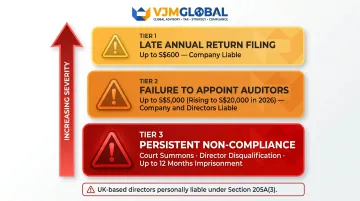
Penalties escalate based on the nature and persistence of the breach. The table below summarises the key exposure areas:
| Breach | Penalty | Who Is Liable |
|---|---|---|
| Late annual return filing | Up to S$600 (varies by delay) | Company |
| Failure to conduct required audit or appoint auditors | Up to S$5,000 per offence (rising to S$20,000 under 2026 amendments) | Company and every director in default |
| Persistent non-compliance | Court summons, director disqualification, or imprisonment up to 12 months | Directors personally |
Under Section 205A(3), director liability for audit failures extends to UK-based directors — not just Singapore residents.
UK-based directors should treat these obligations as personal exposure, not just administrative risk for the Singapore entity.
Frequently Asked Questions
What are the audit requirements for companies in Singapore?
Private limited companies in Singapore must conduct a statutory audit annually unless they qualify for the small company exemption. Auditors must be ACRA-registered and appointed within 3 months of incorporation.
Which companies are exempt from audit in Singapore?
Three categories qualify for exemption: small companies (meeting 2 of 3 revenue/asset/employee thresholds), small groups (same thresholds on a consolidated basis), and dormant companies (no transactions and assets ≤S$500,000).
What is the audit threshold in Singapore?
A company must be audited if it exceeds at least 2 of 3 thresholds: annual revenue above S$10 million, total assets above S$10 million, or more than 50 full-time employees.
What is the 2-year rule for audit?
To qualify for small company audit exemption, the criteria must be met for the immediate past two consecutive financial years. Newly incorporated companies are assessed on their current financial year only in year one.
Do UK branch offices in Singapore need to be audited?
Singapore-registered subsidiaries follow the Companies Act audit rules outlined above. Foreign branch offices must file audited branch accounts plus parent company accounts and generally cannot access the small company exemption.
How soon after incorporating in Singapore does a UK business need to appoint an auditor?
The 3-month window begins from the date of incorporation. If you miss this deadline without qualifying for an exemption, the company directors become personally liable for the breach under the Singapore Companies Act.