Introduction
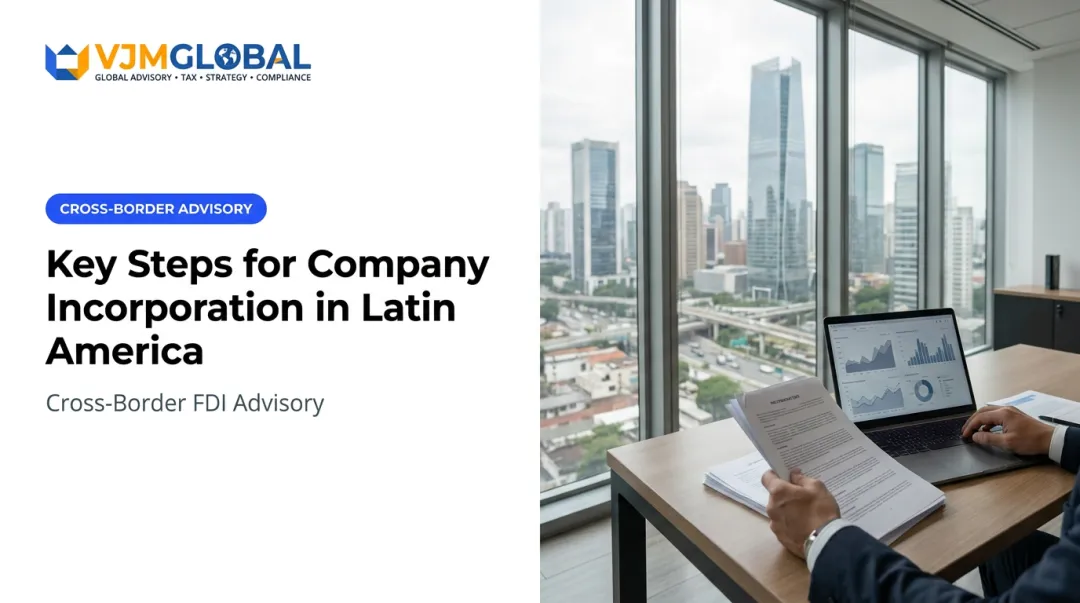
Mexico, Brazil, Colombia, and Chile are pulling in global investment faster than most boardrooms can keep up with. But the paperwork doesn't move at the same speed as the opportunity.
Many foreign founders hit the same wall: confusing entity rules, local representative requirements, and registries that vary wildly from one country to the next. What works in Mexico won't work in Brazil. What's fast in Chile can take months in other jurisdictions.
This guide breaks down the entity types, the step-by-step registration process, and how the major Latin American markets compare, so you can plan your entry with fewer surprises.
Key Takeaways
- Secure a local legal representative, registered address, and tax ID before you can operate in most countries
- Match entity type (S.A., S.R.L./Ltda, S.A.S., or Sucursal) to your liability limits and capital rules
- Choose Chile, Colombia, or Costa Rica when you need faster, more digital registration
- Use a cross-border compliance partner to clear local filings on time and avoid procedure-driven delays
Why Register a Business in Latin America
Local registration is what unlocks cross-border trade benefits in Latin America. Frameworks like USMCA (which replaced NAFTA in July 2020), the Pacific Alliance (Chile, Colombia, Mexico, Peru), and Mercosur (Argentina, Brazil, Paraguay, Uruguay) give established companies preferential access across member markets.
The numbers back this up. In 2024, Brazil pulled in roughly $59.2 billion in FDI, Mexico around $36.9 billion, Colombia $14.2 billion, and Chile $11.4 billion, according to UNCTAD's country profile data.
Sector opportunities are equally concrete:
- Fintech — ecosystem grew 340% (2017–2023); Brazil, Mexico, and Colombia hold 57% of firms, per the IDB's 2024 study
- Manufacturing — Mexico’s US proximity and USMCA access support nearshoring supply chains
- Mining — Peru’s mineral base continues to attract exploration and processing capital
- Renewable energy — Chile and Costa Rica are scaling grid and clean-power investment
- E-commerce — rising middle-class demand is lifting online retail across the region
Brazil in particular actively courts foreign investment in automobiles, renewable energy, life sciences, oil and gas, and infrastructure, according to the U.S. State Department's 2025 Investment Climate Statement.

Common Business Entity Types in Latin America
Picking the right structure shapes your liability exposure, your tax position, and how much red tape you'll deal with. Four structures recur across most jurisdictions, though local rules still differ by country.
Sociedad Anónima (S.A.)
The corporation structure — best suited to larger businesses planning to raise capital or issue shares.
- Mexico: at least two shareholders, each holding one or more shares; liability capped at share value
- Colombia: minimum of five shareholders
Sociedad de Responsabilidad Limitada (S.R.L./Ltda)
The LLC-equivalent. Popular with SMEs and foreign subsidiaries because liability stays limited to capital contributions.
- Mexico: membership capped at 50 partners
- Brazil: partners are jointly responsible for paying in capital, even though individual liability is otherwise limited
Sociedad por Acciones Simplificada (S.A.S.)
The newer, leaner option: one shareholder is enough, capital requirements stay minimal, and formation is often faster.
- Colombia: created through Law 1258 of 2008
- Chile: closest equivalent is the SpA — one or more shareholders, flexible administration
Branch Office (Sucursal)
An extension of the parent company rather than a separate legal entity. Common for large conglomerates that want brand consistency without a standalone subsidiary.
- Mexico: prior authorization from the Ministry of Economy before trading, plus annual publication of the balance sheet
Entity choice locks in capital commitments, shareholder exposure, and the filings that follow. Confirm the structure before you submit formation documents.

Step-by-Step Business Registration Process
While the exact forms differ by country, the sequence follows a similar pattern almost everywhere.
- Reserve and register the company name. Mexico handles this through the Ministry of Economy's Ventanilla MiPymes portal; Brazil routes it through the Junta Comercial via the REDESIM system.
- Draft and notarize your incorporation documents. These define shareholders, capital contributions, and business purpose. Some jurisdictions also require publication of the extract (Chile's general S.A. regime, for example).
- Obtain your local tax ID. Common IDs include the RFC (Mexico), CNPJ (Brazil), and NIT/RUT (Colombia). In Chile, the SII grants the RUT as soon as you subscribe the incorporation form.
- Register with the public/commercial registry. Registration creates the legal entity and, in most countries, requires Ultimate Beneficial Owner (UBO) disclosure—via filings such as Colombia's RUB and Costa Rica's RTBF.
- Open a corporate bank account and complete KYC. You'll need this before registering with social security or labor authorities to hire staff.

Foreign shareholders should expect to provide:
- A Power of Attorney authorizing a local representative (in Chile, a general POA from the parent company to the Chilean legal representative is standard practice, per EY's 2024-2025 Doing Business in Latin America guide)
- Certified translations of foreign corporate documents
- Apostille or consularization of those documents (Brazil's DREI manual explicitly requires this step)
Comparing Registration Ease Across Key Latin American Countries
Not all Latin American markets move at the same pace. Here's how the major economies stack up.
| Country | Common structures | Registration environment |
|---|---|---|
| Mexico | S.A. de C.V., S.R.L. | USMCA access; SAS ~2 days, no fee; manufacturing base; stricter labour and severance rules |
| Brazil | S.A., Ltda | Largest market; São Paulo innovation hub; higher complexity; municipal reviews can take days |
| Chile | SpA, S.A. | Single-shareholder flexibility; free e-registration via Registro de Empresas y Sociedades ("your company in a day") |
| Colombia | S.A.S. | Single-shareholder S.A.S.; Cámara de Comercio filing; statutory fees and taxes apply |
Mexico's manufacturing base and USMCA access make it attractive for companies targeting the US supply chain, but its labour code is stricter than most, particularly around severance. Brazil offers the biggest domestic market in the region but comes with more layers of bureaucracy at both federal and municipal levels.
Chile and Colombia tend to move faster because their registries lean digital-first. That said, exact costs and turnaround times vary by case complexity, so treat any timeline as a starting estimate rather than a guarantee.

Founders often stumble when they assume one country's process mirrors another's. VJM Global applies each jurisdiction's own regulators and statutory instruments, so a Mexico playbook is not used for a Colombia filing.
Ongoing Compliance and Common Challenges
Registration gets your entity on the books. After that, a new set of recurring obligations begins.
Standard ongoing requirements include:
- Annual tax filings and financial statement submissions
- License renewals specific to your industry
- Payroll and social security contributions
- Transfer pricing documentation for related-party transactions
Transfer pricing deserves particular attention. Mexico follows OECD arm's-length principles, with Local file documentation due May 15 and Master file/CbC reporting due December 31 each year. Brazil made its own OECD-aligned transfer pricing rules mandatory starting in 2024, after a voluntary period in 2023.
Tax treaty coverage also varies more than founders expect. Mexico has a broad treaty network, including agreements with the US and UK. Brazil, notably, has no double-taxation treaty with the United States — a detail that surprises a lot of US companies mid-expansion.
Other friction points to plan for:
- Currency fluctuation risk when repatriating profits
- Beneficial ownership filings (e.g., Costa Rica's RTBF: ordinary April declaration, plus a filing within 20 business days of any registration change)
- Foreign investment registration requirements, such as Brazil's Central Bank electronic registration for inbound capital
Many companies use an Employer of Record arrangement to hire locally before full entity formation. That route lets you test a market without incorporation overhead on day one.
Once you do incorporate, payroll, filings, and local reporting become the ongoing load. VJM Global provides payroll, tax compliance, and back-office support through that post-registration stage.
Frequently Asked Questions
Which country in Latin America is easiest to register a company?
Chile, Colombia, and Costa Rica offer faster, more digital registration processes. Brazil usually involves more bureaucratic layers, especially at the municipal level.
Can a U.S. citizen register a business in Mexico or Colombia?
Yes. Foreign nationals can generally register a business in both countries, though most jurisdictions require a local legal representative, a registered address, and completed KYC and tax ID procedures.
What is the most common legal structure for foreign companies in Latin America?
S.A., S.R.L., and S.A.S. structures dominate. The S.A.S. is gaining ground fast because of its minimal capital requirements and single-shareholder flexibility.
How long does it take to register a company in Latin America?
Timelines range from about 1-3 weeks in streamlined jurisdictions like Chile to several months in more document-heavy markets, depending on entity type and documentation readiness.
Do I need a local bank account to register a business in Latin America?
Generally, yes. A local corporate bank account is typically required for tax payments, payroll, and day-to-day transactions. Opening one involves standard KYC documentation.
Is a local director or legal representative mandatory?
Most countries require a legal representative residing locally to handle filings and regulatory correspondence. Citizenship is not always required, but local presence usually is.