Ownership rules, tax treatment, and the compliance layer on both sides of the Atlantic all shift depending on which structure you pick. Many US business owners still assume a local Emirati sponsor is mandatory, or confuse mainland setup with free zone registration entirely. That confusion gets expensive fast.
This guide breaks down the real process, actual costs, and eligibility rules from a US founder's perspective, no filler, no outdated assumptions.
Key Takeaways
- US owners can hold up to 100% of most mainland companies under the UAE’s 2021 company law reform.
- Mainland licences let US companies trade UAE-wide and bid on government contracts, unlike most free zone setups.
- Formation runs six steps: activity, legal structure, trade name, office lease, licensing, and visas.
- Setup costs scale with licence type, office space, and visa quota rather than one fixed number.
- US owners still file FBAR and Form 5471 with UAE returns—support VJM Global coordinates on both sides.
What Is a Mainland Company in Dubai?
A mainland (onshore) company is licensed by the Department of Economy and Tourism (DET) and isn't confined to a designated free zone. It can trade anywhere in the UAE and abroad, sign contracts with any local business, and sell directly to UAE consumers. That unrestricted access is why most US firms targeting the UAE market choose mainland.
For a US company, this structure delivers three practical outcomes:
- Full UAE market access without needing a mainland distributor or local branch
- Direct contracting rights with government entities and private UAE clients
- No restriction on counterparties — you can trade with anyone, anywhere
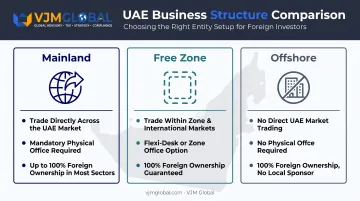
Mainland vs. Free Zone vs. Offshore
- Mainland — Full UAE and international trading rights; contract directly with any local business or consumer
- Free zone — Trade inside the zone or internationally; wider UAE sales usually need a mainland distributor
- Offshore — No physical UAE presence and no local trading rights at all
Mainland is the only structure built for direct, unrestricted UAE operations.
License Categories That Matter for US Founders
DET issues several license types. These four cover most American use cases:
- Commercial — trading, import/export, general goods businesses
- Professional — consulting, tech services, freelance-style operations
- Industrial — manufacturing and production activities
- Tourism — travel and hospitality-related ventures
Note that DET is Dubai's specific regulator. Abu Dhabi, Sharjah, and other emirates each run their own equivalent economic development authority, so the exact process shifts slightly if you're not incorporating in Dubai itself.
Why US Businesses Are Choosing Dubai Mainland Company Formation
The single biggest shift happened in 2021. Federal Decree-Law No. 26 of 2020 amended the UAE's Commercial Companies Law and removed the mandatory 51% Emirati sponsor requirement for most mainland activities. American founders can now fully own their mainland entity in many sectors, though the exact ownership percentage still depends on the specific activity you register under.
That reform didn't happen in isolation. The UAE ranked 5th globally in the IMD World Competitiveness Ranking 2025, a signal of the regulatory and economic stability American founders look for before committing capital abroad.
Trade flows back this up: US goods exports to the UAE hit $31.4 billion in 2025, up from $27 billion the year before, with a trade surplus of more than $23 billion.
Three other factors keep pulling US businesses toward Dubai mainland structures:
- Tax structure: Corporate tax is 0% up to AED 375,000 of taxable income and 9% above that, with no personal income tax. US federal filing obligations still apply.
- Geographic bridge: Dubai sits within an eight-hour flight of two-thirds of the world's population, a practical hub for Middle East, African, and South Asian markets.
- Government tender eligibility: Mainland companies can bid on UAE government contracts and trade UAE-wide without restriction, unlike most free zone entities.
Mainland vs. Free Zone for US Businesses
Choosing between these two structures comes down to where and how you plan to operate in or from the UAE.
| Factor | Mainland | Free Zone |
|---|---|---|
| Local UAE trade access | Full, unrestricted access | Requires a mainland distributor or branch |
| Ownership | Up to 100% in most activities (activity-dependent) | 100% foreign ownership standard |
| Government contracts | Eligible to bid directly | Generally excluded or requires a mainland partner |
| Visa eligibility | Quota set by MOHRE based on office size and activity | Quota set by the free zone authority's package |
| Ideal use case | Businesses selling into or serving the UAE market directly | Holding companies or purely international trading operations |
For most US companies, the choice is straightforward:
- Choose mainland if you will serve UAE customers, bid on government work, or work directly with local partners.
- Choose a free zone if Dubai is only an international trading base or holding vehicle with no local UAE clients.
How US Businesses Can Set Up a Mainland Company in Dubai: Step-by-Step Process
Most of this process can start remotely from the US. You won't need to be physically present in Dubai until office leasing, final licence collection, or visa biometrics come into play.
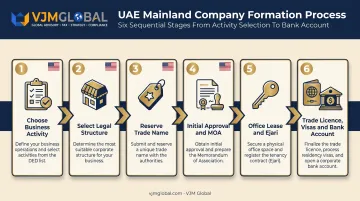
Step 1: Choose Your Business Activity
The UAE maintains over 2,000 approved business activities across its economic development authorities. Your chosen activity determines your licence type, which regulatory approvals apply, and whether 100% foreign ownership is available. Consulting and tech services typically fall under professional licences with full ownership eligibility; trading activities usually sit under commercial licences.
Step 2: Select the Right Legal Structure
Four structures are common for American founders:
- LLC — the standard choice, offering limited liability and broad activity flexibility
- Sole establishment — simpler setup, but the owner carries unlimited personal liability
- Civil (professional) company — suited to licensed professionals like consultants or accountants
- Branch of a US company — extends your existing American entity into the UAE without creating a separate legal entity
Each affects liability exposure and full-ownership eligibility differently, so this decision should align with your broader corporate structure, not just short-term convenience.
Step 3: Reserve a Trade Name
Dubai Economy and Tourism (DET) requires names to avoid offensive language and confirms uniqueness through its own registry. English names generally use transliteration rather than direct translation. The official trade name reservation fee is AED 620 (roughly $169).
Step 4: Obtain Initial Approval and Draft the MOA
Initial approval from DET confirms you can proceed with the activity and structure you selected. US applicants typically need notarized and apostilled passport copies. Branch setups also require the US parent company's incorporation documents and a board resolution authorizing the UAE expansion.
You then draft the Memorandum of Association (MOA), covering shareholding, management, and activity scope. Documents originating outside the UAE generally need certification through the appropriate US authority before submission.
Step 5: Secure Physical Office Space and Register Ejari
Unlike flexible free zone desk options, mainland licensing requires a genuine physical office lease. Once signed, the lease gets registered through Ejari, Dubai's tenancy registration system. Ejari registration runs AED 177.75 online or AED 220 through a trustee center (roughly $48–$60). US founders can typically handle this remotely through a local representative or advisory partner.
Step 6: Obtain the Trade Licence, Then Apply for Visas and a Corporate Bank Account
Once fees are paid and documentation is complete, DET issues the trade licence. From there, investor and employee visa processing begins through MOHRE and GDRFA, followed by corporate bank account opening. Expect additional compliance checks here. UAE banks routinely apply FATCA screening for US-linked applicants, which can extend account opening timelines.
This stage is where cross-border coordination matters most. VJM Global supports American founders on UAE incorporation while aligning US-side entity structuring, tax planning, and ongoing accounting so both sides stay in sync.
Cost and Compliance for US-Owned Mainland Companies in Dubai
Setup costs vary by licence type, activity, and office size, so there's no single accurate all-in figure. Here's what's officially published:
| Item | Official Fee (AED) | Approx. USD |
|---|---|---|
| Trade name reservation | 620 | $169 |
| Ejari (online) | 177.75 | $48 |
| Ejari (trustee center) | 220 | $60 |
| Trade licence | Varies by activity/licence | Not fixed |
| MOA notarization | Varies by share value | Varies |
| Office lease | Market-dependent | Varies |
| Visa fees (per person) | Varies by visa type | Varies |
Build in contingency for external regulatory approvals. Activities such as healthcare, transport, or education often need extra sign-off beyond DET's standard process.
Ongoing UAE Compliance
- Corporate tax registration within three months of incorporation, with filing due nine months after your tax period ends
- VAT registration once taxable supplies cross the AED 375,000 threshold
- Annual trade licence renewal, timing and fees vary by activity
The US Compliance Layer American Owners Often Miss
UAE tax treatment doesn't erase your US filing obligations. Key items:
- FBAR (FinCEN Form 114) — required if aggregate foreign account balances exceed $10,000 at any point in the year; filed electronically, separate from your income tax return
- IRS Form 5471 — applies to US persons meeting specific ownership thresholds (often 10% or more) in a foreign corporation
- GILTI exposure — potentially applicable if your UAE entity qualifies as a controlled foreign corporation, calculated via Form 8992
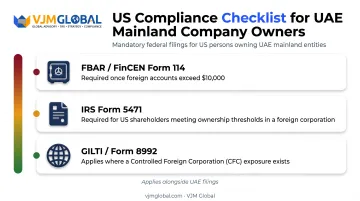
Missing either side creates real filing risk. VJM Global's cross-border tax team runs both as coordinated workstreams: UAE formation and compliance on one track, and US items such as FBAR, Form 5471 analysis, and GILTI mitigation planning on the other.
Frequently Asked Questions
How much does it cost to form a mainland company in Dubai for US businesses?
Official fixed costs include a $169 trade name fee and $48–$60 for Ejari registration. License fees, office lease, and MOA notarization vary significantly by activity and location, so there's no single accurate total figure.
How do US businesses form a mainland company in Dubai?
The process covers choosing an activity, selecting a legal structure, reserving a trade name, and obtaining initial approval. You then secure office space, finalize the license, and apply for visas. Most steps can start remotely from the US before any travel is needed.
Can US businesses own 100% of a mainland company in Dubai?
Yes, most commercial and professional activities now permit full foreign ownership following the 2021 Commercial Companies Law reform. A small number of strategic sectors still require a local Emirati partner, so it's worth confirming your specific activity first.
Do US citizens need a UAE visa to own a mainland company?
Ownership itself doesn't require UAE residency. However, actively operating the business or working from within the UAE typically requires an investor or employment visa tied to the company.
What is the difference between a mainland and free zone company for a US business?
Mainland companies get unrestricted UAE-wide trade access and government contract eligibility. Free zone companies typically offer faster setup and zone-specific tax benefits but face restrictions on direct local UAE trading.
Do US owners of a Dubai mainland company still need to file US taxes?
Yes. US citizens and entities remain subject to US filing obligations, including FBAR and potentially Form 5471, regardless of how the UAE treats your income. Professional cross-border tax guidance is strongly recommended.